

Pradhan Mantri Fasal Bima Yojana (PMFBY) explained for RBI and NABARD exams. Learn through Notes, Infographics, Answer Writing Questions and MCQs covering key concepts, features and recent developments.
Pradhan Mantri Fasal Bima Yojana (PMFBY) offers comprehensive coverage against droughts, floods, cyclones, hailstorms, pests, diseases, prevented sowing, localized calamities, damage by inundation, unseasonal rainfall, hailstorms and specified post-harvest losses nationwide. With ₹12,200 crore allocated for 2026–27, PMFBY continues strengthening farmer resilience, protecting livelihoods, stabilizing incomes, and supporting climate-resilient agriculture nationwide. The integration of technology-driven initiatives such as the Yield Estimation System based on Technology (YES-TECH) and the Weather Information Network and Data System (WINDS) has further strengthened the scheme by enabling faster, fairer, and more transparent claim settlement.

Securing Rural Livelihoods Through Crop Insurance
Crop insurance protects farmers from crop losses caused by natural calamities, adverse weather, pests, and diseases. Timely compensation helps farmers manage income shocks, recover losses, repay loans, and invest in the next cropping season. It strengthens farm resilience, safeguards livelihoods, and supports continuity of agricultural production during uncertain conditions.
- On 18 February 2016, the Pradhan Mantri Fasal Bima Yojana (PMFBY) was launched to bring the maximum number of farmers under crop insurance coverage.
- It covers risks from pre-sowing, including prevented or failed sowing, widespread mid-season adversity, localized calamities caused by hailstorms, inundation, landslide, etc., at individual land parcels, to post-harvest losses caused by cyclones, unseasonal rains, and other specified perils.
- Premium rates remain low and affordable to encourage wider farmer participation.
- The Government has allocated ₹12,200 crore for PMFBY in the Union Budget 2026–27, reinforcing its continued commitment to crop insurance and farmer coverage.
- Farmers pay a maximum premium of 2% for Kharif and 1.5% for Rabi foodgrain and oilseed crops. For commercial and horticultural crops, the maximum premium is 5%.
- The Central & State Governments subsidizes the remaining premium in 50:50 proportion. For the farmers in North-Eastern & Himalayan States/UTs, the contribution of Central & State Govt. subsidy is in a 90:10 proportion.
- This affordable premium structure has helped make crop insurance accessible to a wider section of farmers across the length and breadth of the country.

Inclusive Coverage of Farmers
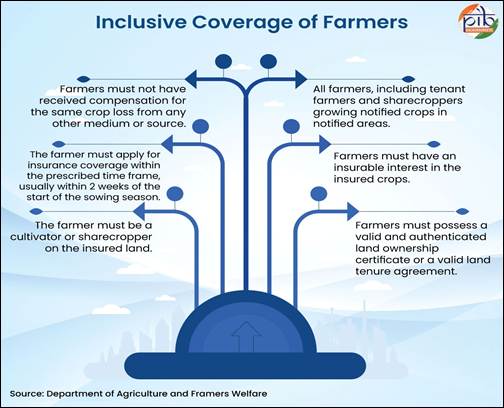
PMFBY provides inclusive crop insurance coverage to farmers, including tenant farmers and sharecroppers, subject to prescribed eligibility conditions. Farmers must have an insurable interest, valid land documents or tenure agreements or sowing certificates as per state-specific pre-defined requirements, and apply within the specified timeframe. To ensure inclusive risk coverage, PMFBY covers both loanee and non-loanee farmers across the agricultural range.
- Non-loanee farmers are those without crop loans or with non-standard Kisan Credit Card (KCC)-linked loans. They can voluntarily enroll under PMFBY for crop insurance coverage. In the last 10 years, on average, 50% of all farmers have voluntarily enrolled as non-loanee farmers, establishing trust among farmers in the scheme.
- Loanee farmers are those who take seasonal crop loans from banks or financial institutions, and their loans or KCCs are active and standard. Their premiums are automatically deducted from the loan amount by the respective banks.
- PMFBY generally provides comprehensive risk cover for all natural and climatic calamities leading to damage or loss of crops, provided that the crop has been insured and the corresponding premium has been paid to the Insurance Company within predefined timelines. However, crop losses in non-notified areas, outside the covered crop lifecycle (i.e., before sowing and after removal of the crop from the field), and losses caused by negligence or man-made or preventable risks are not covered.
Risks Covered
PMFBY provides coverage against crop losses at different stages of cultivation and harvesting:
- Yield Losses (standing crops, on notified area basis): PMFBY provides area-based coverage against non-preventable risks such as drought, dry spells, floods, inundation, cyclones, hailstorms, lightning, pests and diseases.
- Prevented Sowing: Where insured farmers incur expenditure but are prevented from sowing due to adverse weather conditions, they shall be eligible for claims up to a maximum of 25% of the sum insured.
- Post-Harvest Losses: Crops kept in “cut-and-spread” condition for drying in the field are covered for up to 14 days after harvesting against specified cyclonic and unseasonal rain events.
- Localized Calamities: Individual farm-level losses caused by hailstorms, landslides, inundation, cloud bursts, and damage by natural fire are covered under specified conditions.
- However, PMFBY excludes losses from war, nuclear risks, riots, theft, specified post-harvest conditions, and other preventable risks.
Progress and Achievements Under PMFBY
PMFBY has witnessed significant expansion in farmer participation, insurance coverage, and institutional reach in recent years.
- PMFBY is currently being implemented by 25 States and Union Territories in Kharif 2026.
- Since its inception, more than 92.46 crore farmer applications have been insured, and over 26.33 crore farmer applications have received claims exceeding ₹2.06 lakh crore.
- National enrolment reached an all-time high in 2024-25, with more than 15.23 crore farmer applications covering more than 4 crore farmers have been insured, and over 623 lakh hectares covered.
- Tenant and sharecropper farmers are included and covered under the scheme. Since 2018, cumulatively more than 1.44 crore such farmers have been enrolled across States and UTs.
- West Bengal rejoined from Kharif 2026.
- Bihar has decided to return to the national fold and implement PMFBY starting from the Rabi 2026–27 season.
Key Government Initiatives to Strengthen PMFBY Implementation
PMFBY is being implemented through a robust digital and governance framework that ensures transparent, timely, and accurate crop insurance services.
- The National Crop Insurance Portal (NCIP) enables digital farmer enrolment, subsidy administration, coordination, and information dissemination. It also facilitates access to insured farmers’ details, the calculation of eligible claims, and the electronic transfer of claims directly into farmers’ bank accounts.
- Integration of Land Records with NCIP: Enables validation of insured areas through state e-land records. Digital validation of land records is being implemented in the states of Madhya Pradesh, Chhattisgarh, Andhra Pradesh, Maharashtra, Rajasthan, Karnataka, Haryana, Himachal Pradesh, Uttar Pradesh, and Odisha. Around 85% of the insured area in these States is now validated through integrated land records to ensure the correct identification of the land parcel, insured area, and farmer.
- Digiclaim Module: Introduced from Kharif 2022, it enables transparent calculation and settlement of claims on NCIP. Claims are processed through NCIP and paid through the Public Finance Management System (PFMS). It also enables full-cycle monitoring of claims up to the farmer level. Since inception, more than ₹55,000 Crore in claims have been calculated and paid through the digital platform.
- Crop Cutting Experiment (CCE)-Agri App: Enables digital capture and uploading of CCE yield data on NCIP. This yield data is used for the calculation of the Actual Yield for an Insurance Unit, based on which the eligible payable claims due to loss of crop yield are calculated. It also allows insurance companies to witness CCEs, improving transparency and supporting timely claim settlement.
Digital Innovations Strengthening Crop Insurance Delivery
PMFBY’s digital platform integrates farmers, insurers, financial institutions, and government agencies on a single IT ecosystem. It enables real-time information sharing, transparent administration, and streamlined crop insurance services. The portal digitizes area, crop, and scheme notifications, reduces manual processes, and improves access to insurance, particularly for remote and economically vulnerable farmers.
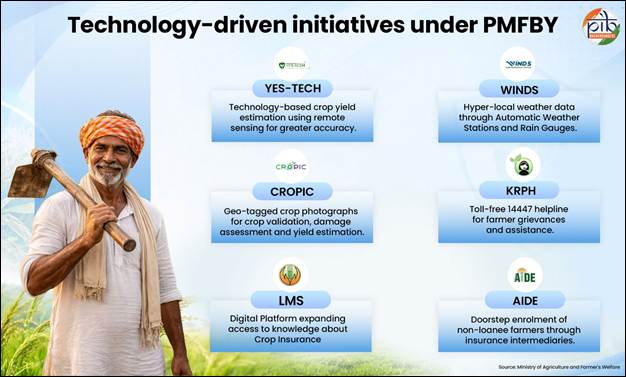
- Yield Estimation System Based on Technology (YES-TECH) uses remote sensing and technology-based methods to provide fair and accurate crop yield estimates. It was launched for paddy and wheat in Kharif 2023, and soybean in Kharif 2024. It started with at least 30% weightage assigned to YES-TECH-derived yields and has now increased up to 50% across certain states.
- The Weather Information Network and Data System (WINDS) employs Automatic Weather Stations and Automatic Rain Gauges to collect hyperlocal weather data at the Block and Gram Panchayat levels. The data support the implementation of the Weather-Based Crop Insurance Scheme for Fruits, vegetables, and plantation crops; crop yield estimation using YES-TECH; disaster management; weather forecasting; and other parametric insurance products.
- Collection of Real-time photos and Observations of Crops (CROPIC): Uses geo-tagged photographs to periodically validate general crop health in a given Insurance Unit. It is also envisaged to support crop damage assessment and yield estimation through pictorial analytics, for which nation-wide pilots are in the process of initiation
- The Krishi Rakshak Portal & Helpline (KRPH) provides a dedicated toll-free helpline (14447) for farmers to register grievances, seek assistance, and track the resolution of crop insurance-related issues. It was launched in January 2024 across the nation, and since then, 26.12 lakh grievances of insured farmers have been addressed & resolved with 99.66% resolution rate.
- Learning Management System (LMS) expands knowledge and understanding of crop insurance across the stakeholders through a digital platform. App for Intermediary Enrolment (AIDE) enables doorstep enrolment of non-loanee farmers. It makes crop insurance more accessible through insurance intermediaries. Similarly, Crop Loss Assessment App (CLAP) is being used to digitally record the crop loss extent on the individual farm level under localized calamities through crop loss surveys and enables faster & transparent claim calculation and settlement.
These technology interventions transformed PMFBY by enabling faster enrolment, accurate loss assessment, timely claim settlement, and effective grievance redressal for farmers.
Restructured Weather-Based Crop Insurance Scheme (RWBCIS)
Complementing PMFBY, the Government implements the Restructured Weather-Based Crop Insurance Scheme (RWBCIS) to address risks arising specifically from adverse weather conditions.
- RWBCIS is a weather index-based scheme where admissible claims are determined using specified weather parameters as a "proxy" for crop damage rather than actual assessed crop-yield losses. Under this scheme, a crop’s life cycle is divided into distinct phenological phases, with the sum insured allocated based on the crop's vulnerability during each phase.
The scheme operates on an "Area Approach" in defined Reference Unit Areas (RUAs). Payouts are triggered when quantifiable weather variables—including deficit or excess rainfall, dry spells, extreme temperatures, humidity, and wind speed-measured at notified local weather stations deviate from pre-defined thresholds.
- States/UTs can also offer add-on farm-level coverage for severe localized perils such as hailstorms and cloudbursts.
- Sharing the same affordable premium rates as PMFBY (1.5% to 5% depending on crop type), RWBCIS remains a highly popular safety net, especially for Fruit, Vegetables, and Plantation crops, covering 25.95 lakh farmer applications covering 12.31 lakh hectares in Kharif 2026.
Infographics: Pradhan Mantri Fasal Bima Yojana (PMFBY)

Answer Writing Practice Question for NABARD Grade A Exam
Indian agriculture remains highly vulnerable to climatic variability, natural calamities, pests and diseases, making crop failure a major source of income insecurity for farmers. In this context, the Pradhan Mantri Fasal Bima Yojana (PMFBY), launched in 2016, seeks to provide affordable crop insurance, stabilize farm incomes and ensure continuity of agricultural credit and production. The scheme has evolved into an important pillar of agricultural risk management and climate resilience.
How PMFBY protects farmers against crop-related risks
1. Comprehensive risk coverage: PMFBY provides protection against a wide range of non-preventable risks, including drought, dry spells, floods, inundation, cyclones, hailstorms, lightning, pests and diseases affecting standing crops.
2. Coverage across the crop cycle: Unlike conventional insurance focused only on standing crops, PMFBY covers different stages:
- Prevented sowing: Compensation of up to 25% of the sum insured where adverse weather prevents sowing.
- Standing crop losses: Compensation for yield losses arising from notified natural calamities, pests and diseases.
- Localized calamities: Farm-level losses due to hailstorms, landslides, inundation, cloudbursts and natural fire are covered under specified conditions.
- Post-harvest losses: Crops lying in cut-and-spread condition are covered for up to 14 days against specified cyclonic and unseasonal rainfall events.
3. Affordable premium: Farmers pay a maximum premium of only 2% for Kharif crops, 1.5% for Rabi foodgrains and oilseeds, and 5% for commercial and horticultural crops, with the balance subsidised by governments. This makes insurance affordable for small and marginal farmers.
4. Income and credit security: Timely compensation helps farmers absorb income shocks, repay agricultural loans, purchase inputs and continue cultivation in the subsequent season. Thus, crop insurance also supports the flow of institutional credit and reduces vulnerability to distress borrowing.
5. Wider inclusion: PMFBY covers both loanee and non-loanee farmers, while tenant farmers and sharecroppers can also be covered subject to prescribed eligibility conditions.
Role of Technology in PMFBY
- Digital Enrolment and Data Integration: The National Crop Insurance Portal (NCIP) enables digital enrolment and facilitates integration of farmer, land and insurance-related information, improving accuracy and reducing manual intervention.
- Transparent Claim Settlement: DigiClaim facilitates automated claim calculation and electronic settlement, thereby reducing delays, improving transparency and limiting scope for errors in claim processing.
- Scientific Yield Estimation: YES-TECH uses remote sensing and technology-based methods to supplement traditional Crop Cutting Experiments, making yield estimation more objective and data-driven.
- Real-time Crop Yield Data: The CCE-Agri App digitises Crop Cutting Experiments and enables recording and uploading of crop-yield data, strengthening the reliability of yield assessment.
- Hyperlocal Weather Monitoring: WINDS uses Automatic Weather Stations and Rain Gauges to generate granular weather information, helping in better assessment of weather-related crop losses.
- Geo-tagged Crop Assessment: CROPIC uses geo-tagged photographs to verify crop health and cultivation status, creating stronger evidence for assessing crop damage.
- Digital Assessment of Localised Losses: CLAP facilitates technology-enabled assessment of localised crop losses, helping improve the speed and accuracy of claim assessment.
- Grievance Redressal: The Krishi Rakshak Portal and Helpline (14447) provide farmers with a mechanism to register and track grievances, thereby improving accountability in the insurance ecosystem.
Way Forward
Despite technological progress, challenges such as digital literacy gaps, connectivity constraints, delayed claims, awareness deficits and difficulties in accessing tenant/sharecropper farmers need continued attention. Technology should therefore be accompanied by stronger last-mile facilitation, interoperable land records, faster grievance redressal and greater use of AI, satellite imagery and drones.
In Conclusion, PMFBY represents a shift from post-disaster relief to institutionalised agricultural risk management. By combining affordable premiums with comprehensive coverage and technology-enabled assessment, it can protect farm incomes while strengthening credit access, investment and climate resilience. Its continued success will depend on making the system farmer-centric, transparent, timely and digitally inclusive.
Objective Practice Question for NABARD Grade A Exam
Q1. Consider the following statements regarding the premium and subsidy architecture of crop insurance schemes in India:
I. The maximum premium payable by a farmer is 2 percent of the sum insured for Kharif foodgrain and oilseed crops, 1.5 percent for Rabi foodgrain and oilseed crops, and 5 percent for commercial and horticultural crops.
II. The balance premium is shared between the Centre and the States in a 50:50 ratio in general, while for North-Eastern and Himalayan States and Union Territories the sharing is in a 90:10 ratio.
III. The Restructured Weather-Based Crop Insurance Scheme (RWBCIS) prescribes a higher band of farmer premium rates than PMFBY because it relies on weather indices rather than yield assessment.
Which of the statements given above is/are correct?
A) I only
B) I and II only
C) II and III only
D) I and III only
E) I, II and III
Correct Answer: B
Explanation:
Statement I is correct. The farmer's share is capped at 2 percent for Kharif and 1.5 percent for Rabi foodgrain and oilseed crops, while commercial and horticultural crops attract a maximum of 5 percent. Note the crop-category distinction, not merely the season distinction, since aspirants often wrongly apply the 2 percent cap to horticultural crops in Kharif.
Statement II is correct. The residual premium after the farmer's share is subsidised by the Centre and the States in a 50:50 proportion, with a more favourable 90:10 pattern for North-Eastern and Himalayan States and UTs. This differential is a deliberate equity provision aimed at fiscally weaker and geographically disadvantaged states.
Statement III is incorrect. RWBCIS shares the same affordable premium band as PMFBY, namely 1.5 percent to 5 percent depending on crop type. The distinction between the two schemes lies in the loss-assessment mechanism, not in the premium rates. RWBCIS uses specified weather parameters as a proxy for crop damage, with payouts triggered when variables such as deficit or excess rainfall, dry spells, extreme temperatures, humidity and wind speed at notified weather stations breach pre-defined thresholds.
Hence only I and II are correct, making B the answer.
Q2. With reference to the risks covered under PMFBY, which one of the following statements is not correct?
A) Where insured farmers incur expenditure but are prevented from sowing due to adverse weather, claims up to a maximum of 25 percent of the sum insured are admissible.
B) Crops kept in "cut-and-spread" condition for drying in the field are covered for up to 14 days after harvesting against specified cyclonic and unseasonal rain events.
C) Localized calamities such as hailstorms, landslides, inundation, cloud bursts and damage by natural fire are covered at the individual farm level under specified conditions.
D) Losses arising from theft and riots are admissible as localized calamity claims when they occur at individual land parcels within notified areas.
E) Yield losses of standing crops are covered on a notified area basis against non-preventable risks including drought, dry spells, floods, inundation, cyclones, hailstorms, lightning, pests and diseases.
Correct Answer: D
Explanation:
Option D is the incorrect statement and is therefore the answer. Losses from war, nuclear risks, riots, theft, specified post-harvest conditions and other preventable risks are explicitly excluded from the scheme. The underlying insurance principle is that PMFBY covers non-preventable natural and climatic perils, whereas man-made, negligence-driven or preventable losses fall outside the risk pool. Similarly excluded are crop losses in non-notified areas and losses occurring outside the covered crop lifecycle, that is before sowing and after removal of the crop from the field.
Option A is correct: prevented or failed sowing due to adverse weather attracts claims capped at 25 percent of the sum insured, a pre-sowing stage cover.
Option B is correct: the post-harvest window is 14 days from harvesting for crops in cut-and-spread condition, and only against specified cyclonic and unseasonal rain events, not against all perils.
Option C is correct: localized calamity cover operates at the individual farm level, unlike the area-based yield loss cover.
Option E is correct: yield losses of standing crops are assessed on the notified area basis, with the Insurance Unit as the reference and Actual Yield derived from Crop Cutting Experiments.
Q3. Several major agricultural States that had earlier opted out of PMFBY have returned to the scheme. Arrange the following States in the correct chronological order of their rejoining or scheduled entry, from the earliest to the latest:
- Bihar
- Jharkhand
- Andhra Pradesh
- West Bengal
Select the correct answer using the code given below:
A) 3, 2, 4, 1
B) 3, 4, 2, 1
C) 2, 3, 1, 4
D) 3, 2, 1, 4
E) 2, 4, 3, 1
Correct Answer: A
Explanation:
The correct sequence is Andhra Pradesh, Jharkhand, West Bengal, Bihar.
Andhra Pradesh rejoined from Kharif 2022, making it the earliest of the four returns.
Jharkhand rejoined from Kharif 2024.
West Bengal rejoined from Kharif 2026.
Bihar decided to return to the national fold with implementation beginning from the Rabi 2026-27 season, which falls after Kharif 2026 in the agricultural calendar. This is the analytical hinge of the question: candidates who treat "2026" as a single point will misplace Bihar relative to West Bengal, since a Rabi 2026-27 entry necessarily follows a Kharif 2026 entry.
Option D is the most attractive distractor because it correctly places Andhra Pradesh first and Jharkhand second but inverts the West Bengal and Bihar positions. Options B, C and E disturb the Andhra Pradesh anchor at the head of the sequence.
The broader significance is that these returns reflect growing State confidence in the centralized insurance framework as compared with regional non-insurance crop relief models.
Q4. Consider the following statements about the technology-driven initiatives supporting PMFBY implementation:
I. YES-TECH began with at least 30 percent weightage assigned to technology-derived yield estimates, and this weightage has since been raised up to 50 percent in certain States.
II. CROPIC uses geo-tagged photographs to periodically validate general crop health in a given Insurance Unit and is envisaged to support damage assessment and yield estimation through pictorial analytics.
III. AIDE enables doorstep enrolment of non-loanee farmers through insurance intermediaries.
IV. The Krishi Rakshak Portal and Helpline operates a dedicated toll-free number 14447 and was launched nationally in January 2024.
Which of the statements given above are correct?
A) I and II only
B) II and III only
C) I, III and IV only
D) II, III and IV only
E) I, II, III and IV
Correct Answer: E
Explanation:
All four statements are correct, making E the answer.
Statement I is correct. YES-TECH, the Yield Estimation System based on Technology, uses remote sensing for crop yield estimation. It was rolled out for paddy and wheat in Kharif 2023 and extended to soybean in Kharif 2024. The weightage assigned to technology-derived yields started at a minimum of 30 percent and has been scaled up to as much as 50 percent in certain States, reflecting growing confidence in remote sensing as a partial substitute for physical Crop Cutting Experiments.
Statement II is correct. CROPIC, the Collection of Real-time photos and Observations of Crops, relies on geo-tagged photographs for periodic validation of crop health, with nationwide pilots for pictorial analytics under initiation.
Statement III is correct. AIDE, the App for Intermediary Enrolment, targets the non-loanee segment specifically, since loanee farmers have premiums auto-deducted by banks and therefore do not face an enrolment access barrier.
Statement IV is correct. KRPH provides the toll-free helpline 14447, was launched across the nation in January 2024, and has since addressed 26.12 lakh grievances with a resolution rate of 99.66 percent.
Candidates should also distinguish the remaining components: WINDS supplies hyperlocal weather data through Automatic Weather Stations and Automatic Rain Gauges at Block and Gram Panchayat levels; the Digiclaim module, operational from Kharif 2022, calculates and settles claims on NCIP with disbursal through PFMS; CLAP digitally records farm-level crop loss under localized calamities; and LMS builds stakeholder knowledge.
Q5. Consider the following statements based on PMFBY enrolment and coverage data:
I. In Kharif 2026, as of 27 August 2026, both the number of insured farmers and the area insured exceeded the corresponding Kharif 2025 levels, yet the average insured area per farmer was marginally lower than in Kharif 2025.
II. Andhra Pradesh's Kharif 2026 enrolment, despite recording a sharp percentage increase over Kharif 2025, remained below its Kharif 2024 enrolment level.
III. Maharashtra's Kharif 2026 enrolment, as of 28 August 2026, exceeded its Kharif 2025 enrolment.
Which of the statements given above is/are correct?
A) I only
B) II and III only
C) I and II only
D) I and III only
E) I, II and III
Correct Answer: C
Explanation:
Statement I is correct and requires a two-step calculation. Kharif 2025 covered 229.77 lakh farmers over 269.38 lakh hectares, giving roughly 1.17 hectares per insured farmer. Kharif 2026, as of 27 August 2026, covered 241.38 lakh farmers over 278.12 lakh hectares, giving roughly 1.15 hectares per insured farmer. Both absolute figures rose, yet the per-farmer insured area edged down, which is consistent with deeper penetration among smaller holdings. This is precisely the kind of derived inference Mains-level questions reward.
Statement II is correct. Andhra Pradesh's enrolment fell 77 percent from 31.92 lakh in Kharif 2024 to 7.43 lakh in Kharif 2025 following the discontinuation of the universalization approach under which the State bore 100 percent of the farmer premium. In Kharif 2026, till 28 August 2026, enrolment recovered to 16.22 lakh, a 108 percent increase over Kharif 2025, but this still remains well short of the 31.92 lakh recorded in Kharif 2024. A high percentage rebound off a depressed base does not restore the earlier absolute level, and that is the misconception this statement targets.
Statement III is incorrect. Maharashtra enrolled 42.55 lakh farmers in Kharif 2026 till 28 August 2026, which is 92 percent of the Kharif 2025 figure of 45.99 lakh, hence below and not above it. The moderate shortfall is attributed to the State's exclusion of certain add-on claims, and it follows the earlier 40 percent decline from 76.59 lakh in Kharif 2024.
Since only I and II hold, C is the answer. Option E is the trap for candidates who read the recovery narrative for both States as uniform, and option B fails by dropping the correct derived statement I.
Source: PIB
*****
