

India’s farms have sustained agricultural growth, but long-term productivity depends on healthy soils and resilient ecosystems. Regenerative agriculture offers a pathway to restore soil vitality, improve biodiversity, and strengthen resilience against climate stresses. Across the country, farmers are adopting practices such as natural farming, agroforestry, micro-irrigation, integrated farming systems, and scientific soil management. Government support has accelerated this transition.
As of March 2026, natural farming clusters covered 8.80 lakh hectares and enrolled 18.19 lakh farmers. About 109 lakh hectares have been brought under Per Drop More Crop as of May 2026. In addition, 25.89 crore Soil Health Cards have been generated since inception, as of March 2026. These efforts are helping build a more productive, resource-efficient, and environmentally responsible future for Indian agriculture.

The Imperative for Regenerative Agriculture
India’s agriculture and allied sectors have demonstrated strong and sustained progress. During FY16-FY25, it recorded decadal growth of 4.45 percent, the highest in previous decades. This achievement reflects the resilience of the sector and the continued efforts of farmers across the country. Yet, sustaining this momentum requires strengthening the ecological foundations that support long-term agricultural productivity.
Each season, farmers return to the same fields with renewed hope and growing responsibility. Years of intensive cultivation, heavy chemical use, and erratic rainfall leave many soils tired and less responsive. Yields that once came easily now demand higher inputs, while heatwaves, dry spells, or excess rain can undo months of labour. For millions of small and marginal farmers, declining soil health often translates into higher costs and uncertain harvests. As a result, the sustainability of farming has become an increasingly important concern.
This is where Regenerative Agriculture finds its relevance. By rebuilding soil vitality, strengthening ecosystem functions, and improving resilience to climatic variability, it addresses both soil and productivity challenges. More importantly, it offers a pathway to revive India’s agricultural foundations while supporting long-term environmental balance and farm prosperity.
Understanding the Regenerative Agriculture Approach
Regenerative agriculture is a holistic farming approach centred on restoring soil health and enhancing biodiversity. At the same time, it seeks to ensure long-term productivity and resilience in farming systems. Healthy soils support higher food and nutritional output, store more carbon, and promote biodiversity. Unlike sustainable farming, which primarily aims to maintain existing conditions, regenerative agriculture seeks to improve them. It goes a step further by actively rebuilding soil health, enhancing biodiversity, and strengthening ecosystem resilience.
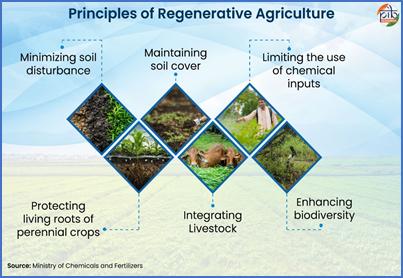
It is based on the following principles:
- Minimizing soil disturbance
- Protecting the living roots of perennial crops
- Maintaining soil cover
- Integrating Livestock
- Limiting the use of chemical inputs
- Enhancing biodiversity
In essence, Regenerative agriculture offers a practical and forward-looking pathway for the future of farming by restoring the natural foundations of agriculture.
Strengthening Agricultural Resilience through Regenerative Approaches
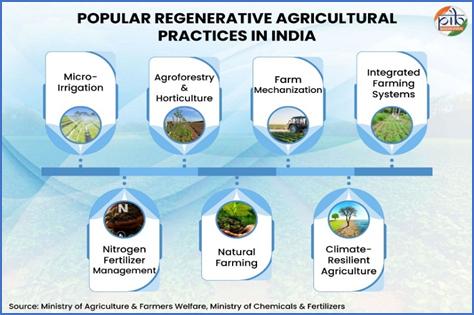
Regenerative agriculture draws upon a diverse set of farming practices adopted in India. While the spectrum of regenerative approaches is much broader, some of the prominent practices can be broadly classified into the following categories:
Water and Resource Efficiency
Micro-irrigation systems such as drippers, sprinklers, and foggers deliver water directly to plant roots. This reduces water wastage and improves water-use efficiency. By optimizing farm-level water management, these systems enhance crop productivity and strengthen resilience to droughts and water stress. As a result, farming systems become more climate-resilient and economically viable.
Farm Mechanization involves the use of agricultural machinery and equipment to streamline and automate various farm operations. It helps optimize the use of key inputs such as water, fuel, and fertilizers, reducing wastage and lowering the carbon footprint. By enabling timely and precise farm operations, mechanization improves resource management, enhances productivity, and helps reduce the environmental impact of farming.
Soil and Nutrient Management
Nitrogen Fertilizer Management helps reduce nitrous oxide emissions while improving crop productivity. It focuses on selecting the right fertilizer and optimizing application timing and dosage. Other practices include deep placement of supergranular urea and the use of leaf color charts for precise assessment of nitrogen status. The approach also promotes biological inputs such as cyanobacteria and legume intercropping. Overall, these measures improve nitrogen-use efficiency and minimize environmental losses.
Natural farming is a chemical-free agricultural approach rooted in India’s traditional knowledge systems. The system relies on on-farm biological inputs such as Beejamrut, Jeevamrut, GhanJeevamrut, Neemastra, and Dashparni, prepared using inputs from native livestock. It also promotes the use of traditional seed varieties and the integration of trees along farm boundaries. Pest management is undertaken through locally prepared, on-farm botanical formulations. Practitioners are encouraged to adopt continuous cover cropping, multi-cropping, mulching, and minimal soil disturbance to maintain soil fertility and ecological balance. The integration of livestock with diversified cropping systems further helps improve soil health, restores ecosystems, and reduces input costs for farmers.
Soil Health Management Practices such as green manuring, cover cropping, and mulching play a vital role in regenerative agriculture. Green manuring involves growing and incorporating specific crops into the soil to add organic matter and nutrients. It helps in improving soil fertility, structure, and carbon sequestration. Cover cropping refers to growing crops primarily to cover the soil rather than for harvest. It protects against erosion, maintains soil organic carbon, and supports nutrient cycling. Mulching involves covering the soil surface with organic residues such as leaves, straw, etc. It helps conserve moisture and regulate soil temperature. Mulching also suppresses weeds, promotes beneficial microbial activity, and improves crop productivity.
Integrated and Climate-Resilient Farming Systems
Integrated Farming Systems (IFS) is a holistic agricultural approach that combines multiple farm enterprises into a single system. It integrates crops, livestock, fisheries, and allied activities such as horticulture, agroforestry, and apiculture. The approach promotes practices such as intercropping, crop rotation, multi-cropping, and mixed farming that maximize resource use. This also reduces the risk of crop failure, diversifies livelihood opportunities, and enhances resilience to climate extremes such as floods and droughts.
Agroforestry integrates perennial tree systems with fruit and plantation crops to create a more sustainable and profitable farming system. It helps farmers earn additional income while improving soil moisture, regulating local temperatures, and storing more carbon.
In rainfed regions, agroforestry plays a crucial role in rejuvenating degraded land. These systems help mitigate the impacts of unpredictable rainfall, enhance agricultural resilience, and reduce greenhouse gas emissions over time.
Climate-Resilient Agriculture (CRA) encompasses a plethora of strategies and technologies to fortify agricultural systems against a changing climate. Its key components include:
- balanced use of nutrients and fertilizers,
- effective pest management,
- efficient and judicious use of water,
- conservation of soil moisture at the field level,
- and appropriate land preparation practices that safeguard soil health and enhance crop performance.
In addition, CRA includes innovations such as water-sharing groups, seed and fodder systems, community nurseries, and collective marketing mechanisms. Together, these practices and innovations strengthen agricultural systems, enabling them to better withstand climate-related stresses and shocks.
The Multifaceted Benefits of Regenerative Farming
Regenerative agriculture offers a wide range of environmental, economic, and social benefits, supporting both healthy ecosystems and resilient farming.
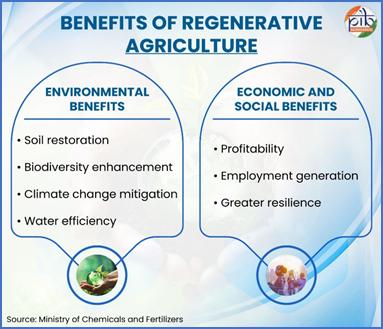
Environmental Outcomes
- Soil restoration: Regenerative practices rebuild soil organic matter, improve soil structure, and enhance long-term soil fertility, supporting stable agricultural productivity.
- Biodiversity enhancement: Regenerative approaches create favourable conditions for a wide variety of species, including pollinators, beneficial insects, and soil microorganisms. This helps in strengthening overall ecosystem balance.
- Climate change mitigation: These systems absorb and store more carbon than they emit, helping reverse agricultural emissions.
- Water efficiency: Healthier soils improve water retention and reduce runoff. This limits soil erosion and the flow of sediments and pollutants into rivers and lakes, helping protect water bodies.
Economic and Social Outcomes
- Profitability: Healthier soils reduce dependence on synthetic fertilizers, pesticides, and irrigation. This lowers input costs, stabilizes yields, and enhances farmers’ net incomes.
- Employment generation: Regenerative agriculture creates new livelihood opportunities across farming, advisory services, technology, and ecological management.
- Greater resilience: Farms adopting regenerative practices are better equipped to withstand climate variability and market fluctuations.
Regenerative agriculture is closely aligned with SDG 13 (Climate Action). Target 13.1 focuses on strengthening resilience and adaptive capacity to climate-related risks and natural disasters. Since regenerative practices help reverse greenhouse gas emissions, they contribute to reducing climate-related risks at the farm level. Consequently, they help in enhancing farm-level climate resilience and strengthening adaptive capacity in the face of increasing climate variability.
Promoting Regenerative Agriculture through Targeted Interventions
The government is implementing a wide range of schemes to promote regenerative agricultural practices. Some of the key initiatives support natural and organic farming, agroforestry, micro-irrigation, integrated farming systems, and scientific soil health management.
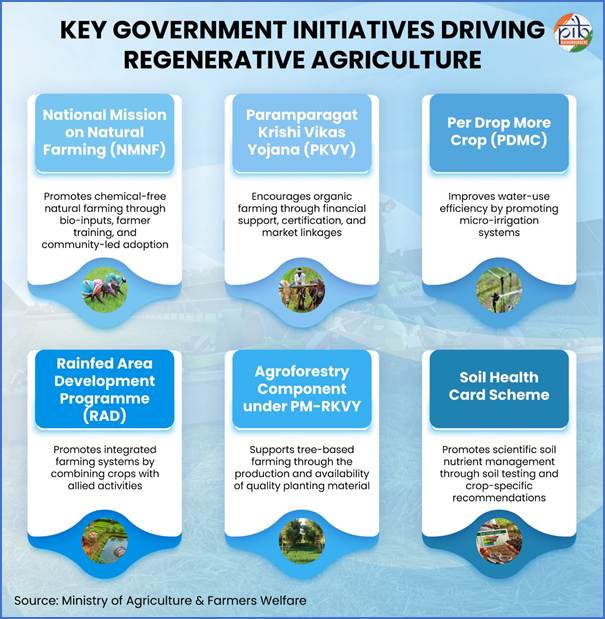
National Mission on Natural Farming
The National Mission on Natural Farming (NMNF), launched in 2024, creates a favourable support ecosystem to help farmers progressively transition to natural farming. The scheme provides an output-based incentive of ₹4,000 per acre per year for two years, covering up to one acre per farmer. In order to support farmers with easy access to bio-inputs such as Jeevamrit and Beejamrit, the mission provides for 10,000 need-based Bio-input Resource Centres. It also envisages the formation of natural farming clusters. Each cluster is supported by two Community Resource Persons (CRPs) to guide farmers in natural farming practices.
As of 05 March 2026, 18,786 clusters have been formed across the country. These clusters cover 8.80 lakh hectares, and 18.19 lakh farmers have been enrolled to promote Natural Farming. Additionally, 33,676 CRPs have been trained at Krishi Vigyan Kendras (KVKs)/ Agricultural Universities (AUs)/ local natural farming institutions.
Paramparagat Krishi Vikas Yojana
Paramparagat Krishi Vikas Yojana (PKVY), launched in 2015, has emerged as a key pillar of India’s organic farming initiative. It provides farmers with an organized framework for adopting eco-friendly practices, obtaining organic certification, and accessing markets that reward sustainable production. Under the scheme, farmers adopting organic farming are supported with ₹31,500 per hectare over three years.
As of 31 October 2025, a total area of 16.90 lakh ha has been covered under PKVY since its inception.
Per Drop More Crop
Per Drop More Crop (PDMC) is being implemented across the country since 2015-16. It helps improve on-farm water use efficiency through micro-irrigation systems, specifically drip and sprinkler irrigation. Drip irrigation delivers water directly to plant roots through pipes and emitters, reducing water wastage. Sprinkler irrigation sprays water onto the field through pipes and nozzles, ensuring uniform coverage.
Under PDMC, the Government provides 55% financial assistance to small and marginal farmers and 45% to other farmers for installing these systems. In addition, some states provide top-up subsidies to farmers from their own budgets.
Implemented since 2015-16, the scheme has covered about 109 lakh hectares as of May 2026. A total of ₹26,325 crore in central assistance has been released, significantly improving water-use efficiency.
Rainfed Area Development Programme
The Rainfed Area Development Programme (RAD), being implemented since 2014-15, promotes Integrated Farming Systems (IFS) through an area-based cluster approach. The programme encourages practices such as multi-cropping, crop rotation, inter-cropping, and mixed cropping. These are integrated with allied activities, including horticulture, livestock, fisheries, and apiculture, to enhance farm income, strengthen livelihoods, and build resilience to climate extremes.
Under RAD, clusters of about 20 hectares are developed within one or more adjoining villages. This approach promotes convergence, encourages community participation, and supports wider replication of successful models. Farmers are supported with financial assistance of ₹30,000 per family for adopting IFS. An additional ₹10,000 per cluster is provided for training and capacity-building activities.
Since its inception, ₹2251.98 crore has been provided as Central Assistance to States for adopting IFS. The scheme covered 9.53 lakh hectares and benefitted 15.73 lakh farmers (as of December 2025).
Krishi Vigyan Kendras (KVKs) further support the programme through demonstrations and training on location-specific IFS models. During 2024-25, KVKs conducted 4,416 demonstrations and trained 96,013 farmers on different IFS models.
In FY 2025–26, an allocation of ₹343.86 crore was made to States/UTs for the implementation of RAD, under which 96,013 farmers received training.
Sub-Mission on Agroforestry
The erstwhile Sub-Mission on Agroforestry (SMAF) was restructured as the Agroforestry Component under the Pradhan Mantri Rashtriya Krishi Vikas Yojana (PM-RKVY) from 2023-24. It supports the establishment of agroforestry nurseries to provide Quality Planting Material (QPM) to farmers. The scheme component includes:
- establishment of new nurseries,
- raising of saplings in existing nurseries,
- setting up tissue culture units,
- skill development and awareness,
- research and development,
- monitoring and evaluation,
- specialised technical activities,
- formulation of projects for the voluntary carbon market in the agriculture sector, and
- local initiatives.
It provides 100% assistance to Government agencies and 50% back ended credit-linked assistance to private beneficiaries.
During 2025-26, as on 31 October 2025, sanctions amounting to ₹78.31 crore were issued to 27 States/UTs. A total of 135 new nurseries were established. Sapling production was undertaken in 614 existing nurseries. About 176.59 lakh saplings were raised in these nurseries, benefitting around 25,693 farmers.
Soil Health Card Scheme
Launched in 2015, the Soil Health Card Scheme (SHC) provides farmers with plot-wise soil test reports, generated through scientific testing, for each landholding. The card assesses soil health on 12 key parameters, covering macronutrients, micronutrients, and critical soil properties.
Issued every 2 years, the Soil Health Card helps farmers understand the nutrient status and physicochemical conditions of their soils. It provides crop-specific recommendations on the appropriate use of chemical fertilisers, bio-fertilisers, organic inputs, and soil treatments.
As of 13 March 2026, a total of 25.89 crore Soil Health Cards have been generated since inception. Around 7.17 lakh demonstrations have been conducted to promote balanced fertiliser use. These demonstrations were conducted through advisories supported by the Agricultural Technology Management Agency (ATMA) and Krishi Vigyan Kendras (KVKs). In addition, 70,002 Krishi Sakhis have been trained to support the dissemination of soil health advisories at the grassroots level.
Infographics: Regenerative Agriculture for a Resilient India | NABARD Grade A

Answer Writing Practice Question for NABARD Grade A Exam
Q. Regenerative agriculture offers a pathway to restore India’s ecological foundations while enhancing farm productivity and resilience. Discuss its principles, major practices and benefits. Examine the role of government initiatives in promoting regenerative agriculture in India. (15 Marks | 600 Words)
Indian agriculture has achieved sustained growth, recording 4.45% decadal growth during FY16–FY25. However, intensive cultivation, excessive chemical use, declining soil health and erratic rainfall pose challenges to the long-term sustainability of this growth. Regenerative agriculture offers a holistic approach that seeks not merely to sustain existing agricultural conditions but to actively restore soil health, enhance biodiversity and strengthen ecosystem resilience.
Principles of Regenerative Agriculture
- Minimising Soil Disturbance: Reducing excessive tillage helps preserve soil structure, organic matter and soil biological activity.
- Maintaining Soil Cover: Cover crops and mulching protect the soil from erosion, conserve moisture and support nutrient cycling.
- Protecting Living Roots: Maintaining living roots of perennial crops supports soil organisms and improves soil health.
- Integrating Livestock: Integration of livestock with crop production promotes recycling of nutrients and strengthens the overall farm system.
- Limiting Chemical Inputs: Reducing dependence on chemical inputs helps restore ecological balance and lowers environmental stress.
- Enhancing Biodiversity: Crop diversification and integration of trees and other biological components create favourable conditions for pollinators, beneficial insects and soil microorganisms.
Major Regenerative Agricultural Practices in India
- Micro-Irrigation: Drippers, sprinklers and other efficient irrigation systems deliver water directly to crops, reducing wastage and improving water-use efficiency, particularly under drought and water-stress conditions.
- Natural Farming: It promotes chemical-free cultivation using on-farm biological inputs such as Jeevamrit and Beejamrit, traditional seed varieties and locally prepared botanical formulations.
- Nitrogen Fertilizer Management: Optimising the type, timing and dosage of nitrogen fertilisers improves nitrogen-use efficiency and reduces nitrous oxide emissions.
- Soil Health Management: Green manuring, cover cropping and mulching improve soil fertility, organic matter, moisture retention and carbon sequestration.
- Integrated Farming Systems: Combining crops with livestock, fisheries, horticulture, agroforestry and other allied activities improves resource utilisation, diversifies income and reduces the risk of crop failure.
- Agroforestry: Integration of perennial trees with crops and plantation or fruit systems provides additional income, improves soil moisture, regulates local temperatures and enhances carbon storage.
- Climate-Resilient Agriculture: Balanced nutrient management, efficient water use, soil-moisture conservation, effective pest management and appropriate land preparation strengthen resilience against climate-related stresses.
Benefits of Regenerative Agriculture
- Soil Restoration: Regenerative practices rebuild soil organic matter, improve soil structure and enhance long-term soil fertility.
- Biodiversity Enhancement: Diverse farming systems support pollinators, beneficial insects and soil microorganisms, strengthening ecosystem balance.
- Climate Change Mitigation: Regenerative systems absorb and store carbon, helping reduce agricultural emissions and contributing to climate action.
- Water Efficiency: Healthier soils improve water retention and reduce runoff, erosion and movement of sediments and pollutants into water bodies.
- Higher Profitability: Reduced dependence on synthetic fertilisers, pesticides and irrigation can lower input costs, stabilise yields and improve farmers’ net incomes.
- Greater Resilience: Diversified and ecologically balanced farming systems are better equipped to withstand climate variability and market fluctuations.
- Employment Generation: Regenerative agriculture can create livelihood opportunities in farming, advisory services, technology and ecological management.
Government Initiatives Promoting Regenerative Agriculture
- National Mission on Natural Farming (NMNF): Launched in 2024, it supports farmers transitioning to natural farming through an output-based incentive of ₹4,000 per acre per year for two years, Bio-input Resource Centres and natural farming clusters.
- Paramparagat Krishi Vikas Yojana (PKVY): Launched in 2015, it promotes organic farming, organic certification and market access, supporting farmers with ₹31,500 per hectare over three years.
- Per Drop More Crop (PDMC): Promotes micro-irrigation through drip and sprinkler systems to improve on-farm water-use efficiency.
- Soil Health Cards: Promote scientific soil and nutrient management through soil-specific recommendations, helping farmers optimise fertiliser use.
- Agroforestry under PM-RKVY: Supports tree-based farming through the production and availability of quality planting material, thereby encouraging diversified and resilient farming systems.
- Rainfed Area Development Programme (RAD): Promotes integrated farming systems by combining crops with allied agricultural activities, improving resource utilisation and resilience.
In conclusion, regenerative agriculture can help India move from input-intensive agriculture towards resource-efficient, ecologically restorative and climate-resilient farming. Its success, however, requires stronger farmer awareness, research, extension support, suitable incentives and market linkages. A coordinated approach combining natural farming, soil restoration, efficient irrigation, biodiversity and integrated farming systems can strengthen both farm prosperity and ecological sustainability, contributing to SDG 13 on Climate Action.
Objective Practice Question for NABARD Grade A Exam
Q1. Consider the following statements regarding the National Mission on Natural Farming (NMNF) and its progress:
I. The maximum output-based incentive that a single farmer can draw over the full incentive period of the Mission is ₹8,000.
II. As of 05 March 2026, the number of Community Resource Persons trained falls short of the requirement worked out on the norm of two CRPs for every cluster formed.
III. The average area covered per natural farming cluster, as of 05 March 2026, works out to more than 60 hectares.
Which of the statements given above is/are correct?
A) I only
B) II and III only
C) I and III only
D) I and II only
E) I, II and III
Correct Answer: D
Explanation:
Statement I is correct. NMNF, launched in 2024, provides an output-based incentive of ₹4,000 per acre per year for two years, with coverage restricted to a maximum of one acre per farmer. The ceiling for an individual farmer is therefore ₹4,000 multiplied by two years for one acre, that is ₹8,000. Candidates often overlook the one-acre cap and wrongly extrapolate the incentive across the farmer's entire holding.
Statement II is correct and requires a comparison. Each natural farming cluster is to be supported by two Community Resource Persons. With 18,786 clusters formed as of 05 March 2026, the requirement works out to 37,572 CRPs, whereas 33,676 CRPs have been trained at Krishi Vigyan Kendras, Agricultural Universities and local natural farming institutions. The trained strength is thus below the norm-based requirement, indicating a capacity gap in extension support.
Statement III is incorrect. The 18,786 clusters cover 8.80 lakh hectares, giving an average of roughly 47 hectares per cluster, which is well below 60 hectares. The figure of 60 is an invented threshold designed to catch candidates who do not perform the division.
Also worth retaining: the Mission provides for 10,000 need-based Bio-input Resource Centres to ensure farmer access to on-farm inputs such as Jeevamrit and Beejamrit, and 18.19 lakh farmers have been enrolled under natural farming.
Hence only I and II hold, making D the answer.
Q2. Consider the following statements about the Rainfed Area Development Programme (RAD):
I. RAD has been under implementation since 2014-15 and promotes Integrated Farming Systems through an area-based cluster approach, with clusters of about 20 hectares developed within one or more adjoining villages.
II. Farmers are supported with financial assistance of ₹30,000 per family for adopting Integrated Farming Systems, with an additional ₹10,000 per cluster earmarked for training and capacity-building activities.
III. Since inception, Central Assistance of ₹2,251.98 crore has been provided to States, and the scheme had covered 9.53 lakh hectares benefiting 15.73 lakh farmers as of December 2025.
IV. For FY 2025-26, an allocation of ₹343.86 crore was made to States and Union Territories for implementation of the programme.
Which of the statements given above are correct?
A) I and II only
B) II and III only
C) I, II and III only
D) II, III and IV only
E) I, II, III and IV
Correct Answer: E
Explanation:
All four statements are correct, making E the answer.
Statement I is correct. RAD has been in operation since 2014-15 and its defining design feature is the area-based cluster approach, with clusters of roughly 20 hectares carved out within one or more adjoining villages. The small cluster size is deliberate, since it enables convergence, community participation and replication of successful IFS models.
Statement II is correct. The assistance pattern combines an individual-level component of ₹30,000 per family for adopting IFS with a collective component of ₹10,000 per cluster for training and capacity building. Distinguishing the per-family from the per-cluster element is the analytical point here.
Statement III is correct on all three figures: ₹2,251.98 crore of Central Assistance since inception, 9.53 lakh hectares covered, and 15.73 lakh farmers benefited as of December 2025.
Statement IV is correct. The FY 2025-26 allocation to States and UTs stood at ₹343.86 crore.
Additional supporting data worth noting: KVKs conducted 4,416 demonstrations and trained 96,013 farmers on location-specific IFS models during 2024-25. RAD's IFS approach integrates multi-cropping, crop rotation, inter-cropping and mixed cropping with allied activities such as horticulture, livestock, fisheries and apiculture, which is why it is treated as the flagship instrument for building climate resilience in rainfed tracts.
Q3. With reference to the Agroforestry Component under the Pradhan Mantri Rashtriya Krishi Vikas Yojana, which one of the following statements is not correct?
A) The erstwhile Sub-Mission on Agroforestry was restructured as the Agroforestry Component under PM-RKVY from 2023-24.
B) The component supports establishment of new nurseries, raising of saplings in existing nurseries, and setting up of tissue culture units to ensure availability of Quality Planting Material.
C) It extends 100 percent back-ended credit-linked assistance to private beneficiaries, while Government agencies are eligible for assistance limited to 50 percent.
D) The scope of the component includes formulation of projects for the voluntary carbon market in the agriculture sector.
E) During 2025-26, as on 31 October 2025, sanctions of ₹78.31 crore were issued to 27 States and Union Territories, and about 176.59 lakh saplings were raised benefiting around 25,693 farmers.
Correct Answer: C
Explanation:
Option C is the incorrect statement and is therefore the answer, because it inverts the assistance pattern. The component provides 100 percent assistance to Government agencies and 50 percent back-ended credit-linked assistance to private beneficiaries. The rationale is straightforward: public agencies raise planting material as a public good and require full funding, whereas private nurseries operate commercially and receive partial, credit-linked support to preserve accountability and leverage institutional finance. Reversing the two ratios is the most common error on this item.
Option A is correct. The restructuring of the Sub-Mission on Agroforestry (SMAF) into a component of PM-RKVY took effect from 2023-24, mirroring the wider consolidation of agriculture schemes under PM-RKVY.
Option B is correct. The component's core objective is Quality Planting Material availability, delivered through new nurseries, sapling production in existing nurseries and tissue culture units, alongside skill development and awareness, research and development, monitoring and evaluation, specialised technical activities and local initiatives.
Option D is correct. Formulation of projects for the voluntary carbon market in the agriculture sector is explicitly within scope, which links agroforestry to carbon revenue streams for farmers.
Option E is correct on the 2025-26 progress figures: ₹78.31 crore sanctioned to 27 States and UTs as on 31 October 2025, with 135 new nurseries established, sapling production in 614 existing nurseries, 176.59 lakh saplings raised and about 25,693 farmers benefited.
Q4. Which one of the following pairs relating to regenerative agricultural practices is not correctly matched?
A) Cover cropping: growing of crops primarily for harvest and sale as a cash crop, with soil protection arising only as an incidental outcome
B) Green manuring: growing and incorporating specific crops into the soil to add organic matter and nutrients, thereby improving soil fertility, structure and carbon sequestration
C) Mulching: covering the soil surface with organic residues such as leaves and straw to conserve moisture, regulate soil temperature, suppress weeds and promote beneficial microbial activity
D) Nitrogen fertilizer management: deep placement of supergranular urea and use of leaf colour charts, supported by biological inputs such as cyanobacteria and legume intercropping
E) Micro-irrigation: use of drippers, sprinklers and foggers to deliver water directly to plant roots, improving water-use efficiency and resilience to drought and water stress
Correct Answer: A
Explanation:
Option A is the incorrectly matched pair and is therefore the answer. Cover cropping refers to growing crops primarily to cover the soil rather than for harvest. Its purpose is to protect against erosion, maintain soil organic carbon and support nutrient cycling. Option A inverts the definition by making harvest the primary aim and soil protection incidental, which is precisely the misconception the question targets. The functional distinction between cover cropping and a cash crop is fundamental to regenerative practice.
Option B is correctly matched. Green manuring differs from cover cropping in that the biomass is deliberately incorporated into the soil to add organic matter and nutrients, with benefits for fertility, structure and carbon sequestration.
Option C is correctly matched. Mulching operates on the soil surface rather than within the profile, conserving moisture, moderating soil temperature, suppressing weeds, encouraging beneficial microbial activity and improving crop productivity.
Option D is correctly matched. Nitrogen fertilizer management reduces nitrous oxide emissions while raising productivity by selecting the right fertilizer and optimising timing and dosage, supplemented by deep placement of supergranular urea, leaf colour charts, cyanobacteria and legume intercropping.
Option E is correctly matched. Micro-irrigation is classified under water and resource efficiency and uses drippers, sprinklers and foggers for root-zone delivery.
The three definitions in A, B and C are frequently interchanged in examinations, so the safest memory anchor is: cover cropping protects the surface with a living crop, green manuring buries the biomass, and mulching covers the surface with dead residues.
Q5. Consider the following statements:
I. Sustainable farming primarily aims to maintain existing conditions, whereas regenerative agriculture goes a step further by actively rebuilding soil health, enhancing biodiversity and strengthening ecosystem resilience.
II. Regenerative agriculture is closely aligned with SDG 13, whose Target 13.1 focuses on strengthening resilience and adaptive capacity to climate-related risks and natural disasters.
III. Integrating livestock and protecting the living roots of perennial crops are both listed among the principles of regenerative agriculture, along with minimizing soil disturbance and limiting the use of chemical inputs.
IV. During FY16 to FY25, agriculture and allied sectors recorded decadal growth of 4.45 percent, which was lower than the growth achieved in the preceding decades.
Which of the statements given above are correct?
A) I and II only
B) I, II and III only
C) II, III and IV only
D) I, III and IV only
E) I, II, III and IV
Correct Answer: B
Explanation:
Statement I is correct and captures the conceptual core of the topic. The distinction between sustainable and regenerative agriculture is one of ambition rather than technique: sustainability seeks to hold the resource base steady, while regeneration seeks a net improvement in soil vitality, biodiversity and ecosystem function. This is the definitional line most likely to be tested in a descriptive or analytical format.
Statement II is correct. The alignment is with SDG 13 on Climate Action, and specifically Target 13.1 on strengthening resilience and adaptive capacity to climate-related hazards and natural disasters. Since regenerative systems absorb and store more carbon than they emit, they contribute both to mitigation and, through improved farm-level resilience, to adaptation.
Statement III is correct. The six stated principles are minimizing soil disturbance, protecting the living roots of perennial crops, maintaining soil cover, integrating livestock, limiting the use of chemical inputs, and enhancing biodiversity. Integration of livestock is frequently omitted by candidates who treat regenerative agriculture as a purely crop-side concept.
Statement IV is incorrect. The decadal growth of 4.45 percent recorded by agriculture and allied sectors during FY16 to FY25 was the highest among previous decades, not lower. The policy argument built on this figure is that strong growth performance must now be underpinned by ecological foundations if it is to be sustained, which is the very premise for promoting regenerative approaches.
Hence I, II and III are correct, making B the answer. Option E is the trap for candidates who recall the 4.45 percent figure without recalling its qualifying descriptor.
Q6. Consider the following statements regarding the Soil Health Card (SHC) Scheme:
I. The card assesses soil health on 12 key parameters covering macronutrients, micronutrients and critical soil properties, and is issued to farmers once every two years.
II. It provides plot-wise soil test reports for each landholding, along with crop-specific recommendations on the use of chemical fertilisers, bio-fertilisers, organic inputs and soil treatments.
III. Around 7.17 lakh demonstrations have been conducted to promote balanced fertiliser use, supported through advisories by the Agricultural Technology Management Agency and Krishi Vigyan Kendras.
IV. The scheme was launched in 2014, and a total of 25.89 crore Soil Health Cards had been generated since inception as of 13 March 2026.
Which of the statements given above are correct?
A) I and II only
B) II, III and IV only
C) I, II and III only
D) I, III and IV only
E) I, II, III and IV
Correct Answer: C
Explanation:
Statement I is correct. The Soil Health Card evaluates soil on 12 key parameters spanning macronutrients, micronutrients and critical soil properties, and the issuance cycle is once in two years. The biennial cycle is deliberate, since soil nutrient status changes slowly and annual re-testing would add cost without adding decision value.
Statement II is correct. The distinguishing feature of the scheme is that reports are plot-wise for each landholding rather than generalised for a village or block, and the advisory extends beyond chemical fertilisers to bio-fertilisers, organic inputs and soil treatments. This is what makes SHC an instrument of scientific and balanced nutrient management rather than merely a soil testing exercise.
Statement III is correct. About 7.17 lakh demonstrations have been organised to promote balanced fertiliser use, delivered through advisories supported by ATMA and KVKs. In addition, 70,002 Krishi Sakhis have been trained to disseminate soil health advisories at the grassroots level, which links the scheme to the wider community-based extension architecture.
Statement IV is partly incorrect and therefore fails as a whole. The cumulative generation figure of 25.89 crore cards as of 13 March 2026 is accurate, but the scheme was launched in 2015, not 2014. Aspirants frequently confuse the SHC launch year with the commencement year of the Rainfed Area Development Programme, which has been under implementation since 2014-15.
Hence only I, II and III are correct, making C the answer.
Q7. Consider the following statements comparing the Paramparagat Krishi Vikas Yojana (PKVY) with the National Mission on Natural Farming (NMNF):
I. Under PKVY, financial support of ₹31,500 per hectare is extended over three years, which works out to an average of ₹10,500 per hectare per year.
II. PKVY was launched in 2015 and had covered a total area of 16.90 lakh hectares since inception as of 31 October 2025, which is more than the area covered by natural farming clusters as of March 2026.
III. Both PKVY and NMNF are directed at certified organic production, since both schemes provide for organic certification and market linkages as their central instrument.
Which of the statements given above is/are correct?
A) I and II only
B) I and III only
C) II and III only
D) I only
E) I, II and III
Correct Answer: A
Explanation:
Statement I is correct. PKVY supports farmers adopting organic farming with ₹31,500 per hectare spread over three years, giving an annualised average of ₹10,500 per hectare. Reducing multi-year assistance to an annual equivalent is a standard analytical step, since scheme comparisons are meaningful only on a common time base.
Statement II is correct on both limbs. PKVY was launched in 2015 and had covered 16.90 lakh hectares since inception as of 31 October 2025. Natural farming clusters under NMNF covered 8.80 lakh hectares as of March 2026, so PKVY coverage is nearly double. The gap is explained by the far longer operational history of PKVY, roughly a decade against about two years for NMNF, and this contextualisation matters more in a Mains answer than the raw comparison.
Statement III is incorrect and is the conceptual trap. PKVY is the organic farming pillar and works through an organised framework for eco-friendly practices, organic certification and access to markets that reward sustainable production. NMNF, by contrast, promotes chemical-free natural farming rooted in India's traditional knowledge systems, relying on on-farm biological inputs such as Beejamrut, Jeevamrut, GhanJeevamrut, Neemastra and Dashparni prepared from native livestock, along with traditional seed varieties, botanical pest formulations and community-led adoption through clusters and Community Resource Persons. Certification is not the operating instrument of NMNF. Treating natural farming and organic farming as interchangeable is the single most common error in this segment.
Hence only I and II hold, making A the answer.
Q8. With reference to Climate-Resilient Agriculture (CRA) and Integrated Farming Systems (IFS) as described among regenerative approaches, which one of the following statements is not correct?
A) The key components of CRA include balanced use of nutrients and fertilizers, effective pest management, judicious use of water, conservation of soil moisture at field level, and appropriate land preparation practices.
B) CRA also encompasses institutional innovations such as water-sharing groups, seed and fodder systems, community nurseries and collective marketing mechanisms.
C) IFS is a holistic approach combining multiple farm enterprises, integrating crops, livestock, fisheries and allied activities such as horticulture, agroforestry and apiculture.
D) IFS promotes intercropping, crop rotation, multi-cropping and mixed farming, thereby reducing the risk of crop failure and diversifying livelihood opportunities.
E) Agroforestry is confined to irrigated command areas, since perennial tree systems cannot be sustained in rainfed tracts where rainfall is unpredictable.
Correct Answer: E
Explanation:
Option E is the incorrect statement and is therefore the answer. Agroforestry plays a crucial role precisely in rainfed regions, where it helps rejuvenate degraded land, mitigate the impacts of unpredictable rainfall, enhance agricultural resilience and reduce greenhouse gas emissions over time. The deep-rooted perennial component is in fact an advantage under moisture stress, since it accesses subsoil moisture and buffers the farm income stream when the seasonal crop fails. Agroforestry integrates perennial tree systems with fruit and plantation crops, allowing farmers to earn additional income while improving soil moisture, regulating local temperatures and storing more carbon.
Option A is correct and lists the five stated technical components of CRA.
Option B is correct. What distinguishes CRA from a purely agronomic package is the inclusion of collective and institutional innovations, namely water-sharing groups, seed and fodder systems, community nurseries and collective marketing. Resilience here is built at the community scale, not only at the plot scale.
Option C is correct. IFS derives its strength from enterprise diversification, where the by-product of one enterprise becomes the input of another, and it explicitly covers crops, livestock, fisheries, horticulture, agroforestry and apiculture.
Option D is correct. The cropping practices promoted under IFS reduce the correlation of failure across enterprises, which is the risk-management logic behind the approach and the reason RAD adopts IFS as its delivery vehicle in rainfed areas.
Q9. Consider the following statements regarding Per Drop More Crop (PDMC) as reported in the context of regenerative agriculture:
I. PDMC has been under implementation since 2015-16 and had covered about 109 lakh hectares as of May 2026, against which total central assistance of ₹26,325 crore has been released.
II. The average central assistance released per hectare brought under micro-irrigation works out to approximately ₹24,000.
III. Financial assistance is provided at 55 percent to small and marginal farmers and 45 percent to other farmers, and some States additionally provide top-up subsidies from their own budgets.
IV. Under PDMC, sprinkler irrigation delivers water directly to plant roots through pipes and emitters, whereas drip irrigation sprays water onto the field through pipes and nozzles to ensure uniform coverage.
Which of the statements given above are correct?
A) I, II and IV only
B) I, II and III only
C) II, III and IV only
D) I and III only
E) I, II, III and IV
Correct Answer: B
Explanation:
Statement I is correct. PDMC has been implemented across the country since 2015-16, coverage stood at about 109 lakh hectares as of May 2026, and cumulative central assistance released amounts to ₹26,325 crore.
Statement II is correct and follows from a division. ₹26,325 crore divided by 109 lakh hectares gives approximately ₹24,150 per hectare, that is roughly ₹24,000. This derived figure is analytically useful because it indicates the average public subsidy intensity per hectare of micro-irrigation created, and it can be contrasted with the far lower per-hectare assistance under area-based schemes such as PKVY.
Statement III is correct. The differential assistance pattern of 55 percent for small and marginal farmers against 45 percent for other farmers is an equity provision, and several States supplement it with top-up subsidies from their own budgets, which is why effective assistance varies across States despite uniform central norms.
Statement IV is incorrect because it reverses the two systems. Drip irrigation delivers water directly to plant roots through pipes and emitters, minimising wastage, while sprinkler irrigation sprays water onto the field through pipes and nozzles to ensure uniform coverage. This inversion is a recurring distractor and should be guarded against.
Hence I, II and III are correct, making B the answer.
Q10. Consider the following statements about the outcomes and headline achievements associated with regenerative agriculture:
I. Employment generation across farming, advisory services, technology and ecological management is classified among the economic and social outcomes rather than the environmental outcomes.
II. Improved water retention and reduced runoff from healthier soils, which limit soil erosion and the flow of sediments and pollutants into rivers and lakes, are treated as an environmental outcome.
III. Profitability under regenerative systems arises primarily from higher output prices secured through certification premiums, rather than from any reduction in input costs.
IV. As of March 2026, natural farming clusters covered 8.80 lakh hectares and enrolled 18.19 lakh farmers, which implies that on average more than two farmers were enrolled per hectare of cluster area.
Which of the statements given above are correct?
A) I and III only
B) II, III and IV only
C) I, III and IV only
D) I, II and IV only
E) I, II and III only
Correct Answer: D
Explanation:
Statement I is correct. The benefits are grouped into two heads. Environmental outcomes comprise soil restoration, biodiversity enhancement, climate change mitigation and water efficiency. Economic and social outcomes comprise profitability, employment generation and greater resilience. Employment generation therefore belongs to the second group, and it spans farming, advisory services, technology and ecological management rather than cultivation alone.
Statement II is correct. Water efficiency is listed as an environmental outcome, and its stated mechanism is that healthier soils retain more water and shed less runoff, which in turn curbs erosion and reduces the movement of sediments and pollutants into water bodies. Note that the benefit runs beyond the farm boundary to downstream water quality, which is why it is classified as environmental and not merely as an on-farm efficiency gain.
Statement III is incorrect. Profitability is attributed to the fact that healthier soils reduce dependence on synthetic fertilizers, pesticides and irrigation, thereby lowering input costs, stabilising yields and raising net incomes. The gain is cost-side, not price-side. Certification premiums are a feature of the PKVY organic pathway and should not be generalised as the source of profitability under regenerative agriculture as a whole.
Statement IV is correct and needs a quick ratio. Dividing 18.19 lakh farmers by 8.80 lakh hectares yields approximately 2.07 farmers per hectare. A figure above two is consistent with the predominance of small and marginal holdings in the cluster areas, and it also signals that per-farmer areas under natural farming are well below half a hectare on average.
Since I, II and IV are correct, D is the answer. Options containing statement III fail on the misattributed source of profitability.
