

Pradhan Mantri Annadata Aay Sanrakshan Abhiyan (PM-AASHA) is the Government’s flagship price-support framework for remunerative prices for farmers. It includes various schemes to strengthen the implementation of the Minimum Support Price (MSP) and reduce distress sales. Procurement of pulses, oilseeds, and copra is undertaken by the Central and State Governments through agencies such as NAFED and NCCF.
With a ₹7,200 crore Budget allocation for 2026–27, PM-AASHA strengthens effective price-support interventions. Digital reforms, including Aadhaar-enabled authentication, e-NAM, e-Samriddhi, and e-Samyukti, have improved transparency and procurement efficiency. Support from the Agriculture Infrastructure Fund and expanded procurement coverage have further strengthened the scheme.

Ensuring Remunerative Prices to Farmers
The government has taken several initiatives to ensure that the benefits of the Minimum Support Price (MSP) reach all farmers, including small and marginal farmers. One major initiative is the Pradhan Mantri Annadata Aay Sanrakshan Abhiyan (PM AASHA). The Government launched the scheme in September 2018. It was designed to ensure remunerative prices for farmers while maintaining price stability for consumers.
PM AASHA brings together multiple price support mechanisms under a unified framework. Each mechanism is implemented according to the crop and market conditions. The scheme strengthens MSP implementation and reduces distress sales among farmers. It also stabilises farm incomes while ensuring food price stability for consumers.
Under PM AASHA, procurement arrangements begin before each marketing season. Central nodal agencies and state governments prepare procurement infrastructure before crops reach the markets. This coordinated approach ensures timely procurement operations and strengthens effective MSP implementation across the country.
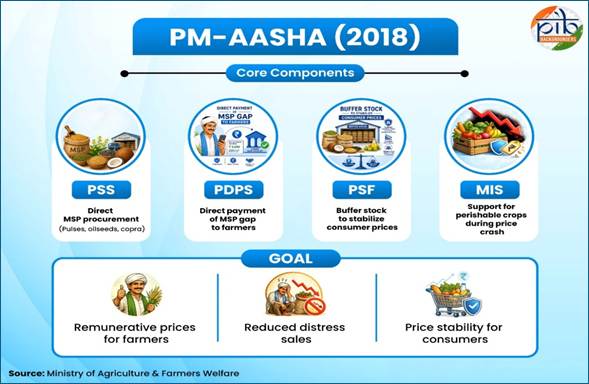
PM AASHA broadly consists of four key components: Price Support Scheme (PSS), Price Stabilization Funds (PSF), Price Deficiency Payment Scheme (PDPS), and Market Intervention Scheme (MIS).
1. Price Support Scheme (PSS)
This scheme ensures procurement of crop at MSP when market prices fall below MSP during harvest. It mainly covers pulses, oilseeds, and copra. Procurement is carried out through agencies such as the National Agricultural Cooperative Marketing Federation of India (NAFED) and the National Cooperative Consumers' Federation of India Limited (NCCF) at the request of state governments.
- Only registered farmers with valid land records are eligible, which ensures direct benefit without intermediaries. This helps prevent distress selling and ensures income stability for farmers during price crashes.
- From the 2024–25 procurement year, under the Price Support Scheme (PSS), procurement of pulses, oilseeds, and copra is initially allowed up to 25% of a State/UT’s production.
- Additional procurement beyond this limit may be approved by the Committee of Secretaries up to 25% of national production.
- However, to boost domestic pulse output and reduce imports, procurement of Tur, Urad, and Masur is permitted up to 100% of State production.
- Provision Government Guarantee to lender banks by the Central Government: To extend cash credit facilities to CNAs for undertaking procurement operations.
- The existing government guarantee has been renewed and enhanced to Rs. 45,000 crores.
- Implemented on the request of the States/ UTs: that agree to exempt from levy of Mandi tax in the interest of farmers.
2. Price Stabilization Fund (PSF)
The Price Stabilization Fund (PSF) protects consumers from price volatility by maintaining buffer stocks of essential commodities like pulses, onions, and potatoes.
- It was set up to stabilize the prices of key agri-horticultural products.
- Commodities are procured during harvest and released in lean seasons to control price spikes and ensure affordability.
- PSF is now merged with PM-AASHA but continues to be managed by the Department of Consumer Affairs.
- Department of Consumer Affairs (DoCA) will procure pulses at market price when prices exceed MSP on-
- eSamridhi portal of National Agricultural Cooperative Marketing Federation of India (NAFED) and
- eSamyukti portal of National Cooperative Consumers' Federation of India (NCCF).
3. Price Deficiency Payment Scheme (PDPS)
Under PDPS, farmers’ produce is not physically procured. Instead, they are paid the price difference between the MSP and the actual market price in the notified market, up to 15% of the MSP value, directly into their bank accounts.
- This scheme is mainly used for oilseeds and reduces the need for large procurement infrastructure.
- It promotes market-based selling while still ensuring MSP protection to farmers.
- Beneficiaries: Pre-registered farmers selling the oilseeds up to 40% of its production through a transparent auction process.
- Option with States/UTs: To implement either PSS or PDPS for the particular oilseeds for the particular year/season.
4. Market Intervention Scheme (MIS)
Aimed at bridging the price gap and countering the effect of price volatility in case of perishable agriculture/horticulture commodities such as Tomato, Onion and Potato (TOP) etc. not covered under MSP. Its key features are:
- It targets products such as tomatoes, onions, and potatoes for which a Minimum Support Price does not apply.
- The scheme activates when market prices drop by at least 10% over the previous normal season's rates.
- It operates through cost-sharing between the Centre and State governments for the operations undertaken by Central Nodal Agencies like NAFED and NCCF.
- This scheme is especially useful during glut situations when supply exceeds demand.
- No need of physical procurement: States have an option to make differential payment between Market Intervention price (MIP) and selling price.
- This is subject to coverage of 25% of production of crops and maximum price difference up to 25% of MIP.
From Cost to Confidence: Strengthening Farmer Remunerative Returns
Higher Minimum Support Prices over production costs strengthen farmers’ income security while encouraging sustained cultivation of key crops, supported by schemes under PM-AASHA. In 2026–27, paddy (common) cost ₹1,627 per quintal, while its MSP was ₹2,441 per quintal, yielding a margin of ₹814. Soybean (yellow) cost ₹3,805 per quintal, while its MSP was ₹5,708 per quintal, yielding a margin of ₹1,903.
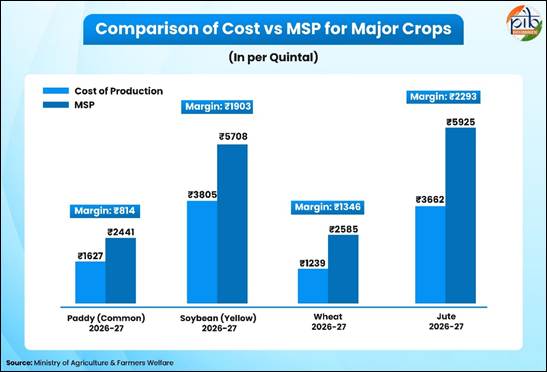
In 2026–27, wheat has a production cost of ₹1,239 per quintal and an MSP of ₹2,585 per quintal, ensuring a ₹1,346 margin. Meanwhile, jute has a production cost of ₹3,662 per quintal and an MSP of ₹5,925 per quintal, providing the highest margin of ₹2,293. These remunerative MSP margins reinforce the objectives of PM-AASHA by strengthening price assurance and improving farmers’ confidence in agricultural markets.
- Overall, MSP consistently exceeds the cost of production across crops and years, and PM-AASHA further strengthens this system by ensuring better price realization for farmers. This highlights a supportive framework that promotes stable income and growth in the agricultural sector.
Strengthening Farm-to-Market Connectivity
The Government has undertaken several initiatives to strengthen agricultural marketing and post-harvest infrastructure, such as AIF and e-NAM.
- The Agriculture Infrastructure Fund (AIF) has sanctioned loans worth ₹96,426 crore for 2,14,437 projects, mobilizing investments exceeding ₹1,66,179 lakh crore.
- The e-NAM platform has integrated 1,656 mandis across 23 States and 4 Union Territories, facilitating trade worth ₹4,94,847 crore.
- It has registered 4,776 FPOs on e-NAM and onboarded 7,334 FPOs onto Open Network for Digital Commerce (ONDC).
- The government has also sanctioned 50,249 warehouses with 992.6 lakh metric tonnes storage capacity alongside 25,081 agricultural marketing infrastructure projects.
- Recent PM-AASHA reforms introduced biometric farmer authentication, direct procurement from pre-registered farmers, transportation support for Tomato, Onion, and Potato (TOP) crops, and price differential payments under the Market Intervention Scheme.
PM-AASHA has emerged as a strong and structured mechanism to support farmers through assured procurement, price stabilization, and effective market interventions. This enables the timely procurement of key crops like pulses, oilseeds, and copra through agencies such as NAFED and NCCF. The establishment of additional procurement centres has further strengthened market access and collective empowerment of farmers.
Infographics: PM-AASHA Scheme: Strengthening MSP-Based Price Support

Answer Writing Practice Question for NABARD Grade A Exam
Q. Minimum Support Price (MSP) is intended to protect farmers from price volatility, but weak market realisation can still lead to distress sales. In this context, discuss the need for the Pradhan Mantri Annadata Aay Sanrakshan Abhiyan (PM-AASHA) and explain how it strengthens the agricultural price-support mechanism (15 Marks | 600 Words)
Agriculture is inherently exposed to price volatility arising from bumper production, market gluts, weak demand, perishability and fluctuations in domestic and international prices. Minimum Support Price (MSP) acts as a safety net by providing a remunerative benchmark to farmers and protecting them against sharp falls in farm prices. However, the effectiveness of MSP depends on actual procurement and market access. When farmers are unable to sell at or near MSP, they may resort to distress sales, particularly immediately after harvest.
In this context, Pradhan Mantri Annadata Aay Sanrakshan Abhiyan (PM-AASHA), launched in September 2018, provides an integrated framework to strengthen price support, reduce distress sales and ensure remunerative returns to farmers while maintaining price stability for consumers.
Understanding MSP and Distress Sale
- Minimum Support Price: MSP is a government-announced price intended to protect agricultural producers against sharp falls in market prices. It is announced on the recommendations of the Commission for Agricultural Costs and Prices (CACP) and provides a price floor for notified crops.
- Distress Sale: Distress sale occurs when farmers are compelled to sell their produce below a remunerative price because of inadequate storage, urgent cash requirements, perishability, debt obligations or weak bargaining power.
- Market Glut: During bumper harvests, increased supply can sharply depress market prices below MSP. Without effective procurement or alternative price-support mechanisms, farmers may have little option but to sell at reduced prices.
Why is PM-AASHA Needed?
- Weak Procurement Coverage: Merely announcing MSP does not guarantee that farmers will actually receive it. PM-AASHA strengthens the institutional mechanisms required for effective price support.
- Protection against Price Crashes: Pulses and oilseeds can experience significant price fluctuations due to changes in domestic production and imports. PM-AASHA provides mechanisms to protect farmers when market prices fall.
- Reducing Distress Sales: Timely procurement and deficiency payments provide farmers with alternatives to selling immediately at depressed market prices.
- Crop Diversification: Stronger price support for pulses and oilseeds can encourage farmers to diversify beyond the rice-wheat dominated cropping pattern, thereby supporting nutritional security and reducing import dependence.
- Consumer Price Stability: Price-support interventions are complemented by buffer-stock and market-intervention mechanisms, helping balance producer interests with consumer affordability.
- Inclusive Price Support: The framework seeks to extend the benefits of MSP implementation to farmers, including small and marginal producers, through better procurement infrastructure and direct payment mechanisms.
How PM-AASHA Strengthens Price Support
- Price Support Scheme (PSS): PSS enables procurement of pulses, oilseeds and copra at MSP when market prices fall below MSP. Procurement is undertaken through agencies such as NAFED and NCCF at the request of States/UTs. Registered farmers with valid land records receive the benefit directly, helping reduce intermediary-related leakages and distress sales.
- Price Stabilization Fund (PSF): PSF addresses price volatility from the consumer side by maintaining buffer stocks of essential commodities such as pulses, onions and potatoes. Commodities can be procured during harvest and released during lean periods to moderate price spikes.
- Price Deficiency Payment Scheme (PDPS): Under PDPS, the government does not physically procure the produce. Instead, eligible farmers receive the difference between MSP and the actual market price, subject to the prescribed limit, directly in their bank accounts. This reduces the need for extensive physical procurement infrastructure while providing MSP protection.
- Market Intervention Scheme (MIS): MIS addresses price crashes in perishable horticultural commodities such as tomatoes, onions and potatoes, which are not covered by MSP. It can be activated when market prices fall substantially and is particularly useful during supply gluts.
- Digital Procurement: Aadhaar-enabled authentication, e-NAM, e-Samriddhi and e-Samyukti have improved transparency, farmer identification, market access and procurement efficiency.
- Financial Support: The PM-AASHA allocation has increased to ₹7,200 crore in 2026–27, demonstrating continued policy emphasis on strengthening price assurance.
MSP provides the price benchmark, while PM-AASHA strengthens the mechanisms through which that assurance can reach farmers. By combining physical procurement, deficiency payments, buffer-stock operations and market intervention, the scheme addresses different dimensions of agricultural price volatility. Going forward, wider procurement infrastructure, better storage, digital integration and greater coverage of farmers and crops can make price support more accessible, efficient and remunerative, thereby reducing distress sales and strengthening farmers’ income security.
Objective Practice Question for NABARD Grade A Exam
Q1. Consider the following statements regarding the procurement limits prescribed under the Price Support Scheme (PSS) component of PM-AASHA:
I. From the 2024-25 procurement year, procurement of pulses, oilseeds and copra is initially permitted up to 25 percent of a State or Union Territory's production.
II. Procurement beyond this initial ceiling may be approved by the Committee of Secretaries, up to 25 percent of national production.
III. To boost domestic pulse output and reduce import dependence, procurement of Tur, Urad and Masur is permitted up to 100 percent of State production.
IV. Eligibility under PSS extends to all cultivating farmers irrespective of registration status, so as to ensure that tenant cultivators without land records are not excluded.
Which of the statements given above are correct?
A) I, II and III only
B) II, III and IV only
C) I, III and IV only
D) I and II only
E) I, II, III and IV
Correct Answer: A
Explanation:
Statement I is correct. The default procurement ceiling under PSS from the 2024-25 procurement year is 25 percent of the production of the concerned State or Union Territory, which caps the fiscal and storage burden while still providing a meaningful market floor.
Statement II is correct. Additional procurement above the initial limit requires approval of the Committee of Secretaries and is capped at 25 percent of national production. Candidates must distinguish the two references clearly: the first ceiling is benchmarked to State production, the second to national production.
Statement III is correct and represents a deliberate policy carve-out. Tur, Urad and Masur enjoy a 100 percent of State production procurement window, since these are the pulses in which India remains import dependent and an unlimited assured market is intended to induce acreage expansion.
Statement IV is incorrect. PSS eligibility is confined to registered farmers with valid land records, an arrangement designed to ensure that the benefit flows directly to the cultivator without intermediaries. The statement inverts this condition and adds an inclusion of unregistered tenant cultivators that does not exist in the scheme design. Aspirants should note the trade-off involved: the registration requirement strengthens leakage control but simultaneously limits access for tenant farmers, a point worth carrying into a descriptive answer on MSP delivery.
Hence only I, II and III hold, making A the answer.
Q2. Which one of the following statements regarding the Price Deficiency Payment Scheme (PDPS) under PM-AASHA is not correct?
A) Under PDPS the produce is not physically procured, and farmers are instead paid the difference between the MSP and the actual market price in the notified market directly into their bank accounts.
B) The payable price difference is subject to a ceiling of 15 percent of the MSP value.
C) The scheme is principally used for oilseeds and reduces the need for large procurement infrastructure.
D) Pre-registered farmers selling oilseeds up to 40 percent of production through a transparent auction process are the designated beneficiaries.
E) A State or Union Territory may operate PSS and PDPS simultaneously for the same oilseed in the same season, so that farmers can choose between physical procurement and deficiency payment.
Correct Answer: E
Explanation:
Option E is the incorrect statement and is therefore the answer. The option available to States and Union Territories is to implement either PSS or PDPS for a particular oilseed for a particular year or season, not both concurrently. The exclusivity is essential to the design, since running physical procurement and deficiency payment for the same crop in the same season would allow a farmer to claim support twice on the same produce and would also distort the market price that serves as the reference for computing the deficiency.
Option A is correct and captures the defining feature of PDPS: it is a compensation-based rather than a procurement-based instrument, with payment routed directly to the farmer's bank account.
Option B is correct. The payment is capped at 15 percent of the MSP value, which limits fiscal exposure when market prices collapse steeply.
Option C is correct. Because no produce is physically lifted, PDPS avoids the warehousing, transport and disposal costs associated with PSS, which is why it suits oilseeds where storage and quality management are demanding.
Option D is correct. Beneficiaries are pre-registered farmers selling oilseeds up to 40 percent of production through a transparent auction process. Note the contrast in coverage limits worth memorising: 25 percent of State production under PSS in general, 100 percent for Tur, Urad and Masur, 40 percent of production under PDPS, and 25 percent of production under the Market Intervention Scheme.
Q3. Consider the following statements about the Market Intervention Scheme (MIS) and the Price Stabilization Fund (PSF) as components of PM-AASHA:
I. MIS is designed for perishable agricultural and horticultural commodities such as tomato, onion and potato that are not covered under MSP, and it is activated when market prices fall by at least 10 percent over the previous normal season's rates.
II. Under MIS, States may opt out of physical procurement and instead pay the differential between the Market Intervention Price and the selling price, subject to coverage of 25 percent of production and a maximum price difference of 25 percent of the MIP.
III. PSF protects consumers from price volatility by maintaining buffer stocks of commodities such as pulses, onions and potatoes, and although merged with PM-AASHA it continues to be managed by the Department of Consumer Affairs.
IV. When market prices exceed MSP, the Department of Consumer Affairs procures pulses at market price using the eSamriddhi portal of NCCF and the eSamyukti portal of NAFED.
Which of the statements given above are correct?
A) I, II and IV only
B) I, III and IV only
C) II, III and IV only
D) I, II and III only
E) I, II, III and IV
Correct Answer: D
Explanation:
Statement I is correct. MIS addresses the price risk of perishables outside the MSP framework, with the TOP crops as the archetypal cases, and the trigger is a fall of at least 10 percent over the previous normal season's rates. It is especially relevant in glut situations where supply outruns demand.
Statement II is correct. The differential payment route under MIS mirrors the logic of PDPS by dispensing with physical procurement, and it carries a twin restriction: coverage limited to 25 percent of production and the price difference capped at 25 percent of the Market Intervention Price. MIS operates through cost sharing between the Centre and the States for operations undertaken by Central Nodal Agencies such as NAFED and NCCF.
Statement III is correct. PSF works on the consumer side of the price band, building buffer stocks during harvest and releasing them in the lean season to check price spikes. Its administrative anchoring in the Department of Consumer Affairs, even after merger with PM-AASHA, is the key institutional distinction from the producer-side components administered on the agriculture side.
Statement IV is incorrect because the portals are attributed to the wrong agencies. The eSamriddhi portal belongs to NAFED and the eSamyukti portal belongs to NCCF. The operational proposition, that DoCA procures pulses at market price when prices exceed MSP, is otherwise accurate, but the swapped attribution renders the statement false. This kind of portal-to-agency mapping is a favoured NABARD trap, so the association should be memorised as a pair.
Hence I, II and III are correct, making D the answer.
Q4. Consider the following statements based on the MSP and cost of production data for 2026-27:
I. Among paddy (common), soybean (yellow), wheat and jute, the crop with the highest absolute margin of MSP over cost of production is jute.
II. Wheat records a higher margin as a percentage of its cost of production than soybean (yellow).
III. Paddy (common) records the lowest absolute margin among the four crops, and its MSP is less than 1.5 times its cost of production.
Which of the statements given above is/are correct?
A) I only
B) I and III only
C) II and III only
D) I and II only
E) I, II and III
Correct Answer: B
Explanation:
Statement I is correct. Jute has a cost of ₹3,662 per quintal against an MSP of ₹5,925 per quintal, giving a margin of ₹2,293, which is the highest of the four. The other margins are soybean (yellow) at ₹1,903 (cost ₹3,805, MSP ₹5,708), wheat at ₹1,346 (cost ₹1,239, MSP ₹2,585) and paddy (common) at ₹814 (cost ₹1,627, MSP ₹2,441).
Statement II is incorrect and is the analytical core of the question. Expressed as a percentage of cost, wheat's margin is ₹1,346 on a cost of ₹1,239, which is roughly 109 percent. Soybean's margin is ₹1,903 on a cost of ₹3,805, which is almost exactly 50 percent. Wheat therefore records a higher, not lower, percentage margin than soybean, so the statement as framed is reversed. Candidates should note that absolute margin and percentage margin can rank crops very differently: soybean's absolute margin exceeds wheat's, yet wheat delivers the far better return over cost.
Statement III is correct on both limbs. Paddy (common) has the smallest absolute margin at ₹814, and its MSP to cost ratio is 2,441 divided by 1,627, which is about 1.50 but marginally below it, since 1.5 times 1,627 equals 2,440.5 and the MSP is 2,441. Working strictly from the ratio, paddy sits essentially at the 1.5 times mark and clearly below the ratios for wheat (about 2.09), jute (about 1.62) and soybean (1.50). The broader inference for a Mains answer is that MSP consistently exceeds the cost of production across crops, but the extent of the cushion varies widely, which has implications for cropping pattern signals.
Since only I and III hold, B is the answer.
Q5. Consider the following statements regarding PM-AASHA's budgetary trajectory and the supporting marketing infrastructure:
I. The budget allocation for PM-AASHA rose from an actual expenditure of ₹5,437.99 crore in 2024-25 to ₹6,941.36 crore in 2025-26 and further to ₹7,200.00 crore in 2026-27, with the percentage increase in 2026-27 over the preceding year being smaller than that in 2025-26 over 2024-25.
II. The existing Government guarantee to lender banks, extended so that Central Nodal Agencies can avail cash credit facilities for procurement operations, has been renewed and enhanced to ₹45,000 crore.
III. PSS is implemented on the request of States and Union Territories that agree to exempt the procurement from levy of mandi tax in the interest of farmers.
IV. Under the e-NAM platform, 1,656 mandis have been integrated across 23 States and 4 Union Territories, and 4,776 FPOs have been registered on e-NAM.
Which of the statements given above are correct?
A) I, II and III only
B) II, III and IV only
C) I, III and IV only
D) I, II and IV only
E) I, II, III and IV
Correct Answer: E
Explanation:
All four statements are correct, making E the answer.
Statement I is correct and requires a two-step computation. The rise from ₹5,437.99 crore to ₹6,941.36 crore is an increase of about ₹1,503 crore, roughly 27.6 percent. The subsequent rise from ₹6,941.36 crore to ₹7,200.00 crore is about ₹259 crore, roughly 3.7 percent. The 2026-27 increment is therefore far smaller in percentage terms, indicating a consolidation year after a sharp step-up. Candidates should note that the 2024-25 figure is actual expenditure, whereas the later figures are allocations, so the comparison is not strictly like for like, a nuance worth flagging in a descriptive answer.
Statement II is correct. The Central Government provides a guarantee to lender banks so that Central Nodal Agencies can draw cash credit for procurement operations, and this guarantee has been renewed and enhanced to ₹45,000 crore. This is the working capital backbone of PSS, since agencies such as NAFED and NCCF must pay farmers before the procured stock is disposed of.
Statement III is correct. PSS operates on the request of the State or Union Territory concerned, subject to the State agreeing to exempt the transaction from mandi tax, so that the levy does not erode the effective price realised by the farmer.
Statement IV is correct. e-NAM integration stands at 1,656 mandis across 23 States and 4 Union Territories with trade facilitated worth ₹4,94,847 crore, 4,776 FPOs registered on e-NAM and 7,334 FPOs onboarded onto the Open Network for Digital Commerce.
Related infrastructure data worth retaining: the Agriculture Infrastructure Fund has sanctioned loans of ₹96,426 crore for 2,14,437 projects, and 50,249 warehouses with 992.6 lakh metric tonnes of storage capacity have been sanctioned alongside 25,081 agricultural marketing infrastructure projects. Recent PM-AASHA reforms include biometric farmer authentication, direct procurement from pre-registered farmers, transportation support for TOP crops and price differential payments under MIS.
Source: PIB
*****
