

The e-Shram Portal completes five years on 26 August 2026, marking a significant milestone in strengthening social security for India's unorganised workforce. Launched in 2021 by the Ministry of Labour and Employment, it created the country's first-ever Aadhaar-seeded National Database of Unorganised Workers.
It gives every registered worker a unique Universal Account Number and has evolved into a one-stop digital platform integrating welfare, jobs, skilling, apprenticeship and pension services. With over 31.89 crore registrations, e-Shram has improved benefit delivery, portability and evidence-based policymaking. It advances the Government's vision of an inclusive, technology-driven social security ecosystem.

Empowering India's Unorganised Workforce
As India advances towards the vision of Viksit Bharat, empowering its vast workforce remains central to inclusive and sustainable growth. The unorganised sector comprises a diverse range of workers, including agricultural labourers, construction workers, domestic workers, street vendors, migrant workers, gig and platform workers, and many others. Together, they form a vital pillar of India’s workforce and economy. Ensuring their access to social security and welfare has therefore remained a key priority of the Government.
Building on this commitment, the e-Shram Portal was launched on 26 August 2021, and completes 5 years since then. It marks an important milestone in India's efforts to build a comprehensive social security ecosystem for unorganised workers.
The Vision Behind e-Shram
The e-Shram Portal, developed by the National Informatics Centre (NIC), created the country's first Aadhaar authenticated National Database of Unorganised Workers (NDUW).It provides every registered worker with a unique 12-digit Universal Account Number (UAN). The key objectives include:
- Improve delivery of social security services by enabling the convergence of welfare schemes across Ministries and Departments.
- Facilitate secure sharing of worker data with government agencies through APIs. This supports the effective delivery of welfare schemes and evidence-based policymaking.
- Facilitate nationwide access and portability of social security and welfare benefits for migrant and construction workers.
- Create a comprehensive national database that supports timely planning and response during national emergencies and crises.
"Unorganised worker" includes a home-based worker, self-employed worker, or a wage worker in the unorganised sector. It also includes a worker in the organised sector who is not a member of ESIC/ EPFO/ Government Employee.
Evolution into a One-Stop Solution
The e-Shram portal transformed from a worker registry into a unified service delivery platform with the launch of the e-Shram One-Stop Solution on 21 October 2024. It now integrates welfare, employment, skilling and pension services. This aligns with the Union Budget 2024–25 vision of delivering a wide range of labour services through a single digital platform. Registered workers can access eligible schemes and view benefits already received. The platform also promotes convergence across government portals. It strengthens access to social security and improves service delivery for unorganised workers.
- The One-Stop Solution brings together 15 Social Security and Welfare Schemes on a single platform. These include Pradhan Mantri Shram Yogi Maan-Dhan Yojana (PM-SYM), Pradhan Mantri Suraksha Bima Yojana (PMSBY), Pradhan Mantri Jeevan Jyoti Bima Yojana (PMJJBY), National Social Assistance Programme (NSAP), One Nation One Ration Card (ONORC), Pradhan Mantri Awaas Yojana–Gramin (PMAY-G) and others.
- eShram registrants can conveniently enrol in the Pradhan Mantri Suraksha Bima Yojana (PMSBY) and Pradhan Mantri Jeevan Jyoti Bima Yojana (PMJJBY) through the eShram portal. Under PMSBY, workers are eligible for accidental insurance benefits of ₹2 lakh for accidental death or permanent disability and ₹1 lakh for partial disability. PMJJBY provides a life insurance cover of ₹2 lakh in the event of death due to any cause.
- The portal connects workers with the National Career Service (NCS) for employment opportunities. It also provides access to the Skill India Digital Hub for skilling and apprenticeship. Workers can also use myScheme to identify government schemes for which they may be eligible.
- Through the portal, eligible workers can enrol in the Pradhan Mantri Shram Yogi Maan-Dhan (PM-SYM) Scheme, which offers a minimum assured pension of ₹3,000 per month upon attaining the age of 60 years, subject to eligibility.
- Powered by the Bhashini platform, multilingual functionality in 22 languages was introduced in 2025.
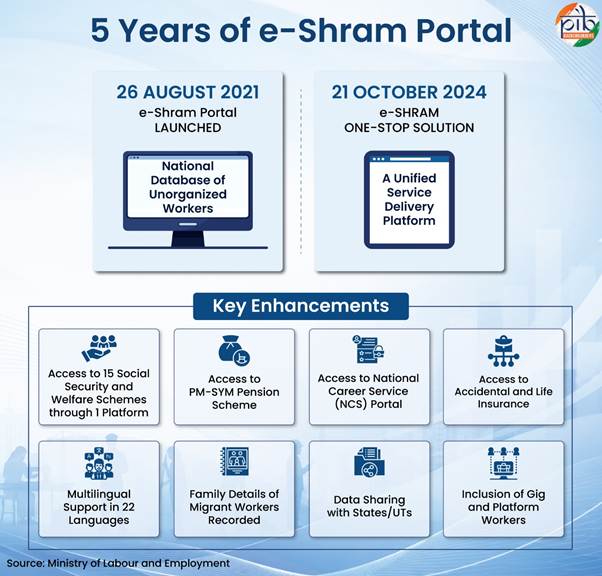
- The portal includes a provision to capture the family details of migrant workers.
- It enables sharing of construction workers' data with States and Union Territories. This facilitates their registration with the respective Building and Other Construction Workers (BOCW) Boards.
- eShram provides a platform for the identification and registration of gig and platform workers as part of the national database of unorganised workers.
- As of date, around 11.5 lakh platform workers have registered on the portal. This database may support the formulation and implementation of suitable social security and welfare measures for such workers.
e-Shram Registration: Eligibility and Process
- Registration on the e-Shram Portal is simple, accessible and a one-time process.
- Eligibility: Any worker aged 16 years and above, engaged in the unorganised sector, is eligible to register on the e-Shram Portal. A worker must not be an income tax-payer or a member of the Employees' Provident Fund Organisation (EPFO) or the Employees' State Insurance Corporation (ESIC).
- Coverage: The portal covers a wide range of unorganised workers. These include construction workers, migrant workers, gig and platform workers, street vendors, domestic workers, agricultural workers, and other unorganised workers.
- How to register: Workers can register by visiting the e-Shram Portal. They can also register through the nearest Common Service Centre (CSC) or State Seva Kendra. State Government field officers also facilitate registration at the district and sub-district levels.
- Registration cost: Registration on the e-Shram Portal is completely free of cost. Workers are not required to pay any fee to any registering agency or service provider.
- Required Documents: Registration requires their Aadhaar number (for Aadhar eKYC) and a mobile number (preferably linked with Aadhaar).
Growing Coverage of India's Unorganised Workforce
Registrations on e-Shram portal over the past 5 years reflects broad participation across genders, age groups, occupations and States (as on 18 August, 2026).
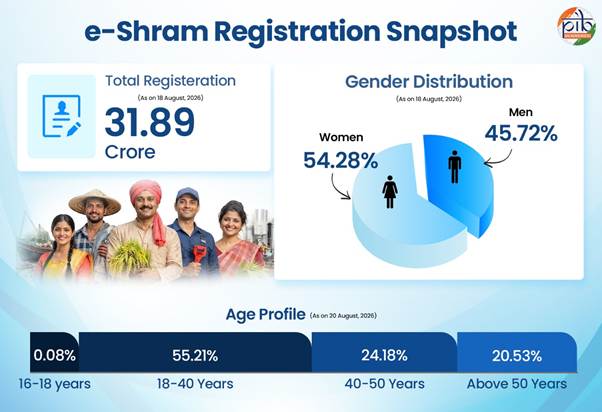
- Total registrations: The portal has recorded 31.89 crore registrations.
- Gender distribution: Women account for 54.28% of registered workers, while men account for 45.72%.
- Age profile: 0.08% are aged 16-18 years, 55.21% of registered workers are aged 18–40 years, 24.18% are aged 40–50 years and 20.53% are above 50 years (as on 20 August, 2026).
- Top occupational categories: Agriculture, Domestic and Household Workers, Construction, and Apparel account for the highest registrations.
- Top States: Uttar Pradesh, Bihar, West Bengal, Madhya Pradesh, and Maharashtra have recorded the highest registrations.
- Mode of registration: Most registrations have been completed through Common Service Centres (CSCs), followed by self-registration.
Infographics Based on 5 Years of e-Shram Portal: Building an Inclusive Social Security Ecosystem

NABARD Grade A | ESI/ARD Answer Writing
Q. The unorganised sector is a vital pillar of India’s economy and provides livelihood to a large section of the workforce, particularly in rural and vulnerable communities. Discuss the significance and major challenges of the unorganised sector in India. Also, examine the key government initiatives for its welfare and explain how the e-Shram Portal is facilitating its integration into the formal social security and economic system. (15 Marks | 600 Words)
The unorganised sector constitutes a vital pillar of India’s economy, providing employment and livelihoods to a large and diverse workforce, including agricultural labourers, construction workers, domestic workers, street vendors, migrant workers, gig and platform workers. Despite its economic importance, workers in this sector often face limited access to social security, formal credit, insurance, pensions and stable employment. Therefore, integrating the unorganised workforce with formal economic and social security systems is essential for inclusive growth and the vision of Viksit Bharat.
Significance of the Unorganised Sector in India
I. Major source of employment: It provides livelihood opportunities to a large section of India’s workforce, particularly workers with limited formal education and skills.
II. Rural livelihood and poverty reduction: Agricultural labour, construction, small-scale activities and self-employment provide important sources of income for rural and low-income households.
III. Economic contribution: Street vendors, domestic workers, artisans, small producers and other informal enterprises contribute significantly to production, consumption, services and local economic activity.
IV. Support to vulnerable communities: The sector provides employment opportunities to women, migrants and economically vulnerable groups who may otherwise have limited access to formal employment.
V. Link with inclusive growth: Improving productivity, income security and access to finance for these workers can reduce vulnerability and promote broader participation in economic growth.
Major Challenges Faced by the Unorganised Sector
I. Limited social security: Workers often lack adequate access to pension, insurance, healthcare and other welfare benefits.
II. Income and employment insecurity: Informal workers are vulnerable to irregular employment, low wages and sudden loss of livelihood.
III. Limited access to formal finance: Lack of formal documentation, collateral and stable income can restrict access to institutional credit.
IV. Migrant vulnerability: Migrant workers may face difficulties in accessing welfare benefits when they move across States.
V. Digital and institutional exclusion: Lack of awareness, digital access and fragmented delivery of welfare schemes can prevent eligible workers from receiving benefits.
Key Government Initiatives
The Government has undertaken several initiatives to improve the economic and social security of unorganised workers. PM Jan Dhan Yojana (PMJDY) has expanded access to formal banking, Direct Benefit Transfer, insurance, pensions and need-based credit. Pradhan Mantri Shram Yogi Maan-Dhan (PM-SYM) provides a minimum assured pension of ₹3,000 per month after attaining 60 years, subject to eligibility. Insurance schemes such as PMSBY and PMJJBY, along with initiatives relating to skill development, employment and financial inclusion, further strengthen the social security framework.
The e-Shram Portal, launched on 26 August 2021, represents an important step towards bringing these dispersed workers into a common institutional framework.
How e-Shram is Integrating the Unorganised Workforce
I. National database: e-Shram created India's first Aadhaar-authenticated National Database of Unorganised Workers (NDUW) and provides registered workers with a unique 12-digit Universal Account Number (UAN).
II. One-stop social security platform: The e-Shram One-Stop Solution, launched on 21 October 2024, integrates welfare, employment, skilling, apprenticeship and pension services. It brings together 15+ social security and welfare schemes on a single platform.
III. Portability and migrant support: The platform facilitates nationwide access and portability of social security benefits and captures family details of migrant workers. Construction-worker data can also be shared with States and UTs for registration with BOCW Boards.
IV. Employment and skilling: e-Shram connects workers with the National Career Service, Skill India Digital Hub and apprenticeship opportunities, thereby linking social security with employment and skill development.
V. Inclusion of emerging workers: The portal also facilitates identification and registration of gig and platform workers, with around 11.5 lakh platform workers registered as stated in the provided source.
In conclusion, the unorganised sector is indispensable for employment generation, rural livelihoods and inclusive economic growth, but its workers remain vulnerable because of informality and fragmented access to welfare. Government initiatives such as PMJDY, PM-SYM, insurance schemes and, most importantly, e-Shram are helping create an integrated social security ecosystem. With 31.89 crore registrations as of August 2026, e-Shram can serve as a foundation for portable welfare, better employment opportunities, evidence-based policymaking and greater formalisation of India’s unorganised workforce.
NABARD Grade A (Phase II) / RBI Grade B: Mains Level MCQ Set
Topic: e-Shram Portal and Social Security for Unorganised Workers
Q1. Consider the following statements regarding the origin and institutional design of the e-Shram Portal:
I. The portal was launched on 26 August 2021 by the Ministry of Labour and Employment and was developed by the National Informatics Centre.
II. It created the country's first Aadhaar-authenticated National Database of Unorganised Workers, providing every registered worker with a unique 12-digit Universal Account Number.
III. Among its stated objectives is the facilitation of secure sharing of worker data with government agencies through APIs, supporting effective welfare delivery and evidence-based policymaking.
IV. The definition of "unorganised worker" adopted for the portal is confined to home-based workers, self-employed workers and wage workers in the unorganised sector, and excludes any worker employed in the organised sector.
Which of the statements given above are correct?
A) I, II and III only
B) II, III and IV only
C) I, III and IV only
D) I and II only
E) I, II, III and IV
Correct Answer: A
Explanation:
Statement I is correct on the launch date, the administering ministry and the developing agency. The Ministry of Labour and Employment is the nodal ministry, while NIC provided the technical architecture.
Statement II is correct. The database is Aadhaar-authenticated, and the UAN issued to each worker is a 12-digit number. Aspirants should note that this 12-digit UAN under e-Shram is distinct from the Universal Account Number under EPFO, and the two systems are in fact mutually exclusive in their target population.
Statement III is correct. API-based secure data sharing is what makes the database usable by other ministries and departments, and it underpins the objective of convergence of welfare schemes. The other stated objectives are improved delivery of social security services, nationwide portability of benefits for migrant and construction workers, and creation of a database supporting timely planning and response during national emergencies and crises. The last of these traces directly to the migrant crisis experience that exposed the absence of any national registry of unorganised workers.
Statement IV is incorrect and is the key trap. The definition expressly includes a worker in the organised sector who is not a member of ESIC, EPFO or a Government employee. The classification therefore turns on social security status rather than sector of employment: a worker employed in an organised-sector establishment but outside the statutory social security net is treated as unorganised for this purpose. This is a conceptually important point, since it reframes "unorganised" as a coverage category rather than a sectoral one.
Hence I, II and III are correct, making A the answer.
Q2. Case Study: A Common Service Centre operator in a district of Bihar receives five persons seeking registration on the e-Shram Portal:
- Applicant P: an agricultural labourer aged 17 years, not an income tax payer, not a member of EPFO or ESIC
- Applicant Q: a domestic worker aged 34 years who files an income tax return every year
- Applicant R: a construction worker aged 45 years, an active member of ESIC through a previous employer
- Applicant S: a street vendor aged 58 years, not an income tax payer, not covered by EPFO or ESIC
- Applicant T: a gig worker aged 15 years engaged with a food delivery platform
Assuming all applicants possess Aadhaar and a mobile number, which of them are eligible to register on the e-Shram Portal?
A) P, S and T only
B) P and S only
C) S only
D) P, Q and S only
E) P, R and S only
Correct Answer: B
Explanation:
Eligibility on e-Shram rests on one positive condition and three negative conditions. The positive condition is that the worker must be aged 16 years and above and engaged in the unorganised sector. The negative conditions are that the worker must not be an income tax payer, must not be a member of EPFO, and must not be a member of ESIC.
Applicant P is 17 years old, which satisfies the 16-and-above threshold, and clears all three negative conditions. Eligible. Note that the age profile data confirms this cohort exists on the portal, with 0.08 per cent of registrants aged 16 to 18 years.
Applicant Q fails on the income tax condition. Filing an income tax return as a tax payer disqualifies the applicant regardless of occupation, since the scheme is designed for workers outside the formal income and social security net.
Applicant R fails on ESIC membership. The occupation as a construction worker is squarely within the covered categories, but active ESIC membership means the worker already has statutory social security and is therefore outside the e-Shram universe.
Applicant S is 58 years old, and since there is no upper age limit prescribed, and all three negative conditions are cleared, the applicant is eligible. The age profile data supports this, with 20.53 per cent of registrants above 50 years.
Applicant T fails on age. At 15 years the applicant is below the 16-year threshold, and gig and platform workers, though expressly covered as a category with around 11.5 lakh already registered, must still satisfy the age condition.
Only P and S qualify, making B the answer.
Q3. With reference to the e-Shram One-Stop Solution, which one of the following statements is not correct?
A) The One-Stop Solution was launched on 21 October 2024, transforming the portal from a worker registry into a unified service delivery platform aligned with the Union Budget 2024-25 vision.
B) It brings together 15 social security and welfare schemes on a single platform, including PM-SYM, PMSBY, PMJJBY, NSAP, ONORC and PMAY-G.
C) The portal connects workers with the National Career Service for employment opportunities and with the Skill India Digital Hub for skilling and apprenticeship, while myScheme helps workers identify schemes for which they may be eligible.
D) Multilingual functionality in 22 languages, introduced in 2025, is powered by the Bhashini platform.
E) Registered workers can view schemes for which they are eligible, but the platform does not display benefits already received, since disbursement records are held exclusively by the implementing ministries.
Correct Answer: E
Explanation:
Option E is the incorrect statement and is therefore the answer. Registered workers can access eligible schemes and view benefits already received. This "benefits received" view is not a cosmetic feature: it converts the portal from a discovery tool into an accountability instrument, since a worker who can see what has and has not reached them is in a position to pursue entitlements that have lapsed. It also reflects the underlying convergence architecture, in which data flows back from implementing ministries through APIs rather than remaining siloed.
Option A is correct. The 21 October 2024 launch marks the second phase in the portal's evolution, the first being the 26 August 2021 creation of the registry itself. Aspirants should hold both dates.
Option B is correct on the count of 15 schemes and on the named examples, which span pension (PM-SYM), insurance (PMSBY and PMJJBY), social assistance (NSAP), food security (ONORC) and housing (PMAY-G). The spread across ministries is precisely what makes convergence the operative concept.
Option C is correct. The portal's integration extends beyond welfare into livelihood, linking employment through NCS, skilling and apprenticeship through the Skill India Digital Hub, and scheme discovery through myScheme.
Option D is correct. Bhashini-powered multilingual support in 22 languages was introduced in 2025, addressing the language barrier that would otherwise exclude much of the target population from self-service access.
Q4. Case Study: A policy analyst studying e-Shram registration data as on 18 to 20 August 2026 records the following:
- Total registrations: 31.89 crore
- Gender distribution: women 54.28 per cent, men 45.72 per cent
- Age profile: 0.08 per cent aged 16 to 18 years, 55.21 per cent aged 18 to 40 years, 24.18 per cent aged 40 to 50 years, 20.53 per cent above 50 years
- Platform workers registered: around 11.5 lakh
Consider the following statements:
I. The number of women registered on the portal exceeds the number of men by more than 2.5 crore.
II. Registered workers aged above 40 years together constitute less than 45 per cent of all registrations.
III. Registered platform workers constitute less than 0.05 per cent of total registrations.
Which of the statements given above are correct?
A) I and II only
B) II and III only
C) I and III only
D) I, II and III
E) I only
Correct Answer: D
Explanation:
All three statements are correct, making D the answer.
Statement I is correct. The gender gap in percentage terms is 54.28 minus 45.72, that is 8.56 percentage points. Applied to 31.89 crore registrations, this gives 0.0856 multiplied by 31.89 crore, that is approximately 2.73 crore, which exceeds 2.5 crore. The female majority is analytically significant, since it mirrors the pattern seen in PM-JDY accounts and indicates that digital registration drives have been more successful in reaching women than earlier paper-based welfare enrolment.
Statement II is correct. Workers aged above 40 comprise the 40 to 50 cohort at 24.18 per cent plus the above-50 cohort at 20.53 per cent, that is 44.71 per cent, which is below 45 per cent. Correspondingly, workers aged 18 to 40 at 55.21 per cent constitute the clear majority, which is consistent with the concentration of unorganised employment in the prime working-age population.
Statement III is correct and requires a unit conversion. Total registrations of 31.89 crore equal 3,189 lakh. Platform workers at 11.5 lakh therefore represent 11.5 divided by 3,189, that is approximately 0.036 per cent, which is below 0.05 per cent. This figure deserves comment in a descriptive answer: gig and platform workers are among the most policy-visible categories under discussion for social security extension, yet their registered share on e-Shram remains marginal, which points to a gap between the policy salience of the category and its actual capture in the national database.
Supplementary data worth retaining: the top occupational categories are Agriculture, Domestic and Household Workers, Construction and Apparel; the top States by registration are Uttar Pradesh, Bihar, West Bengal, Madhya Pradesh and Maharashtra; and most registrations have been completed through Common Service Centres, followed by self-registration.
Q5. Consider the following statements regarding the benefits and linkages available to e-Shram registrants:
I. Through the portal, eligible workers can enrol in the Pradhan Mantri Shram Yogi Maan-Dhan Yojana, which offers a minimum assured pension of ₹3,000 per month on attaining 60 years of age.
II. Under PMSBY, e-Shram registrants are eligible for accidental insurance benefits of ₹2 lakh for accidental death or permanent disability and ₹1 lakh for partial disability, while PMJJBY provides life insurance cover of ₹2 lakh in the event of death due to any cause.
III. The portal enables sharing of construction workers' data with States and Union Territories to facilitate their registration with the respective Building and Other Construction Workers Boards.
IV. Registration on the portal is a one-time process, is free of cost, and requires only the Aadhaar number for eKYC and a mobile number.
Which of the statements given above are correct?
A) I, II and III only
B) II, III and IV only
C) I, III and IV only
D) I, II and IV only
E) I, II, III and IV
Correct Answer: E
Explanation:
All four statements are correct, making E the answer.
Statement I is correct. PM-SYM is the pension arm of the e-Shram ecosystem, offering a minimum assured pension of ₹3,000 per month from age 60, subject to eligibility. Candidates should distinguish this from the Atal Pension Yojana, which provides a guaranteed pension in the range of ₹1,000 to ₹5,000 and is not restricted to unorganised workers in the same manner.
Statement II is correct on the coverage structure of both insurance schemes. Note the internal logic: PMSBY has a three-tier payout (₹2 lakh for accidental death or permanent disability, ₹1 lakh for partial disability), whereas PMJJBY pays a single sum of ₹2 lakh but on death due to any cause, not only accident. The two are complementary rather than duplicative, which is why registrants are enabled to enrol in both through the portal.
Statement III is correct and represents one of the more practically consequential features. Construction workers form a distinct statutory constituency under the BOCW framework, with State-level Boards holding cess-funded welfare corpora. Data sharing from e-Shram to States enables these workers to be enrolled with the relevant Board, which is where their statutory entitlements actually reside. This is a good illustration of the portability objective in operation.
Statement IV is correct on all three limbs. Registration is one-time, entirely free of cost with no fee payable to any registering agency or service provider, and the documentary requirement is limited to the Aadhaar number for eKYC and a mobile number, preferably Aadhaar-linked. The minimal documentation is itself a design decision, since documentary burden was historically the principal exclusion mechanism for unorganised workers. Registration can be completed at the portal, at a Common Service Centre or State Seva Kendra, or with the assistance of State Government field officers at district and sub-district levels.
For a descriptive answer, the closing point is that e-Shram illustrates the shift in Indian social protection from scheme-by-scheme enrolment to identity-led convergence: the worker registers once, receives a portable identifier, and the identifier becomes the key through which welfare, employment, skilling, insurance and pension services are accessed.
Source: PIB
