

India's young and dynamic workforce is one of its greatest strengths. It offers a unique opportunity to drive economic growth and deliverthe vision of Viksit Bharat 2047. Millions of young people enter the labour market each year. Expanding formal employment with social security is essential to transform this demographic advantage into sustained and inclusive development.
Quality employment is central to inclusive growth. The Pradhan Mantri Viksit Bharat Rojgar Yojana (PM-VBRY) supports this vision by encouraging first-time employment and incentivising employers to create new formal jobs. Through an EPFO-linked, technology-driven framework, the scheme promotes workforce formalisation, expands social security coverage and strengthens financial security for workers.

Turning Opportunity into Employment
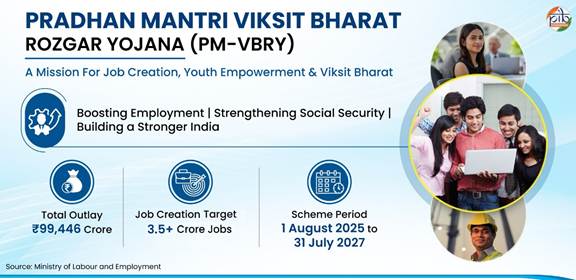
Announced in August 2025, PM-VBRY is being implemented over a two-year period from 1 August 2025 to 31 July 2027, with an outlay of ₹99,446 crore. On 1 August 2026, the scheme completes one year of implementation, marking an important milestone in India's efforts to expand formal employment and social security coverage.
PM-VBRY aims to generate employment for over 3.5 crore people, including 1.92 crore first-time employees. The scheme encourages young people to enter the organised workforce through EPFO registration. It also expands social security coverage across various sectors, particularly labour-intensive manufacturing. It complements the National Manufacturing Mission by promoting employment in new and expanding industries.
A Win-Win for Employees and Employers
At the heart of PM-VBRY is a two-part incentive framework, with distinct provisions for employees and employers.
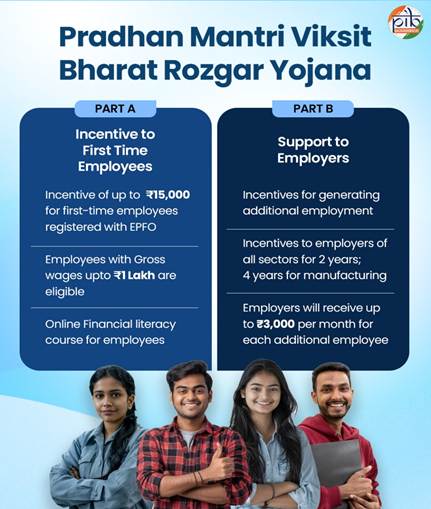
Part A: Incentive to First-Time Employees
- First-time employees earning up to ₹1,00,000 per month are eligible for this part.
- They receive a one-time incentive equivalent to one month's EPF wage, capped at ₹15,000.
- The incentive is paid in two instalments.
- The first is paid after six months of service and the second after twelve months of continuous service, following completion of a financial literacy programme.
- A portion of the incentive is invested in a designated savings instrument, encouraging financial security and savings. It can be withdrawn by the employee at a later date.
- The incentives to the employees shall be paid through Direct Benefit Transfer using the Aadhaar Bridge Payment System to their Aadhaar-seeded bank accounts.
- The incentive shall be disbursed within 45 days after fulfilling the eligibility condition and filing of the paid Electronic Challan-cum-Return (ECR).
Part B: Support to Employers
- Employers are eligible for incentives for employees with salaries of up to ₹1,00,000 per month.
- Employers receive up to ₹3,000 per month for two years for every eligible additional employee retained for at least six months.
- The support lowers hiring costs and encourages sustained employment generation.
- For the manufacturing sector, incentives are extended to the third and fourth year
sas well, owing to high employment generation potential. - For additional employees with an Employees' Provident Fund wage less than or equal to ₹10,000/-, the benefit to the employer is up to ₹1,000/- per additional employment per month.
- For additional employees with an Employees' Provident Fund wage greater than ₹10,000/- and up to ₹20,000/-, the benefit is ₹2,000/- per additional employment per month.For additional employees with an Employees' Provident Fund wage greater than ₹20,000/- and up to ₹1,00,000/-, the benefit is ₹3,000/- per additional employment per month.The benefits will be provided to all eligible establishments on a six-monthly lump-sum basis after the filing of six completed months' Electronic Challan-cum-Returns.
- Conditions
- The employer must fulfill the threshold limit continuously, generating at least 2 additional employments with a baseline of less than 50, and at least 5 additional employments with a baseline of 50 or above.
- The first-time employee must successfully complete the mandatory Financial Literacy Course available through the Employees' Provident Fund Organisation Employee portal to receive the second installment.
- The benefits to the employer will not accrue for any month in which the employer is not eligible as per the threshold criteria laid out in the Scheme.
Eligibility Criteria:
- The applicant must not have been a contributing member of the Employees' Provident Fund Organisation or an Exempted Trust prior to the commencement of the scheme.
- The applicant must join an establishment during the scheme registration period from 01.08.2025 to 31.07.2027.
- The applicant must have their Universal Account Number authenticated by Face Authentication Technology on the UMANG Application.
- The applicant must have gross wages up to ₹1,00,000/- per month at the time of joining the establishment.
- The applicant must have Electronic Challan-cum-Returns along with contributions filed for six continuous months.
- The applicant must continue with the same establishment for the entire period of six months if they are employed in a seasonal industry.
- The applicant must have a previous contributory membership of the Employees' Provident Fund.
- The applicant must join an establishment registered with the Employees' Provident Fund Organisation or an exempted trust during the scheme registration period.
- The applicant must have a Universal Account Number, which is Aadhaar-authenticated using biometric or face authentication technology.
- The applicant must be covered under the Employees' Provident Funds and Miscellaneous Provisions Act, 1952.
- The applicant must have a unique Permanent Account Number.
- The applicant must file the Electronic Challan-cum-Return along with contributions regularly.
- The applicant must generate additional employment meeting the threshold of at least 2 additional employments if their baseline is less than 50.
- The applicant must generate additional employment meeting the threshold of at least 5 additional employments if their baseline is 50 or above.
- The applicant must provide details of their Permanent Account Number, Goods and Services Tax Network, and a Permanent Account Number linked Bank Account Number.
- The applicant must not be an old employee who joined the establishment before 01.08.2025.
- The applicant must not have pending inquiries under Section 7A, 7B, or 7C of the Employees' Provident Funds and Miscellaneous Provisions Act, 1952.
- The applicant must not have a First Information Report filed against them by the Employees' Provident Fund Organisation for fraudulent practices.
- The applicant must not have pending or decided inquiries relating to irregularities under the Atmanirbhar Bharat Rojgar Yojana scheme.
PMVBRY’s IMPACT
Within its first year, PM-VBRY has strengthened workforce formalisation by encouraging first-time hiring and expanding social security coverage. The scheme is helping bring more workers into the organised sector while encouraging employers to create new jobs across industries.
- Over 72 lakh first-time employees have joined the formal workforce since August 2025.
- Nearly 30% of beneficiaries are women, promoting greater female participation in formal employment.
- More than 15 lakh beneficiaries have already received employment-linked incentives under the scheme.
- By linking employment with EPFO registration and direct benefit transfers, PM-VBRY is strengthening India's organised labour market and creating a more secure talent pool.
Infographics: PM-VBRY Scheme: Expanding Formal Employment

Objective Practice Question for RBI Grade B, NABARD Grade A Exam
Q1. Consider the following statements regarding Part A of PM-VBRY, which provides incentives to first-time employees:
I. The incentive is equivalent to one month's EPF wage, subject to a ceiling of ₹15,000, and is released in two instalments.
II. The first instalment is payable after six months of service and the second after twelve months of continuous service, the latter being contingent on completion of a financial literacy programme.
III. The incentive is to be disbursed within 30 days of fulfilment of the eligibility condition and filing of the paid Electronic Challan-cum-Return.
IV. Payment is made through Direct Benefit Transfer using the Aadhaar Bridge Payment System into the employee's Aadhaar-seeded bank account.
Which of the statements given above are correct?
A) I and II only
B) II, III and IV only
C) I, II and IV only
D) I, III and IV only
E) I, II, III and IV
Correct Answer: C
Explanation:
Statement I is correct. The first-time employee receives a one-time incentive equal to one month's EPF wage, capped at ₹15,000, split into two instalments. The cap means that an employee whose EPF wage exceeds ₹15,000 does not receive a proportionately larger benefit, so the incentive is progressively weighted towards lower wage entrants.
Statement II is correct. The staggering of payments at six months and twelve months is a retention device, since it rewards continuity rather than mere entry into the workforce. The second instalment additionally requires successful completion of the mandatory Financial Literacy Course available through the EPFO employee portal, which links the cash benefit to a capability-building condition.
Statement III is incorrect. The prescribed disbursal window is 45 days, not 30 days, counted after fulfilment of the eligibility condition and filing of the paid Electronic Challan-cum-Return.
Statement IV is correct. Disbursal is through DBT using the Aadhaar Bridge Payment System into Aadhaar-seeded accounts, which is what makes the scheme's leakage control comparable to other DBT-based transfers.
A further design feature worth retaining is that a portion of the incentive is parked in a designated savings instrument, withdrawable by the employee at a later date, so that the scheme promotes savings behaviour and not only immediate income support.
Hence I, II and IV are correct, making C the answer.
Q2. Case Study: M/s Sundaram Auto Components, a manufacturing establishment covered under the EPF and Miscellaneous Provisions Act, 1952, satisfies all threshold and documentation conditions under PM-VBRY. During a given six-month period it retains three eligible additional employees whose monthly Employees' Provident Fund wages are ₹9,500, ₹18,000 and ₹45,000 respectively. All three have completed the requisite six months of contribution.
What is the total employer incentive that the establishment will receive as a lump sum for this six-month period under Part B?
A) ₹18,000
B) ₹36,000
C) ₹54,000
D) ₹6,000
E) ₹72,000
Correct Answer: B
Explanation:
The computation proceeds slab by slab, since the employer incentive under Part B is graded by the EPF wage of each additional employee.
The employee with an EPF wage of ₹9,500 falls in the slab of wages less than or equal to ₹10,000, attracting ₹1,000 per month.
The employee with an EPF wage of ₹18,000 falls in the slab above ₹10,000 and up to ₹20,000, attracting ₹2,000 per month.
The employee with an EPF wage of ₹45,000 falls in the slab above ₹20,000 and up to ₹1,00,000, attracting ₹3,000 per month.
The monthly entitlement is therefore ₹1,000 plus ₹2,000 plus ₹3,000, that is ₹6,000. Since the benefit is released on a six-monthly lump-sum basis after filing of six completed months' Electronic Challan-cum-Returns, the payout for the period is ₹6,000 multiplied by six, that is ₹36,000.
Option D of ₹6,000 is the trap for candidates who stop at the monthly figure without applying the six-month lump-sum mechanism.
Option C of ₹54,000 arises if the maximum slab rate of ₹3,000 is wrongly applied uniformly to all three employees.
Option A of ₹18,000 results from applying the lowest slab rate of ₹1,000 across all three.
Two supplementary points are relevant for a Mains answer. First, the employer support runs up to ₹3,000 per month for two years for every eligible additional employee retained for at least six months, and for the manufacturing sector the incentive is extended into the third and fourth years as well, on account of the higher employment generation potential of the sector. Second, the benefit does not accrue for any month in which the employer fails to satisfy the threshold criteria, so the entitlement is not automatic once initially established.
Q3. Which one of the following pairs relating to the categories of employees and establishments defined under PM-VBRY is not correctly matched?
A) New employee: an employee who joins the establishment during the scheme registration period running from 01.08.2025 to 31.07.2027
B) First timer: an employee who was not a contributing member of EPFO or an Exempted Trust prior to commencement of the scheme, whose date of joining falls within the registration period and for whom contribution is received for the first time
C) Old employee: an employee who joined the establishment before 01.08.2025 and has not exited, in respect of whom the employer is not eligible for any incentive under the scheme
D) Re-joinee: an employee with previous contributory EPF membership, in respect of whom employer incentives are admissible only where the Universal Account Number has been authenticated through Face Authentication Technology on the UMANG App, biometric authentication being impermissible for this category
E) Eligible employee: a new employee for whom contribution is received in EPFO or an Exempted Trust for at least six months for both the employee and the employer, and whose gross wages at the time of joining are less than ₹1,00,000 per month
Correct Answer: D
Explanation:
Option D is the incorrectly matched pair and is therefore the answer. For a re-joinee, employer incentives are admissible where the UAN is Aadhaar-authenticated using biometric or face authentication technology, so both routes are permitted. The exclusive requirement of Face Authentication Technology on the UMANG App applies to the first timer under Part A, not to the re-joinee. The distinction is deliberate: Part A involves a direct cash transfer to a new entrant with no prior EPFO footprint, which justifies the stricter and more fraud-resistant face authentication route, whereas a re-joinee already carries a contributory history that can be verified by either method.
Option A is correctly matched. The "new employee" definition is purely temporal and turns on joining during the registration period.
Option B is correctly matched. The "first timer" definition is more restrictive than "new employee", since it additionally requires the absence of any prior contributory membership with EPFO or an Exempted Trust and the receipt of a first-time contribution. Every first timer is a new employee, but not every new employee is a first timer.
Option C is correctly matched. Employees who joined before 01.08.2025 and have not exited are old employees, and the employer earns no incentive in respect of them. This exclusion is central to the additionality principle: the scheme pays for jobs created, not for the existing wage bill.
Option E is correctly matched, and it is the operative definition for Part B employer incentives, combining a six-month contribution condition for both parties with a wage ceiling of less than ₹1,00,000 per month at joining.
Q4. Case Study: Three establishments, all covered under the EPF and Miscellaneous Provisions Act, 1952, holding valid PAN, GSTN and PAN-linked bank account details and filing ECRs regularly, report the following position during the scheme registration period:
- Firm X: baseline strength of 48 employees, generates 3 additional employments.
- Firm Y: baseline strength of 50 employees, generates 4 additional employments.
- Firm Z: baseline strength of 120 employees, generates 6 additional employments.
Assuming all other conditions are met, which of the establishments satisfy the additional employment threshold prescribed under PM-VBRY?
A) Firm X and Firm Z only
B) Firm Y and Firm Z only
C) Firm X and Firm Y only
D) Firm Z only
E) Firm X, Firm Y and Firm Z
Correct Answer: A
Explanation:
The threshold rule under PM-VBRY has two limbs, and the applicable limb is determined by the establishment's baseline strength.
Where the baseline is less than 50, the establishment must generate at least 2 additional employments. Firm X has a baseline of 48, which is below 50, and it has created 3 additional employments. It therefore clears the applicable threshold of 2 and is eligible.
Where the baseline is 50 or above, the establishment must generate at least 5 additional employments. Firm Y has a baseline of exactly 50, which falls in the higher bracket, and it has created only 4 additional employments. It therefore falls short of the required 5 and is not eligible. This is the analytical pivot of the question: a baseline of exactly 50 attracts the stricter requirement, since the rule reads "50 or above" and not "above 50". Candidates who treat 50 as belonging to the lower bracket will wrongly admit Firm Y.
Firm Z has a baseline of 120, which is well above 50, and it has created 6 additional employments against a requirement of 5. It is therefore eligible.
Hence only Firm X and Firm Z qualify, making A the answer.
Two supplementary conditions must be kept in view. First, the threshold has to be fulfilled continuously, and the employer earns no benefit for any month in which the threshold criteria are not met, so eligibility is assessed on a rolling basis rather than once at the outset. Second, an establishment is disqualified if it has pending inquiries under Section 7A, 7B or 7C of the EPF and Miscellaneous Provisions Act, 1952, if an FIR has been filed against it by EPFO for fraudulent practices, or if it has pending or decided inquiries relating to irregularities under the Atmanirbhar Bharat Rojgar Yojana.
Q5. Consider the following statements regarding the design parameters and first-year performance of PM-VBRY:
I. The scheme was announced in August 2025 and is being implemented over a two-year period from 01 August 2025 to 31 July 2027 with an outlay of ₹99,446 crore.
II. The scheme targets employment generation for over 3.5 crore people, of whom 1.92 crore are first-time employees, implying that first-time employees constitute more than half of the overall target.
III. Over 72 lakh first-time employees have joined the formal workforce since August 2025, and nearly 30 percent of the beneficiaries are women.
IV. More than 15 lakh beneficiaries have already received employment-linked incentives, which is less than one-fourth of the number of first-time employees who have joined the formal workforce.
Which of the statements given above are correct?
A) I and II only
B) II, III and IV only
C) I, III and IV only
D) I, II and III only
E) I, II, III and IV
Correct Answer: E
Explanation:
All four statements are correct, making E the answer.
Statement I is correct on all three parameters: announcement in August 2025, a two-year implementation window from 01 August 2025 to 31 July 2027, and an outlay of ₹99,446 crore. The completion of one year of implementation on 01 August 2026 is the milestone against which the first-year performance figures are reported.
Statement II is correct and requires a ratio check. Dividing 1.92 crore by 3.5 crore gives approximately 54.9 percent, which is indeed more than half. The dominance of the first-timer segment in the overall target reflects the scheme's primary objective of drawing new entrants into the organised workforce through EPFO registration, rather than merely subsidising churn among already formalised workers.
Statement III is correct. Over 72 lakh first-time employees have entered the formal workforce since August 2025, and close to 30 percent of beneficiaries are women, which is a meaningful indicator given the persistently low female participation in formal employment.
Statement IV is correct and again turns on a computation. More than 15 lakh beneficiaries have received employment-linked incentives against over 72 lakh first-time entrants, giving a ratio of roughly 20.8 percent, which is below one-fourth. The gap is explained by the design itself rather than by implementation failure, since the first instalment under Part A becomes due only after six months of service and the second only after twelve months of continuous service coupled with completion of the financial literacy course. Employees who entered later in the year would not yet have crossed these qualifying periods.
For a descriptive answer, it is worth adding that PM-VBRY complements the National Manufacturing Mission by channelling employment into labour-intensive manufacturing, which is also why the employer incentive under Part B is extended into the third and fourth years for that sector.
Source: PIB
*****
