

Per Drop More Crop (PDMC) promotes micro-irrigation to improve water use efficiency and enhance agricultural productivity. The scheme has brought over 115 lakh hectares under micro irrigation as of July 2026. Financial assistance through direct benefit transfer and digital implementation has improved transparency and farmer access to affordable micro-irrigation facilities.

Improving Irrigation Efficiency with Per Drop More Crop (PDMC)
More than 80% of India's available water resources are used for agricultural irrigation. However, only about 50% of the net sown area has irrigation facilities. Improving water use efficiency has therefore become a national priority. Micro irrigation is an important solution for improving water use efficiency in agriculture. This is because it delivers water directly to crops with minimum losses. The government is implementing the Per Drop More Crop (PDMC) scheme to promote efficient water use at the farm level. It is a centrally sponsored scheme. It supports micro-irrigation systems: drip irrigation and sprinkler irrigation.
Under this scheme, the government provides financial assistance of up to five hectares per beneficiary to install micro irrigation systems.
- Small and marginal farmers receive 55%, and other farmers receive 45% financial assistance.
- Central assistance of ₹8,123.24 crore has been released in the last three years. Some state governments also provide additional subsidies from their own budgets.
- Farmers can receive assistance again for the same land after seven years.
The initiative originally began in January 2006 as the Centrally Sponsored Scheme (CSS) for Micro Irrigation.
- It was later upgraded to the National Mission on Micro Irrigation (NMMI) in 2010-11.
- During FY 2014-15, it became part of the National Mission on Sustainable Agriculture (NMSA) under the "On Farm Water Management" (OFWM) component.
- From FY 2015-16 to FY 2021-22, it was officially named Per Drop More Crop (PDMC) and implemented as a core component of the Pradhan Mantri Krishi Sinchayee Yojana (PMKSY).
- Since 2022-23, PDMC has been implemented under the Pradhan Mantri Rashtriya Krishi Vikas Yojana (PM-RKVY).
Strategic Focus Areas of PDMC
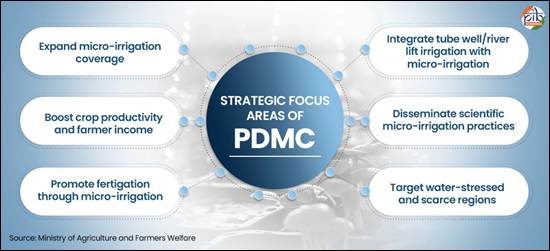
The PDMC scheme promotes precision water management to enhance crop productivity and increase farmers' incomes. The scheme also promotes fertigation to improve nutrient application efficiency and prioritizes water-scarce and groundwater-stressed regions. Fertigation is the process of applying fertilizers with irrigation water directly to the region where most of the plant’s roots develop.Further, PDMC supports the integration of micro irrigation with tube wells, river-lift irrigation, and solar-powered irrigation systems. It encourages convergence with other government programmes to maximize the utilization of water resources. The scheme also promotes scientific advancements in micro-irrigation for agriculture and horticulture.
Progress in Scaling Micro Irrigation across India through PDMC
- Maharashtra, Karnataka, Andhra Pradesh, Tamil Nadu, Gujarat, and Rajasthan recorded the highest areas covered by micro-irrigation under PDMC.
- 12.30 lakh farmers were benefitted by the scheme.
- Around 20% of the beneficiaries were women.
To further promote efficient water use and boost farmer income, the government has introduced new flexibilities under the PDMC scheme. The initiative empowers states and UTs to undertake micro-level water storage and conservation activities. such as the construction of diggis (large water storage tanks or farm ponds) and water harvesting systems, under the “Other Interventions” component. Because these systems can be developed for both individual and community use based on local needs, they help ensure reliable, sustainable water availability for micro-irrigation.
Crucially, the revised guidelines eliminate previous funding restrictions for these conservation projects. Earlier, funds for such activities were strictly capped at 20% of the total allocation for general states/UTs. It was 40% for North Eastern States, Himalayan States, and the UTs of Jammu & Kashmir and Ladakh. Now, States and UTs have the flexibility to exceed these limits based entirely on their specific local requirements.
Types of Micro Irrigation Systems under PDMC
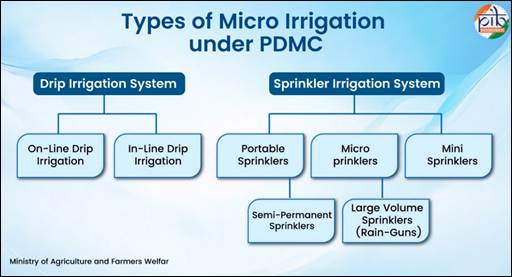
There are two major micro-irrigation systems under PDMC:
Drip Irrigation System
Drip Irrigation technology involves irrigating the root zone through emitters fitted to a lateral tube or inserted within the tubing. In simpler terms, it is a method of watering crops in which water is delivered slowly and directly to the roots of plants through small outlets (called emitters) mounted on thin pipes or tubes. This ensures that only the required area around the plant gets water, reducing wastage and improving efficiency.
There are two types of drip irrigation systems:
- On-line drip irrigation: Water is given to each plant through small drippers installed along the pipe wherever a plant is located. This makes it suitable for crops with uneven spacing.
- In-line drip irrigation: Water comes out of drippers built into the pipe at fixed intervals. In this system, all plants get water evenly.
Sprinkler Irrigation System
In sprinkler irrigation, water is discharged under pressure in the air through a set of nozzles attached to a network of pipes. This system simulates a rainfall and waters the crops evenly. Sprinkler irrigation systems are suitable for irrigating crops where the plant density is very high. It is widely used for cereals, pulses, seeds, spices and field crops.
The sprinkler irrigation system is further classified into the following types:
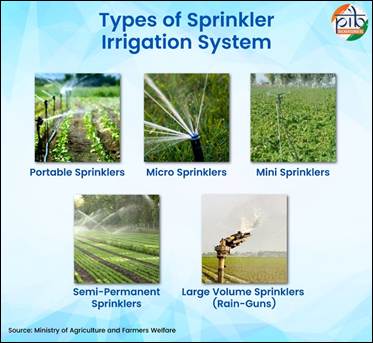
- Portable Sprinklers: In this system, the main and sub-main pipes can be shifted to different parts of the field as required. This allows irrigation according to the crop's water needs. These can be used in both, plains as well as in undulating terrains.
- Micro Sprinklers: Micro sprinklers are low radius sprinklers. They are mostly used for irrigating leafy vegetables, nurseries and hardening of seedlings. Apart from providing irrigation, the micro sprinkler also helps in changing the micro climatic conditions near the plant.
- Mini Sprinklers: They are commonly used for close growing crops like groundnut, potato, onion, ginger, short statured fodder crops, etc. Mini sprinklers are also suitable for frost protection. Their radius is larger than micro sprinklers.
- Semi-Permanent Sprinklers: In this system, the main and lateral pipes are permanently installed below the ground. Sprinkler nozzles attached to riser pipes can be moved to different locations. This allows irrigation of different parts of the field according to the crop's water requirement.
- Large Volume Sprinklers (Rain-Guns): They are used where larger areas are to be covered with one or two sprinklers. These sprinklers have a discharge ranging from 10,000 litres per hour to 32,000 litres per hour and radius of throw from 24 m to 36 m. These systems require high pressure and high discharge pipes & pumps to operate them. These are preferred for irrigating crops spread over large areas in short time.
Implementation Framework of PDMC
Since PDMC is implemented under the Pradhan Mantri Rashtriya Krishi Vikas Yojana (PM-RKVY), it adopts the scheme's overall institutional architecture. At the national level, the National Stewardship Council (NSC) provides strategic direction for guidance and planning.
At the state level, the framework operates through a three-tier structure. At the top, the State Level Sanctioning Committee (SLSC) approves the plans. The Inter-Departmental Working Group (IDWG) coordinates planning and implementation across departments.
At the district level, the District Level Implementation Committee (DLIC) oversees execution and ensures inter-departmental coordination.
Infographics: Per Drop More Crop (PDMC): Improving Irrigation Efficiency Explained

Answer Writing Practice Question for NABARD Grade A Exam
Objective Practice Question for NABARD Grade A Exam
Q1. Consider the following statements regarding the institutional evolution of the Per Drop More Crop (PDMC) scheme:
I. The initiative originated in January 2006 as a Centrally Sponsored Scheme for Micro Irrigation and was subsequently upgraded to the National Mission on Micro Irrigation in 2010-11.
II. During FY 2014-15, it functioned as the "On Farm Water Management" component of the National Mission on Sustainable Agriculture.
III. The nomenclature "Per Drop More Crop" was formally adopted when the programme became a core component of the Pradhan Mantri Krishi Sinchayee Yojana, and it has continued under the same parent programme without any subsequent change.
Which of the statements given above is/are correct?
A) I and II only
B) I and III only
C) II and III only
D) I only
E) I, II and III
Correct Answer: A
Explanation:
Statement I is correct. The scheme began in January 2006 as a Centrally Sponsored Scheme for Micro Irrigation and was elevated to the status of the National Mission on Micro Irrigation (NMMI) in 2010-11, marking its shift from a standalone assistance programme to a mission-mode intervention.
Statement II is correct. In FY 2014-15, the programme was absorbed into the National Mission on Sustainable Agriculture (NMSA) as its "On Farm Water Management" (OFWM) component, which located micro irrigation within the broader climate-resilience framework of NMSA.
Statement III is only half correct, which makes the full statement incorrect. The name Per Drop More Crop was indeed adopted from FY 2015-16 when it became a core component of the Pradhan Mantri Krishi Sinchayee Yojana (PMKSY), and this arrangement continued till FY 2021-22. However, since 2022-23 PDMC has been implemented under the Pradhan Mantri Rashtriya Krishi Vikas Yojana (PM-RKVY), so the parent programme has in fact changed. This transfer is analytically important, because PDMC's present institutional architecture (National Stewardship Council at the Centre, State Level Sanctioning Committee and Inter-Departmental Working Group at the State level, and District Level Implementation Committee at the district level) is inherited from PM-RKVY and not from PMKSY.
Hence only I and II hold, making A the answer.
Q2. Consider the following statements about the financial provisions under the PDMC scheme:
I. Financial assistance for installation of micro irrigation systems is available for a maximum of five hectares per beneficiary.
II. Small and marginal farmers are eligible for assistance at 55 percent, while other farmers receive 45 percent.
III. A farmer becomes eligible to receive assistance again for the same parcel of land after a period of five years.
IV. Central assistance of ₹8,123.24 crore has been released in the last three years, and some State Governments supplement this with additional subsidies from their own budgets.
Which of the statements given above are correct?
A) I, II and III only
B) II, III and IV only
C) I, II and IV only
D) I, III and IV only
E) I, II, III and IV
Correct Answer: C
Explanation:
Statement I is correct. The ceiling for assistance is five hectares per beneficiary, a design feature that directs the subsidy towards small and medium holdings rather than allowing large landholders to capture a disproportionate share of the outlay.
Statement II is correct. The differential assistance pattern of 55 percent for small and marginal farmers against 45 percent for other farmers is an equity-weighted subsidy structure, since the higher upfront capital cost of drip and sprinkler systems is the principal adoption barrier for smaller cultivators.
Statement III is incorrect. The re-eligibility period for the same land is seven years, not five. This gap is aligned to the working life of micro irrigation equipment and is deliberately set to prevent repeated claiming on the same parcel.
Statement IV is correct. Central assistance of ₹8,123.24 crore has been released over the last three years, and several States provide top-up subsidies from their own budgets, which is why effective assistance rates vary across States even though the central norms are uniform.
Since only I, II and IV are correct, C is the answer. Option E is the trap for candidates who accept the seven-year interval as five, and option B fails by dropping the five-hectare ceiling.
Q3. Which one of the following pairs relating to sprinkler irrigation systems under PDMC is not correctly matched?
A) Micro sprinklers: low radius sprinklers used for leafy vegetables, nurseries and hardening of seedlings, which also modify microclimatic conditions near the plant
B) Mini sprinklers: used for close growing crops such as groundnut, potato, onion and ginger, and also suitable for frost protection
C) Semi-permanent sprinklers: main and lateral pipes installed permanently below the ground, with nozzles attached to riser pipes that can be moved across the field
D) Large volume sprinklers (rain-guns): discharge ranging from 10,000 to 32,000 litres per hour with a radius of throw between 24 metres and 36 metres
E) Portable sprinklers: main and sub-main pipes permanently fixed underground, making the system suitable only for level plains and unsuitable for undulating terrain
Correct Answer: E
Explanation:
Option E is the incorrectly matched pair and is therefore the answer. Portable sprinklers are defined precisely by the fact that the main and sub-main pipes can be shifted to different parts of the field as required, allowing irrigation to be matched to the crop's water need. Further, they are usable both in plains and in undulating terrain. Option E inverts both attributes: it borrows the permanent underground installation feature from semi-permanent sprinklers and adds a terrain restriction that does not exist.
Option A is correctly matched. Micro sprinklers are low radius devices used for leafy vegetables, nurseries and seedling hardening, and they additionally alter the microclimate around the plant.
Option B is correctly matched. Mini sprinklers, which have a larger radius than micro sprinklers, serve close growing crops such as groundnut, potato, onion, ginger and short statured fodder crops, and are also used for frost protection.
Option C is correctly matched. In semi-permanent systems the main and lateral pipes are permanently laid below ground while the nozzles on riser pipes remain movable.
Option D is correctly matched. Rain-guns cover large areas with one or two sprinklers, discharging 10,000 to 32,000 litres per hour with a throw radius of 24 to 36 metres, and they require high pressure and high discharge pumps and pipes.
Aspirants should separately retain the drip classification: on-line drip suits crops with uneven spacing since drippers are placed wherever a plant is located, while in-line drip has drippers built into the pipe at fixed intervals and delivers water evenly.
Q4. With reference to the new flexibilities introduced under the PDMC scheme for micro-level water storage and conservation activities, which one of the following statements is correct?
A) The permissible ceiling for such activities has been uniformly raised from 20 percent to 40 percent of the total allocation for all States and Union Territories.
B) Funds for such activities were earlier capped at 20 percent of the total allocation for general States and UTs and at 40 percent for North Eastern States, Himalayan States and the UTs of Jammu and Kashmir and Ladakh, and States and UTs may now exceed these limits based on local requirements.
C) Structures such as diggis and water harvesting systems may be developed only for community use, since individual assets are outside the scope of the "Other Interventions" component.
D) The "Other Interventions" component has replaced financial support for drip and sprinkler systems, which are now funded solely through State budgets.
E) The decision to exceed the earlier funding ceilings rests with the National Stewardship Council, and States may act only after obtaining its prior approval.
Correct Answer: B
Explanation:
Option B is correct. Under the earlier dispensation, allocation for micro-level water storage and conservation activities was strictly capped at 20 percent of the total allocation for general States and UTs, and at 40 percent for North Eastern States, Himalayan States and the UTs of Jammu and Kashmir and Ladakh. The revised guidelines remove these restrictions, giving States and UTs the flexibility to exceed the limits entirely on the basis of their specific local requirements. The logic is that micro irrigation cannot function without an assured source of water, so upstream storage creation is complementary rather than competing expenditure.
Option A is incorrect because the change is not a uniform revision of the ceiling to 40 percent; it is the removal of the binding character of the ceilings altogether.
Option C is incorrect because diggis, which are large water storage tanks or farm ponds, and water harvesting systems can be developed for both individual and community use depending on local needs.
Option D is incorrect because "Other Interventions" is an additional avenue and does not displace assistance for drip and sprinkler systems, which remain the core of the scheme.
Option E is incorrect because the flexibility is vested in the States and UTs themselves. The National Stewardship Council provides strategic direction, guidance and planning at the national level, while approval of plans at the State level rests with the State Level Sanctioning Committee, with the Inter-Departmental Working Group coordinating across departments and the District Level Implementation Committee overseeing execution.
Q5. Consider the following statements regarding the progress and context of micro irrigation in India:
I. The 115 lakh hectares brought under micro irrigation as of July 2026 constitutes about 8.11 percent of India's net sown area, which implies a net sown area of roughly 1,400 lakh hectares.
II. More than 80 percent of India's available water resources are used for agricultural irrigation, even though only about 50 percent of the net sown area has irrigation facilities.
III. In 2025-26, Uttar Pradesh, Punjab and West Bengal recorded the highest areas covered under micro irrigation through PDMC, reflecting the concentration of the scheme in the Indo-Gangetic plains.
Which of the statements given above is/are correct?
A) I only
B) II only
C) II and III only
D) I and II only
E) I, II and III
Correct Answer: D
Explanation:
Statement I is correct and requires a back-calculation. If 115 lakh hectares represents 8.11 percent of the net sown area, then the net sown area works out to approximately 115 divided by 0.0811, that is about 1,418 lakh hectares, which is of the order of 1,400 lakh hectares. This derived figure is worth internalising, because it converts the coverage percentage into a meaningful scale statement: more than nine-tenths of India's net sown area still lies outside micro irrigation.
Statement II is correct. Agriculture accounts for more than 80 percent of India's available water resources, while only about 50 percent of the net sown area is irrigated. The two figures together explain why water use efficiency, rather than fresh water augmentation alone, has become the policy priority, and why micro irrigation, which delivers water directly to the root zone with minimum conveyance and evaporation losses, is treated as the central instrument.
Statement III is incorrect. The States recording the highest areas covered under PDMC in 2025-26 were Maharashtra, Karnataka, Andhra Pradesh, Tamil Nadu, Gujarat and Rajasthan. These are peninsular and western States characterised by water scarcity and groundwater stress, which is consistent with the scheme's stated prioritisation of water-scarce and groundwater-stressed regions. The Indo-Gangetic framing in the statement is the intended misconception.
Two further data points from the same period are worth retaining: 12.30 lakh farmers benefited from the scheme in 2025-26, and around 20 percent of these beneficiaries were women, which translates to roughly 2.46 lakh women beneficiaries.
Since only I and II are correct, D is the answer.
Source: PIB
*****
