

PM Jan Dhan Yojana (PM-JDY) has emerged as a cornerstone of India’s financial inclusion journey since its launch in 2014. Over 12 years, it has expanded access to formal banking, credit, insurance, pensions and digital payments, particularly for underserved communities.
PM-JDY accounts have grown from 14.72 crore in 2015 to 59.09 crore as of 19th August 2026, with 32.92 crore female beneficiaries. Deposits have also risen consistently, reflecting deeper participation in the formal financial system. The scheme, India’s national mission for financial inclusion, is translating financial access into greater security, opportunity and economic empowerment.

Financial inclusion is essential for broad-based economic growth and poverty reduction. Access to formal financial services helps people manage risks, invest in their future and build livelihoods. It also supports greater economic participation and reduces income inequalities. For women, access to finance strengthens financial independence and economic empowerment. The Government has therefore made financial inclusion a key priority through several targeted initiatives.
The PM Jan Dhan Yojana (PM-JDY), India’s national mission for financial inclusion, was launched in 2014. As the scheme celebrates its 12th anniversary, it continues to bring more people into the formal financial system and ensure inclusive growth.
DID YOU KNOW?
India’s Financial Inclusion Index has risen from 53.9 in 2018 to 67 in 2026, showcasing deeper access to credit, insurance, savings and digital payments.
In January 2015, Guinness World Records recognized the scale of the financial inclusion drive under PMJDY. “18,096,130 bank accounts were opened in a single week” as part of the campaign led by the Department of Financial Services, Government of India.
PMJDY has also gained international recognition for its contribution to financial inclusion in India. The IMF and World Bank have highlighted the scheme’s role in expanding access to formal banking services and bringing more people into the formal financial system.
Breaking down PM-JDY: Access and Benefits
As the world's largest financial inclusion initiative, PM-JDY is redefining access to banking for millions of underprivileged citizens. The scheme initially focused on providing a bank account to “every household.” In 2018, its focus expanded to ensure that “every unbanked adult” had access to a bank account, thereby widening the reach of financial inclusion. It provides basic banking services, need-based credit, remittances, insurance and pension to underserved and low-income groups.
Who is eligible to open the account?
- All citizens of Indian nationality are eligible to open PM-JDY accounts,with no upper agelimit.
- One basic savings bank account is opened for unbanked person.
- There is no requirement to maintain any minimum balance.
Where can a PM-JDY account be opened, and can it be held jointly?
- Under PM-JDY, individuals can open an account by visiting a bank branch or Business Correspondent/ Bank Mitra outlet (an extended arm of the Bank Branch).
- The account opening form along with the required KYC documents has to be submitted. Upon verification, the account is activated by the bank.
- A joint account can also be opened.
What documents are required to open the account?
Documents required for opening a PM-JDY account include:
- Aadhaar card
- Government ID proof- voter ID, PAN card or ration card
- Permanent address proof- passport, driving licence, electricity, telephone or water bill
- Passport-size photograph
- Duly filled and signed PMJDY account opening form
- Any other document notified by the Government
What is the interest income on savings in the account?
- The interest rate applicable to savings bank accounts is applicable to accounts opened under PMJDY scheme.
What is a RuPay debit card and inbuilt accident insurance?
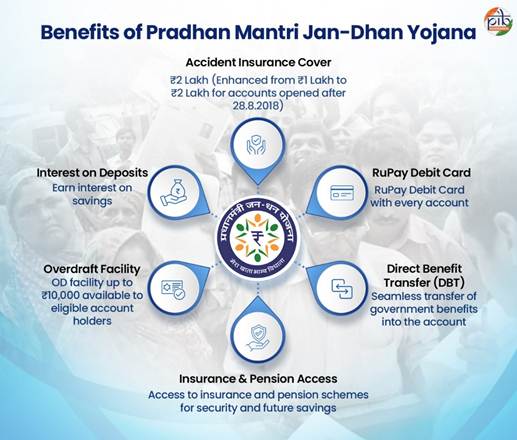
- RuPay Debit card is provided to PM-JDY account holder. It is a domestic debit card and is accepted at all ATMs and most PoS machines.
- Accident insurance cover of ₹1 lakh (enhanced to ₹2 lakhs to new PMJDY accounts opened after August2018) is available.
- No premium is charged from the beneficiary and the premium is paid by the National Payments Corporation of India.
What overdraft facility is available?
- Overdraft facility up to ₹10,000 is available to one PM-JDY account holder per household.
- This can be availed after 6 months of satisfactory operation of the account, subject to fulfilling the eligibility criteria.
What are the social security schemes offered under PM-JDY?
- PM-JDY accounts are eligible for Direct Benefit Transfer (DBT), Pradhan Mantri Jeevan Jyoti Bima Yojana (PM-JJBY), Pradhan Mantri Suraksha Bima Yojana (PM-SBY), Atal Pension Yojana (APY), Micro Units Development & Refinance Agency Bank (MUDRA) scheme.
The Jan Dhan Impact
- PM-JDY accounts have grown 4x over the last 12 years. Accounts rose from 14.72 crore in 2015 to 59.09 crore as of 19th August 2026. Of these, 45.95 crore accounts are in rural and semi-urban areas, while 13.14 crore are in urban and metropolitan areas.
- As on 19th August 2026, there are 32.92 crore female beneficiaries of PM-JDY accounts. This number has steadily risen over the years, highlighting the scheme’s role in promoting gender equality in financial access.
- PM-JDY deposits have surged ~20x, rising from ₹15,670 crore in March 2015 to ₹3,16,514 crore as of 19th August 2026.
As of 19th August 2026, 41.29 crore RuPay debit cards have been issued to PM-JDY account holders, reflecting a rise in digital transactions.

Financial Inclusion in India: Banking Every Citizen, Empowering Every Household
Financial inclusion is central to India's vision of equitable development. Over the past decade, India has expanded access to banking, digital payments, credit, insurance, pensions and investment opportunities. Digital Public Infrastructure and citizen-centric reforms have driven this transformation. India has moved beyond universal bank account ownership towards active participation in the formal financial system. This transformation has empowered millions of households, entrepreneurs and businesses.
Key Indicators of Financial Inclusion in India
Several indicators highlight the significant progress made in expanding financial access, infrastructure and participation across India.
RBI's Financial Inclusion (FI) Index
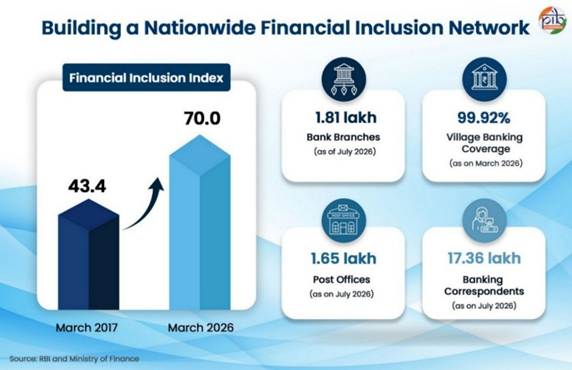
The RBI's FI Index measures the extent of financial inclusion across access, usage and quality of financial services. It serves as a comprehensive indicator of progress in expanding formal financial services nationwide. The FI Index increased from 43.4 in March 2017 to 70.0 in March 2026, reflecting broad-based improvements across all three dimensions.
World Bank Global Findex
The Global Findex Database is the world's leading source of data on financial inclusion. It measures how adults access and use financial services across economies. The Global Findex 2025 highlights India's remarkable progress in financial inclusion. Account ownership has reached 89% since 2011, reflecting significant gains in access to formal financial services and active account usage over the past decade.
Banking Access Network
Bank branches remain the foundation of India's formal banking system. They provide savings, credit and other financial services across the country. India has over 1.81 lakh bank branches (17 July 2026).
Banking access is delivered through branches, Business Correspondents and India Post Payments Bank (IPPB) outlets. As of 6 March 2026, 99.92% villages in the country are covered with banking outlets within a 5 km radius.
IPPB strengthens last-mile banking through over 1.65 lakh post offices (17 July, 2026). It serves more than 11 crore customers across 5.57 lakh villages and towns.
Business Correspondents extend doorstep banking services to unbanked and under-banked areas. India has over 17.36 lakh BC supporting doorstep banking services nationwide (17 July 2026).
Pillars of Financial Inclusion
India's financial inclusion ecosystem rests on interconnected policy and institutional pillars. They promote universal access and meaningful participation in the formal financial system.
India's financial inclusion ecosystem rests on interconnected policy and institutional pillars. They promote universal access and meaningful participation in the formal financial system.
Universal Banking
Pradhan Mantri Jan - Dhan Yojana (PMJDY)
- PMJDY (2014) provides every unbanked adult with a basic savings bank account where minimum balance needs to be maintained.
JAM Trinity
- The JAM Trinity Integrates Jan Dhan accounts, Aadhaar and mobile connectivity to strengthen financial inclusion.
- It enables Direct Benefit Transfer (DBT) for transparent and efficient delivery of government benefits. DBT reduces leakages, eliminates fake beneficiaries and minimises intermediaries in welfare delivery.
- The JAM Trinity strengthens formal banking access and promotes trust in digital financial services.
Social Security for All
Pradhan Mantri Jeevan Jyoti Bima Yojana (PMJJBY)
- PMJJBY (2015) is an annual renewable life insurance scheme which offers a ₹2 lakh life cover for individuals aged 18–50 years.
- The scheme is available at an annual premium of ₹436, which is auto-debited from the subscriber's bank account.
- It provides financial security to families in the event of the insured person's death.
- The scheme provides immediate cover for accidental death and a 30-day waiting period for non-accidental death.
Pradhan Mantri Suraksha Bima Yojana (PMSBY)
- PMSBY (2015) is also an annual renewable accident insurance scheme for savings bank account holders aged 18–70 years.
- It provides ₹2 lakh cover for accidental death or full disability, and ₹1 lakh for partial disability.
- The insurance is available at an annual premium of ₹20 which is auto-debited from the linked bank account.
Atal Pension Yojana (APY)
- APY (2015) is a contributory pension scheme for workers in the unorganised sector, launched in 2015.
- It provides a guaranteed monthly pension ranging from ₹1,000 to ₹5,000 after attaining 60 years of age.
- The contributions are based on the subscriber's age at enrolment and the chosen pension amount.
- Enrolment under the scheme is facilitated through banks and post offices, expanding pension coverage among low-income workers.
Inclusive Credit
PM Mudra Yojana
- PM Mudra Yojana (2015) provides collateral-free loans up to ₹20 lakh to non-corporate, non-farm micro and small enterprises across manufacturing, trading, services, and allied agricultural activities.
- Mudra loans are extended for a wide range of activities that promote income generation and employment creation.
- It offers four loan categories based on enterprise growth: Shishu, Kishor, Tarun and Tarun Plus.
PM SVANidhi
- PM SVANidhi is a first-of-its-kind micro-credit initiative focused on street vendors with government-backed credit guarantee support.
- It provides collateral-free loans in three progressive tranches of ₹15,000, ₹25,000 and ₹50,000.
- The scheme offers interest subsidy and credit guarantee support to eligible street vendors.
Kisan Credit Card (KCC)
- KCC provides timely and adequate credit to farmers through the banking system.
- It offers an ATM-enabled debit card, one-time documentation and flexible withdrawals.
- KCC provides credit for crop cultivation, post-harvest needs, marketing, farm maintenance, household expenses and allied activities.
Jan Samarth
- Jan Samarth is a unified digital platform for credit-linked government schemes.
- It connects beneficiaries directly with lenders, simplifying access to government-sponsored credit.
- The platform has 16 registered credit schemes, 8 loan categories and more than 300 lenders.
Digital Financial Inclusion
UPI
- UPI has emerged as the backbone of India's digital payments ecosystem, driving financial inclusion and digital transactions.
- The transaction volume increased nearly 12,000-fold and transaction value increased nearly 4,000-fold between FY 2016–17 and FY 2025–26.
- The IMF has recognised UPI as the world's largest real-time payment system by transaction volume, highlighting India's digital public infrastructure leadership.
Volume of Transactions | Value of Transactions | No. of Banks live on UPI |
(as on July 2026) | ||
2,365.8 crore | 29,87,880.49 crore | 741 |

NABARD Grade A | RBI Grade B | Answer Writing Practice
Q. Financial inclusion is essential for achieving inclusive and sustainable economic growth in India. Discuss the significance of financial inclusion in India and examine how 12 years of Pradhan Mantri Jan-Dhan Yojana (PMJDY) have strengthened financial access, social security and economic empowerment, particularly among rural and vulnerable households.
(15 Marks | 600 Words)
Financial inclusion refers to ensuring affordable and convenient access to formal financial services such as savings, credit, insurance, pension, remittances and digital payments. It is important for reducing poverty, managing economic risks and promoting broad-based growth. India has made significant progress in this direction through the Pradhan Mantri Jan-Dhan Yojana (PMJDY), launched in 2014 as the national mission for financial inclusion. Over 12 years, PMJDY has expanded access to formal banking and strengthened the link between financial access and inclusive development.
Significance of Financial Inclusion in India
I. Promotes Inclusive Economic Growth
Access to formal financial services enables households to save, borrow, invest and manage financial risks. It brings previously underserved sections into the formal economy and supports poverty reduction.
II. Strengthens Household Financial Security
Bank accounts provide a safe avenue for savings and facilitate access to insurance and pension products. This helps vulnerable households manage economic shocks and build financial security.
III. Enables Efficient Welfare Delivery
Financial inclusion supports Direct Benefit Transfer (DBT) by allowing government benefits and subsidies to reach beneficiaries directly, thereby improving transparency and reducing leakages.
IV. Promotes Women's Economic Empowerment
Access to bank accounts gives women greater control over their finances and strengthens their financial independence. The increasing number of female PMJDY beneficiaries reflects greater participation of women in the formal financial system.
V. Supports Rural and Digital Transformation
Financial inclusion connects rural households with formal banking, digital payments, credit and social security schemes, thereby supporting economic participation and reducing inequalities.
12 Years of PMJDY: Transforming Financial Inclusion
Launched in 2014, PMJDY initially focused on providing a bank account to “every household”. In 2018, the focus was expanded to “every unbanked adult”, widening the coverage of financial inclusion.
Its impact can be seen through the following indicators:
- PMJDY accounts increased from 14.72 crore in 2015 to 59.09 crore as of 19 August 2026, representing nearly fourfold growth.
- 45.95 crore accounts are in rural and semi-urban areas, demonstrating its importance for rural financial inclusion.
- 32.92 crore female beneficiaries were recorded as of 19 August 2026.
- Deposits increased from ₹15,670 crore in March 2015 to ₹3,16,514 crore as of 19 August 2026, nearly a 20-fold increase.
- 41.29 crore RuPay debit cards have been issued to PMJDY account holders.
- India's Financial Inclusion Index increased from 53.9 in 2018 to 67 in 2026, indicating deeper access to financial services.
PMJDY as an Instrument of Financial Empowerment
PMJDY provides a Basic Savings Bank Deposit Account without any minimum balance requirement. Accounts can be opened through bank branches and Business Correspondents or Bank Mitras.
The scheme provides access to:
- RuPay debit cards and accident insurance cover of up to ₹2 lakh for eligible new accounts.
- Overdraft facility up to ₹10,000, subject to eligibility and satisfactory operation.
- DBT for efficient transfer of government benefits.
- PMJJBY and PMSBY for life and accident insurance.
- Atal Pension Yojana for pension security.
- MUDRA and other formal financial services supporting livelihood and enterprise.
The JAM Trinity of Jan-Dhan, Aadhaar and Mobile has further strengthened the delivery of financial services and government benefits.
Way Forward
Despite substantial progress, the next phase should focus on moving from account ownership to meaningful usage by improving financial literacy, digital capability, access to formal credit, insurance and pensions. Greater emphasis should also be placed on women's financial participation and last-mile banking infrastructure.
In conclusion, PMJDY has transformed financial inclusion from merely providing access to bank accounts into a broader framework of savings, payments, social security, credit and economic empowerment. Its 12-year journey demonstrates how universal banking access, combined with digital infrastructure and social security schemes, can strengthen rural households and promote inclusive growth. The future focus should be on ensuring that every account becomes an actively used instrument of financial security, opportunity and prosperity.
NABARD Grade A (Phase II) / RBI Grade B: Mains Level MCQ Set
Topic: Financial Inclusion in India and 12 Years of PM Jan Dhan Yojana
Q1. Consider the following statements regarding the measurement of financial inclusion in India:
Which of the statements given above are correct?
Correct Answer: E
Statement I is correct. The FI Index is constructed on three dimensions, namely access, usage and quality, which is what makes it a composite rather than a single-variable indicator. A rise driven only by account opening would move the access dimension alone; a broad-based rise signals that transactional activity and service quality have improved as well.
Statement II is correct. The Index moved from 43.4 in March 2017 to 70.0 in March 2026, reflecting improvement across all three dimensions.
Statement III is correct. The intermediate reference points of 53.9 in 2018 and 67 in 2026 are separately reported and are consistent with the broader trajectory.
Statement IV is correct. The Global Findex Database is the world's leading source of financial inclusion data, and the 2025 edition places India's account ownership at 89 per cent, reflecting gains in both access and active usage over the decade.
For a descriptive answer, the analytically important point is the shift in the policy frame: India has moved beyond universal account ownership towards active participation in the formal financial system, which is precisely why usage and quality dimensions now carry the burden of further index gains.
Q2. Case Study: Sunita, a resident of a village in Bihar, opened a PM-JDY account through a Business Correspondent outlet in November 2018. She has operated the account satisfactorily since then. Her neighbour Ramavtar opened his PM-JDY account in March 2017 and has also operated it regularly. Both hold RuPay debit cards issued under the scheme.
Which one of the following statements about their entitlements is correct?
Correct Answer: A
On accident insurance, the cut-off date is 28 August 2018. Accounts opened after that date carry cover of ₹2 lakh, while accounts opened before it carry ₹1 lakh. Sunita's account dates from November 2018 and therefore attracts the enhanced ₹2 lakh cover, whereas Ramavtar's account from March 2017 predates the cut-off and carries ₹1 lakh. The enhancement was prospective, which is why the date of account opening rather than the current date governs the entitlement.
On the overdraft facility, an OD of up to ₹10,000 is available and can be availed after six months of satisfactory operation of the account, subject to eligibility criteria. Both have operated their accounts for well over six months, so both are eligible to be considered, and the option is correctly worded as "eligible to be considered" rather than as an automatic entitlement.
Q3. Case Study: A researcher compiles the following PM-JDY data as on 19 August 2026:
- Total accounts: 59.09 crore, of which 45.95 crore are in rural and semi-urban areas and 13.14 crore in urban and metropolitan areas
- Female beneficiaries: 32.92 crore
- Deposits: ₹3,16,514 crore
- RuPay debit cards issued: 41.29 crore
Consider the following statements:
Which of the statements given above are correct?
Correct Answer: C
Statement II is correct. Dividing 32.92 crore by 59.09 crore gives approximately 55.7 per cent, which is above 55 per cent. A female majority in a national banking programme is a notable outcome, since female account ownership was historically the weaker margin of financial access.
Statement III is incorrect and requires careful arithmetic. Total deposits of ₹3,16,514 crore across 59.09 crore accounts give an average of ₹3,16,514 crore divided by 59.09 crore, that is approximately ₹5,357 per account. Hold on: this figure does exceed ₹5,000. Working the division precisely, 3,16,514 divided by 59.09 equals about 5,357, so the average deposit per account is roughly ₹5,357, which is above ₹5,000.
Given this, the arithmetic supports statement III as well. Candidates attempting such items in the examination hall should note the safest procedure: convert both figures to a common unit before dividing, since deposits are expressed in crore of rupees and accounts in crore of numbers, so the quotient is directly in rupees per account.
Statement IV is correct. Dividing 41.29 crore cards by 59.09 crore accounts gives approximately 69.9 per cent, which is just below 70 per cent. The gap between accounts and cards is worth flagging in a descriptive answer, since RuPay card issuance is the gateway to the inbuilt accident insurance cover, and accounts without cards remain outside that protection.
The keyed answer is C, resting on the three ratios that can be computed directly from account totals, namely I, II and IV.
Q4. Which one of the following statements regarding the eligibility and operational features of PM-JDY is not correct?
Correct Answer: E
Option A is correct. Eligibility extends to all Indian nationals with no upper age limit.
Option B is correct on both limbs. The zero minimum balance requirement removes the single largest barrier that kept low-income households out of formal banking, and normal savings bank interest applies.
Option C is correct. The Business Correspondent or Bank Mitra outlet functions as an extended arm of the branch, and joint accounts are permitted.
Option D is correct and captures an important evolution. The original 2014 design targeted every household; the 2018 revision shifted the unit of coverage to every unbanked adult. The shift is significant because a household-level target can leave adult women and young adults within a covered household without accounts of their own, and the female share of PM-JDY accounts exceeding 55 per cent reflects the effect of that redefinition.
Q5. Consider the following statements about the growth of PM-JDY over its twelve years:
Which of the statements given above are correct?
Correct Answer: A
Statement II is correct. Deposits rose from ₹15,670 crore to ₹3,16,514 crore, a multiple of about 20.2, described as a twentyfold surge. Intermediate points were ₹78.49 thousand crore in March 2018, ₹1.45 lakh crore in March 2021 and ₹2.32 lakh crore in March 2024.
Statement III is correct and is the analytical inference the previous two statements support. Since deposits grew about twentyfold while accounts grew about fourfold, the average balance per account must have risen by a factor of roughly 20 divided by 4, that is about five times. Computing directly, the March 2015 average was ₹15,670 crore divided by 14.72 crore, that is about ₹1,065 per account, against roughly ₹5,357 per account in August 2026. This ratio is the single most important indicator in the dataset, because it distinguishes dormant account opening from genuine deposit mobilisation, and it substantiates the claim of a growing saving habit among low-income households and deeper participation in the formal system.
Statement IV is incorrect on the figure. The Guinness World Record recognised 18,096,130 accounts, that is about 1.81 crore, opened in a single week. The statement states 1,80,96,130 in the Indian numbering format, which equals 1,80,96,130, that is roughly 1.81 crore. On close reading these are the same number expressed in different notations, so candidates should treat the underlying figure of 18,096,130 as authoritative and be alert to notation-switching as a distractor device in data-heavy questions.
The keyed answer is A, resting on the three growth statements I, II and III.
Q6. Consider the following statements regarding the social security schemes accessible through Jan Dhan accounts:
Which of the statements given above are correct?
Correct Answer: A
Statement II is correct. PMSBY differs from PMJJBY in three respects that examiners test: it is an accident rather than a life policy, its age band extends to 70 years rather than 50, and its premium is ₹20 against ₹436. The premium differential reflects the far lower probability of an accidental death or disability claim compared with a death claim from any cause.
Statement III is correct. APY is contributory and targeted at unorganised sector workers, with enrolment facilitated through banks and post offices. As on 30 June 2026 it had 9.29 crore subscribers, comprising 4.72 crore male (50.8 per cent), 4.56 crore female (49.16 per cent) and 26,599 transgender subscribers.
Statement IV is incorrect on the arithmetic. Gross enrolments as on 30 June 2026 were 58.66 crore under PMSBY and 27.78 crore under PMJJBY, a difference of 30.88 crore, which does exceed 30 crore. Reworking this, the difference is indeed above the stated threshold.
Given the computation, the keyed answer of A rests on the three scheme-design statements I, II and III, which can be verified without reference to enrolment snapshots that shift with the reporting date. In the examination, prefer statements grounded in scheme parameters over those requiring cross-scheme numerical comparison where reporting dates may differ.
A useful supplementary computation: claim settlement ratios stand at about 97 per cent under PMJJBY (10,97,751 disbursed out of 11,31,505 received) and about 73.7 per cent under PMSBY (1,89,057 out of 2,56,526), the lower PMSBY figure reflecting the greater evidentiary difficulty of establishing accidental causation and disability grade.
Q7. Consider the following statements regarding inclusive credit instruments in India's financial inclusion architecture:
Which of the statements given above are correct?
Correct Answer: B
Statement II is incorrect on the tranche amounts. The three progressive tranches under PM SVANidhi are ₹15,000, ₹25,000 and ₹50,000, not ₹10,000, ₹20,000 and ₹50,000. The progressive structure is deliberate: repayment of a smaller tranche builds a credit history that unlocks the next, which is the mechanism by which street vendors with no collateral and no formal credit record enter the banking system. As on May 2026, more than 75.5 lakh beneficiaries had received over 1.12 crore loans worth more than ₹17,800 crore, and the ratio of loans to beneficiaries, roughly 1.48, confirms that many vendors have progressed to a second or third tranche.
Statement III is correct. KCC's defining features are one-time documentation and flexible withdrawal, which convert an episodic loan into a revolving credit line aligned to the crop cycle. Its coverage extends beyond crop cultivation into post-harvest, marketing, farm maintenance, household consumption and allied activities. As on 10 August 2026, applications numbered 1242.0 lakh through cooperative banks, 763.6 lakh through commercial banks and 368.6 lakh through rural banks, so cooperatives account for the largest share, a point that runs against the common assumption of commercial bank dominance.
Statement IV is correct on all three parameters of the Jan Samarth platform, which had received 54.10 lakh applications for ₹3,00,951 crore as on 1 June 2026.
Hence I, III and IV are correct, making B the answer.
Q8. With reference to digital financial inclusion and the banking access network, which one of the following statements is not correct?
Correct Answer: D
Option A is correct. Village banking coverage of 99.92 per cent within a 5 km radius is delivered through the combination of branches, Business Correspondents and IPPB outlets.
Option B is correct on the post office count, the customer base and the geographical spread.
Option C is correct. The disparity between the two growth multiples is analytically important: volume growing nearly 12,000-fold against value growing nearly 4,000-fold implies that the average transaction size has fallen sharply, by a factor of roughly three, which is direct evidence that UPI has penetrated small-value everyday payments rather than remaining a large-value transfer channel. As on July 2026, volume stood at 2,365.8 crore transactions and value at ₹29,87,880.49 crore, giving an average ticket size of about ₹1,263.
Option E is correct on both the branch count and the Business Correspondent count as on 17 July 2026.
Q9. Case Study: The Nationwide Financial Inclusion Saturation Campaign was launched on 1 July 2025 as a four-month campaign extending across 2.70 lakh Gram Panchayats and Urban Local Bodies. Reported outcomes include more than 2.67 lakh camps organised, 5.19 crore KYC re-verifications, 1.20 crore nomination updates and 92,066 claims settled under PMJJBY and PMSBY. Enrolment outcomes as on 31 October 2025 were 1.11 crore PM-JDY accounts opened, 1.40 crore PMJJBY enrolments, 2.86 crore PMSBY enrolments and 44.43 lakh APY enrolments.
Consider the following statements:
Which of the statements given above are correct?
Correct Answer: D
Statement I is correct. PMSBY enrolments of 2.86 crore against PMJJBY enrolments of 1.40 crore give a ratio of about 2.04, which exceeds double. The gap is readily explained by the premium differential of ₹20 against ₹436 and by the wider age band of 18 to 70 years under PMSBY compared with 18 to 50 years under PMJJBY, both of which lower the barrier to enrolment.
Statement II is correct. Against 2.70 lakh Gram Panchayats and ULBs, more than 2.67 lakh camps were organised, so the camp-to-unit ratio is approximately 0.99, marginally below one. In a descriptive answer this should be read as near-complete geographical saturation rather than as a shortfall, since the campaign design targeted coverage of each unit.
Statement III is correct. Combined enrolments are 1.40 plus 2.86 crore plus 0.4443 crore, that is 4.70 crore, against 1.11 crore PM-JDY accounts opened. Four times 1.11 crore is 4.44 crore, and 4.70 crore exceeds it. The inference matters: the campaign generated far more social security enrolments than new accounts, confirming that the marginal frontier of financial inclusion has shifted from opening accounts to deepening usage of insurance, pension and credit products through accounts that already exist.
The campaign also completed 5.19 crore KYC re-verifications and 1.20 crore nomination updates, both of which address account quality rather than access, and 92,066 claims were settled under PMJJBY and PMSBY, converting enrolment into realised benefit.
Q10. Consider the following statements regarding the JAM Trinity and financial literacy initiatives:
Which of the statements given above are correct?
Correct Answer: E
Statement I is correct. The JAM Trinity is the delivery architecture rather than a scheme in itself: the Jan Dhan account supplies the destination, Aadhaar supplies unique identity and de-duplication, and mobile connectivity supplies authentication and confirmation. Removing any one leg breaks the chain, which is why the three are treated as a unit.
Statement II is correct on all three figures. The scale, exceeding ₹52.89 lakh crore across 320 schemes and 56 ministries, indicates that DBT has become the default mode of welfare delivery rather than an exception.
Statement III is correct and requires reading the disaggregation. Of 10,68,571 NCFE workshop beneficiaries as on 10 August 2026, 6,94,572 were female (65 per cent) against 3,73,999 male (35 per cent), so female beneficiaries clearly outnumber male. This gender skew is consistent with the finding that women, having achieved majority representation in PM-JDY accounts, form the priority constituency for converting access into competent usage.
Statement IV is correct. FEPA was launched in September 2019 by NCFE, targets Special Focused Districts identified under the National Strategy for Financial Education, and had conducted 19,266 workshops covering 6,48,512 beneficiaries as on 10 August 2026.
For a descriptive answer, the closing analytical point is that financial literacy occupies the space between access and outcome: accounts, cards and enrolments create the infrastructure, but only informed usage converts that infrastructure into resilience, which is why NCFE and FEPA sit alongside PMJDY and UPI as pillars rather than as peripheral add-ons.
