

Pradhan Mantri Kisan Samman Nidhi (PM-KISAN) is a central sector scheme of the Government of India launched by the honourable Prime Minister on February 2019 and implemented with effect from December 1, 2018. The scheme aims to provide financial assistance to landholding farmer families across the country, subject to certain exclusion criteria, to enable them to take care of expenses related to agriculture, allied activities and domestic needs. Under the scheme, an amount of ₹ 6,000/- per year is transferred in three equal instalments of ₹ 2,000/-, viz. (April–July, August–November, and December–March) each financial year, directly into the farmers’ bank accounts through Direct Benefit Transfer (DBT) mode.
PM-KISAN is a technology-driven IT solution for transferring direct benefits into the aadhaar seeded beneficiaries’ bank accounts through the aadhaar-enabled payment system. The states/UTs identify and verify the beneficiaries under the scheme as per the operational guidelines of the scheme.
So far, more than ₹4.47 lakh crore has been disbursed to eligible farmer families across the country through 23 instalments till June 2026. Prime Minister released the 23rd installment of the PM-Kisan on 20th June 2026 from Tarakeswar, Hooghly , West Bengal. The benefits of the scheme are provided to farmers upon seeding of land records in the PM-KISAN portal. They are also required to link their bank accounts with Aadhaar and complete the e-KYC verification. Reflecting the government’s continued commitment to strengthening farmers’ income security, the Union Budget 2026–27 has allocated ₹60,000 crore for the PM-KISAN scheme.

Cabinet approves continuation of the PM-KISAN Scheme from 2026-27 to 2030-31 with a Financial Outlay of Rs.3.15 lakh crore
The Union Cabinet chaired by the Prime Minister Shri Narendra Modi has approved continuation of the Pradhan Mantri Kisan Samman Nidhi (PM-KISAN) Scheme from 2026–27 to 2030–31. A total financial outlay of Rs.3.15 lakh crore has been approved for the Scheme during this period.
The approval reiterates the Government’s commitment that the prosperity of farmers forms the foundation of the nation’s prosperity. Through the PM-KISAN Scheme, timely and transparent income support is being provided to eligible farmer families through the Direct Benefit Transfer (DBT) system, enabling farmers to increase agricultural investment and strengthen their livelihoods.
Key Features of PM-KISAN Scheme
- PM Kisan is a Central Sector scheme with 100% funding from Government of India.
- It has become operational from 1.12.2018.
- Under the scheme an income support of 6,000/- per year in three equal installments will be provided to all land holding farmer families.
- Definition of family for the scheme is husband, wife and minor children.
- State Government and UT administration will identify the farmer families which are eligible for support as per scheme guidelines.
- The fund will be directly transferred to the bank accounts of the beneficiaries.
- There are various Exclusion Categories for the scheme.
PM-KISAN Exclusion
- The following categories of beneificiaries of higher economic status shall not be elligible for benefit under the scheme.
- All Institutional Land holders.
- Farmer families which belong to one or more of the following categories:.
- Former and present holders of constitutional posts
- Former and present Ministers/ State Ministers and former/present Members of LokSabha/ RajyaSabha/ State Legislative Assemblies/ State Legislative Councils, former and present Mayors of Municipal Corporations, former and present Chairpersons of District Panchayats.
- All serving or retired officers and employees of Central/ State Government Ministries /Offices/Departments and its field units Central or State PSEs and Attached offices /Autonomous Institutions under Government as well as regular employees of the Local Bodies
- (Excluding Multi Tasking Staff /Class IV/Group D employees)
- All superannuated/retired pensioners whose monthly pension is Rs.10,000/-or more
- (Excluding Multi Tasking Staff / Class IV/Group D employees) of above category
- All Persons who paid Income Tax in last assessment year
- Professionals like Doctors, Engineers, Lawyers, Chartered Accountants, and Architects registered with Professional bodies and carrying out profession by undertaking practices.
- Farmers who acquired land ownership after February 1, 2019, are generally not eligible for the PM-Kisan Samman Nidhi scheme benefits for five years, except through inheritance.

Key Achievements of the PM-KISAN Scheme:
- More than Rs.4.47 lakh crore has been transferred directly into farmers’ bank accounts through 23 instalments under the Scheme.
- Under the 23rd instalment, more than 9.49 crore farmers benefited, with over Rs.18,984 crore released.
- During the COVID-19 pandemic, more than Rs.1.71 lakh crore was disbursed to provide financial assistance to farmers.
- Women farmers have received more than Rs.1.06 lakh crore under PM-KISAN, and nearly one out of every four beneficiaries is a woman farmer.

Significant Role in Strengthening Agricultural Investment and Farmers’ Income:
- The assistance provided under PM-KISAN has enabled farmers to make timely investments in seeds, fertilizers, irrigation, agricultural machinery and other agricultural requirements. This has enhanced farmers’ productive capacity, reduced their dependence on informal credit and strengthened the financial stability of rural households.
Positive Impact Confirmed through Independent Evaluations:
- The impact of the PM-KISAN Scheme has been assessed by various independent institutions. According to the evaluation conducted by the Development Monitoring and Evaluation Office (DMEO) of NITI Aayog:
- More than 92% of beneficiaries reported that they utilised the assistance amount for agricultural activities and agricultural investment.
- Approximately 85% of beneficiaries confirmed an improvement in agricultural income and a reduction in dependence on informal credit.
The PM-KISAN Fund Transfer Journey
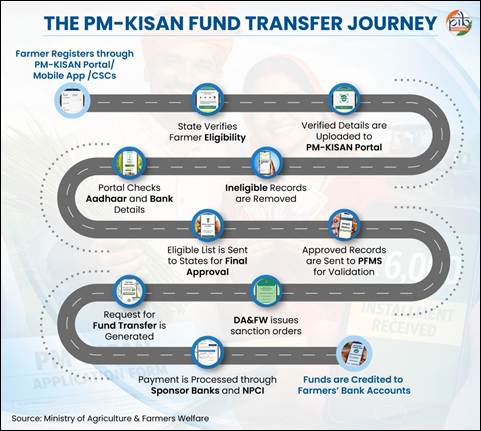
The process begins with farmer registration through the PM-KISAN portal, mobile app, or Common Service Centres (CSCs). State governments verify eligibility and upload beneficiary details to the portal. The system then validates Aadhaar and bank account details and screens out ineligible applicants. After final state approval, the data is sent to the Public Financial Management System (PFMS) for account verification. Eligible records are used to generate fund transfer requests and payment orders. The Department of Agriculture and Farmers Welfare issues sanction orders. Payments are then processed through sponsor banks and the National Payments Corporation of India (NPCI). Finally, funds are credited directly to farmers’ bank accounts, ensuring fast, transparent, and efficient delivery of benefits.
Targeting, Beneficiary Identification, and Database Management
State Governments are responsible for identifying eligible farmer households and developing a comprehensive beneficiary database. This database includes key details such as name, age, category, Aadhaar number, bank account information, and mobile number. States ensure the accuracy of these records to prevent duplicate payments. These records are regularly updated, digitized, and linked to Aadhaar and bank account information to enable seamless DBT of benefits.
The lists of eligible beneficiaries are publicly displayed at the village level to promote transparency. This also enables farmers, who may have been inadvertently excluded, to seek inclusion through the appropriate grievance redressal mechanisms. Additionally, States and UTs conduct recovery proceedings for the benefits that have been disbursed to ineligible individuals. These include income tax payers, government employees, public sector undertaking (PSU) personnel, and holders of constitutional posts. As of December 2025, a total amount of ₹416.75 crore has been recovered from ineligible beneficiaries nationwide.
Technology-Enabled Service Delivery System under PM-KISAN
PM-KISAN is supported by a farmer-centric digital infrastructure that streamlines access and enhances transparency in the delivery of benefits. Aadhaar-based authentication forms a key pillar of the system, facilitating secure beneficiary identification and payment verification. Farmers can complete e-KYC using:
- OTP-based authentication
- Biometric authentication
- Face authentication
The PM-KISAN web portal serves as the central digital platform for beneficiary registration, verification, and data management. It maintains a unified national database of farmers and facilitates fund transfers through integration with the Public Financial Management System (PFMS). It also enables real-time monitoring of financial transactions nationwide. The portal further provides location-wise lists of beneficiary farmers, thereby enhancing transparency in programme implementation.
Complementing the portal, the PM-KISAN mobile application, launched in 2020, extends these services to mobile users. The application enables farmers to undertake self-registration, track the status of benefit transfers, and complete e-KYC verification. In 2023, the application was upgraded with a Face Authentication feature. This allows farmers to complete e-KYC by scanning their faces, thereby eliminating the need for OTP or fingerprint-based verification. Hence, this measure has been proven instrumental in improving accessibility of this scheme.
Artificial Intelligence (AI) Support System: Kisan-eMitra
In September 2023, the Government introduced Kisan-eMitra, an AI-enabled chatbot integrated with the PM-KISAN digital ecosystem. It was developed with technical support from the EkStep Foundation and BHASHINI. The chatbot provides farmers with real-time information on payments, registrations, and eligibility under the scheme in multiple Indian languages.
The platform offers 24/7 assistance in 11 major languages: Hindi, English, Tamil, Bengali, Odia, Malayalam, Gujarati, Punjabi, Telugu, Marathi, and Kannada. Hence, this improves accessibility for a diverse user base. Through voice- and text-based queries, farmers can check the status of their applications, track payment updates, and obtain scheme-related information.
Infographics Based on PM-KISAN Scheme

Objective Practice Questions Based on PM-KISAN
Q1. Consider the following statements regarding the PM-KISAN Scheme:
- It is a Central Sector scheme with 100% funding from the Government of India.
- It was launched by the Prime Minister in February 2019 but implemented with effect from 1 December 2018.
- Under the scheme, ₹6,000 per year is transferred in three equal instalments of ₹2,000 each.
Which of the statements given above is/are correct?
A. 1 and 2 only
B. 2 and 3 only
C. 1 and 3 only
D. 1, 2 and 3
E. 3 only
Answer: D
All three are correct. PM-KISAN is a Central Sector scheme fully funded by the Government of India, launched in February 2019 and implemented with effect from 1 December 2018, providing ₹6,000 per year in three equal instalments of ₹2,000.
Q2. The Union Cabinet recently approved the continuation of the PM-KISAN Scheme. For which period and with what total financial outlay was the continuation approved?
A. 2024-25 to 2028-29, with an outlay of ₹2.15 lakh crore
B. 2025-26 to 2029-30, with an outlay of ₹3.15 lakh crore
C. 2026-27 to 2030-31, with an outlay of ₹3.15 lakh crore
D. 2026-27 to 2031-32, with an outlay of ₹3.60 lakh crore
E. 2026-27 to 2030-31, with an outlay of ₹60,000 crore
Answer: C
The Union Cabinet approved the continuation of PM-KISAN from 2026-27 to 2030-31 with a total financial outlay of ₹3.15 lakh crore.
Q3. With reference to the disbursement figures of the PM-KISAN Scheme, consider the following:
- The 23rd instalment was released on 20 June 2026 from Tarakeswar, Hooghly, West Bengal.
- Under the 23rd instalment, more than 9.49 crore farmers benefited.
- Over ₹18,984 crore was released under the 23rd instalment.
Which of the statements given above is/are correct?
A. 1 and 2 only
B. 2 and 3 only
C. 1 and 3 only
D. 1, 2 and 3
E. 1 only
Answer: D
All three are correct. The 23rd instalment was released on 20 June 2026 from Tarakeswar, Hooghly, West Bengal, under which more than 9.49 crore farmers benefited and over ₹18,984 crore was released.
Q4. For the purposes of the PM-KISAN Scheme, the "family" eligible for support is defined as:
A. Husband, wife, and all dependent children
B. Husband, wife, and minor children
C. Husband, wife, minor children, and dependent parents
D. All members of a landholding household sharing a common kitchen
E. Husband, wife, and unmarried children
Answer: B
For the scheme, the family is defined as husband, wife, and minor children.
Q5. Ramesh, a resident of a village in Bihar, is checking his eligibility for PM-KISAN. The following facts are available:
- He is a landholding farmer whose land records are seeded on the PM-KISAN portal.
- He paid income tax in the last assessment year.
- He completed his e-KYC verification and linked his bank account with Aadhaar.
- His monthly pension from a previous government job is ₹12,000.
Which of the following combinations correctly identifies the facts that make Ramesh ineligible for the scheme?
A. 1 and 3 only
B. 2 and 4 only
C. 1 and 2 only
D. 3 and 4 only
E. 2, 3 and 4 only
Answer: B
Persons who paid income tax in the last assessment year are excluded, and superannuated or retired pensioners whose monthly pension is ₹10,000 or more are also excluded. So facts 2 and 4 make him ineligible. Facts 1 and 3 are eligibility conditions, not disqualifiers.
Q6. Which of the following categories is/are excluded from the benefit of the PM-KISAN Scheme?
- All institutional landholders
- Multi-Tasking Staff / Class IV / Group D government employees
- Professionals such as doctors, engineers, and chartered accountants registered with professional bodies and carrying out practice
- Former and present holders of constitutional posts
Select the correct answer using the codes below:
A. 1, 2 and 3 only
B. 1, 3 and 4 only
C. 2, 3 and 4 only
D. 1 and 4 only
E. 1, 2, 3 and 4
Answer: B
Institutional landholders, practising registered professionals, and holders of constitutional posts are excluded. Multi-Tasking Staff, Class IV, and Group D employees are specifically excluded from the exclusion, meaning they remain eligible.
Q7. Suresh acquired ownership of agricultural land in March 2020 through a normal sale transaction, not through inheritance. Based on the scheme provisions, which of the following is correct regarding his eligibility?
A. He is immediately eligible since he is a landholding farmer.
B. He is generally not eligible for five years, since he acquired land after 1 February 2019.
C. He is permanently barred from the scheme.
D. He is eligible only if his monthly income is below ₹10,000.
E. He is eligible only if he acquires the land through a bank loan.
Answer: B
Farmers who acquired land ownership after 1 February 2019 are generally not eligible for five years, except where the land is acquired through inheritance. Since Suresh acquired it by sale, the five-year restriction applies.
Q8. Read the following paragraph and answer the question:
"The assistance provided under PM-KISAN has enabled farmers to make timely investments in seeds, fertilizers, irrigation, agricultural machinery and other agricultural requirements. This has enhanced farmers' productive capacity, reduced their dependence on informal credit and strengthened the financial stability of rural households."
Based on the above paragraph, which of the following is the most appropriate inference?
A. PM-KISAN provides subsidised agricultural machinery directly to farmers.
B. PM-KISAN mandates that the assistance be spent only on seeds and fertilizers.
C. PM-KISAN has helped reduce farmers' reliance on informal credit and improved rural financial stability.
D. PM-KISAN replaces all forms of formal agricultural credit for farmers.
E. PM-KISAN assistance is disbursed only after farmers purchase machinery.
Answer: C
The paragraph highlights that the assistance enabled timely agricultural investment, reduced dependence on informal credit, and strengthened the financial stability of rural households.
Q9. As per the independent evaluation conducted by the Development Monitoring and Evaluation Office (DMEO) of NITI Aayog, consider the following:
- More than 92% of beneficiaries reported using the assistance for agricultural activities and investment.
- Approximately 85% of beneficiaries confirmed an improvement in agricultural income and a reduction in dependence on informal credit.
- The evaluation was conducted by the Reserve Bank of India.
Which of the statements given above is/are correct?
A. 1 and 2 only
B. 2 and 3 only
C. 1 and 3 only
D. 1, 2 and 3
E. 1 only
Answer: A
Statements 1 and 2 are correct as per the DMEO evaluation. Statement 3 is wrong because the evaluation was conducted by the DMEO of NITI Aayog, not the Reserve Bank of India.
Q10. Consider the following statements regarding the achievements and funding of the PM-KISAN Scheme:
- During the COVID-19 pandemic, more than ₹1.71 lakh crore was disbursed to farmers.
- Women farmers have received more than ₹1.06 lakh crore under the scheme.
- The Union Budget 2026-27 allocated ₹60,000 crore for PM-KISAN.
- Nearly one out of every three beneficiaries under the scheme is a woman farmer.
Which of the statements given above is/are NOT correct?
A. 1 only
B. 2 only
C. 3 only
D. 4 only
E. 2 and 4 only
Answer: D
Statement 4 is not correct. The document states that nearly one out of every four beneficiaries is a woman farmer, not one out of every three. Statements 1, 2, and 3 are correct.
Source: PIB
*****
