

Observed on 7 August, National Handloom Day celebrates India’s weaving heritage. It recognises 35.22 lakh weavers and allied workers, over 72% of whom are women. In 2026, the occasion reflects a sector firmly rooted in regional knowledge. Handlooms are also finding new expression through design, digital platforms and global markets. Government support, awards, market access and authenticity safeguards are carrying these traditions from rural communities to wider national and international audiences.

India’s handloom tradition has deep historical roots, with its earliest traces dating back to the Indus Valley Civilisation. Spinning and weaving find mention across the Rigveda, the Ramayana and the Mahabharata. The fine quality of Indian cotton and silk is also documented in these texts and in the works of Kautilya. The institution of National Handloom Day in 2015 gave this long-standing heritage a dedicated national platform.
National Handloom Day
National Handloom Day is celebrated annually on 7 August. It commemorates the launch of the Swadeshi Movement in 1905, which promoted indigenous goods and encouraged self-reliance. The occasion celebrates India’s weaving traditions and recognises the socio-economic and cultural contribution of handloom workers.
Rich Variety of Indian Handlooms

India’s handloom sector is known for its wide range of fabrics, including cotton, khadi, jute, linen, and rare fibres like Himalayan nettle. It also produces distinctive silk varieties such as Tussar, Mashru, Mulberry, Eri, Muga and Ahimsa, along with woollen weaves like Pashmina, Shahtoosh and Cashmere.
Every region in India has developed its own unique handloom style. For example, Rajasthan is known for its tie and dye, Madhya Pradesh for Chanderi, and Uttar Pradesh for Jacquard patterns. These distinct traditions have made Indian handlooms popular both in India and around the world for their detailed designs and artistic value.
Other well-known styles include Bomkai from Odisha, Kunbi from goa, Paithani from Maharashtra, Kotpad from Oisha , Balarampuram from Kerala , Jamdani and Baluchari from West Bengal Each piece is handmade using traditional methods, making every product unique.
The People Behind India’s Handlooms
The Fourth All India Handloom Census 2019-20, the comprehensive official census of the sector, recorded around 31.45 lakh handloom households. It also counted 35.22 lakh handloom weavers and allied workers across the country. Of these, 8.48 lakh were allied workers engaged in pre-loom and post-loom activities such as winding, warping, dyeing and calendaring. Further, social and geographical patterns show that handloom is closely tied to rural livelihoods.
- Women form the majority of India’s handloom workforce. They account for 25.46 lakh, or more than 72% of the total workers engaged in weaving and allied activities.
The handloom workforce included 4.84 lakh Scheduled Caste workers, 6.28 lakh Scheduled Tribe workers and 12.67 lakh workers belonging to Other Backward Classes.
- Furthermore, the census recorded 28.20 lakh looms across the country. Of these, 25.30 lakh were situated in rural areas and 2.90 lakh in urban areas. Thus, placing nearly nine out of every ten handlooms in rural India.
Handloom Census
- India has conducted four censuses so far: 1987-88, 1995-96, 2009-10 and 2019-20.
- They are conducted at intervals averaging 8-12 years.
Recognising and Registering Handloom Workers
Workers enumerated through the Census have been provided Pehchan/ e-Pehchan cards. To further extend this coverage, the e-Pehchan portal was launched in January 2025. It allows new and previously left-out workers to register, while existing workers can update details and download their cards.
By July 2026, around 84,000 additional workers had been approved for e-Pehchan cards.
An Ecosystem of Support for Handloom Weavers
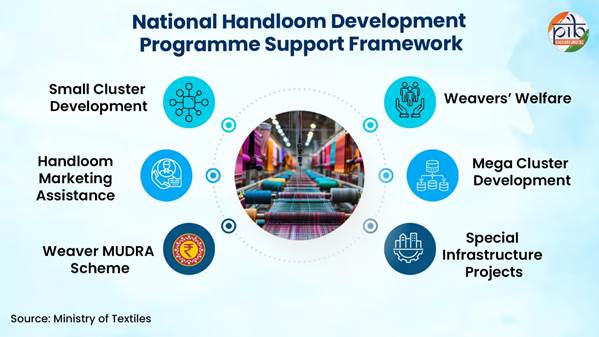
NHDP was formulated for implementation from 2021-22 to 2025-26. It follows a need-based approach to the integrated development of the handloom sector, focusing on the welfare of handloom weavers.
NHDP components are implemented through Government handloom organisations, as well as national and State-level handloom corporations. Implementing agencies also include weavers’ cooperative societies, federations, Handloom Producer Companies and participating banks.
Handloom Producer Companies organise weavers into professionally managed, member-owned enterprises. Under NHDP, 200 HPC were formed during 2020-21 to 2026-27.
The Programme delivers its wider support through the following key components:
a. Small Cluster Development Programme (SCDP)
SCDP supports small handloom clusters with funding of up to ₹2 crore to address their specific development needs. The assistance covers better looms, lighting and worksheds, alongside design, product development and marketing.
- From 2021-22 to 2026-27 (till June), 357 clusters were sanctioned under the programme.
- Additionally, during 2025-26, ₹94 crore was released for key interventions such as worksheds, looms and accessories, and electronic jacquards.
- Between 2021-22 to 2026-27 (till June), 960+ events were organised to facilitate the sale of handloom products at the district, state and national levels. These included National, State and District Handloom Expos, Craft Melas and other marketing events.
- Under HMA, two national-level awards, The Sant Kabir Handloom Award and The National Handloom Award recognise outstanding contributions to the handloom sector. The latest completed award cycle covered the 2024 awards, presented on National Handloom Day 2025. A total of 24 recipients were honoured, including 5 Sant Kabir and 19 National Handloom awardees. The awardees included six women and one Divyang weaver.
The Sant Kabir Handloom Award recognises outstanding weavers for exceptional skills and contributions to weaving traditions, community welfare and sector development. The award carries ₹3.5 lakh, a mounted gold coin, tamrapatra, shawl and certificate.
The National Handloom Award honours craftsmanship, dedication and innovation and includes ₹2 lakh, a tamrapatra, shawl and certificate.
c. Concessional Credit/Weaver MUDRA Scheme
The scheme provides handloom-sector loans at a concessional 6% interest rate for three years. This is further supported by government interest subvention of up to 7%. It also offers margin money assistance and covers credit guarantee fees. The Handloom Weaver MUDRA Portal supports the timely transfer of financial assistance.
- Between 2021-22 to 2026-27 (till June), a total of ~40,000+ loans, amounting to ~₹280+ crore, were sanctioned.
- As on 2026-27, a total of 967 loans, amounting to ₹7.45 crore, were sanctioned.
The Ministry of Textiles continues to provide social security to handloom weavers across India. Social security is ensured through insurance schemes like the Pradhan Mantri Jeevan Jyoti Bima Yojana (PMJJY), Pradhan Mantri Suraksha Bima Yojana (PMSBY) and converged Mahatma Gandhi Bunkar Bima Yojana (MGBBY). These offer coverage against natural and accidental death, as well as disability.
The weavers’ welfare measures provide social security to handloom weavers and workers, along with scholarships for their children. These include:
- Pradhan Mantri Jeevan Jyoti Bima Yojana (PMJJBY): PMJJBY provides annually renewable life insurance to handloom weavers and workers aged 18-50 years. It offers a benefit of ₹2 lakh in the event of death due to any cause.
- Pradhan Mantri Suraksha Bima Yojana (PMSBY): PMSBY provides annually renewable accident insurance to handloom weavers and workers aged 18-70 years. It offers ₹2 lakh for accidental death or permanent total disability and ₹1 lakh for permanent partial disability.
- Scholarship: Scholarships of up to ₹2 lakh annually support two children per handloom worker pursuing recognised textile diploma, undergraduate or postgraduate courses. Since inception, 531 applications were sanctioned by June 2026.
Awardee weavers above 60 years of age, living in indigent conditions and earning below ₹1 lakh annually, are provided financial support of ₹8,000 per month. In addition, their children (up to two) are eligible for scholarships of up to ₹2 lakh per year for pursuing diploma, undergraduate, or postgraduate studies in government-recognised textile institutions
Under the Mega Cluster Development Programme, each mega handloom cluster covers at least 10,000 handlooms/clusters and can receive central assistance of up to ₹30 crore over five years.
- Eight Mega clusters are completed and functional and Four Mega clusters are under implementation.
- Under the Programme, financial assistance of ₹370.72 crore was released, benefiting a total of 1,62,682 handloom weavers.
Under the Programme, assistance of up to ₹12 crore is provided for product development, productivity, quality improvement, value addition and marketing.
Six Craft Handloom Villages are operational and three are under implementation.2. Raw Material Supply Scheme (RMSS)
The Yarn Supply Scheme (YSS), now partially modified and renamed as the Raw Material Supply Scheme (RMSS), has been approved for implementation for the period 2021–22 to 2025–26. The scheme aims to support handloom weavers by ensuring the availability of quality yarn at affordable prices through the following key objectives and components.
Objectives
- Provide quality yarn and blends to eligible handloom weavers at subsidised rates.
- Set benchmark prices and maintain consistent quality and supply.
- Supply dyed yarn to address poor dyeing facilities and support product diversification.
- Support handloom weavers in competing with the mill sector.
Subsidy
Under the scheme, freight charges are reimbursed for all type of yarns and component of 15% of yarn subsidy is there for cotton hank yarn, domestic silk, wool and linen yarn and blended yarn of natural fibers with quantity cap, so that handloom weavers may can compete with power-looms in pricing.
The Next-Generation GST reforms recommended at the 56th GST Council meeting in September 2025 included measures supporting the handloom sector.
- Under the GST rationalisation, the tax rate on 36 handicraft items was reduced from 12% to 5%.
- Cotton handloom rugs and handwoven carpets were also brought under the 5% GST rate.
- The rate on domestic and industrial sewing machines was similarly reduced from 12% to 5%, easing costs for tailoring units and supporting domestic manufacturing.
4. Union Budget 2026-27: A New Policy Push for India’s Handlooms
The Union Budget 2026-27 placed special emphasis on textiles through several new measures:
- The National Fibre Scheme is designed to strengthen the textile raw-material base. It promotes self-reliance in natural, man-made and new-age fibres.
- Traditional clusters will be modernised under the Textile Expansion and Employment Scheme. It provides capital support for machinery, technology upgrades, and common testing and certification centres.
- The National Handloom and Handicraft Programme will integrate and strengthen existing schemes. This will ensure targeted support for both sectors.
- The Mahatma Gandhi Gram Swaraj Initiative will strengthen khadi, handloom and handicrafts while benefiting weavers, village industries, rural youth and the One District One Product (ODOP) initiative. It focuses on global market linkages, branding, training, skilling, and improvements in production processes and quality.
- Weave The Future 4.0: Upcycling Edition of the event took place at Dilli Haat, New Delhi, from 12-17 July 2026. The exhibition brought together more than 100 brands, artisans, recyclers and innovators working in circular design. It promoted upcycling, repair, sustainable production and responsible consumption.
- Handloom Hackathon 2026: Ministry of Textiles launched Handloom Hackathon 2026 –‘Weaving Innovation’ for National Handloom Day 2026. The challenge invites students, weavers, artisans, researchers, startups and professionals to develop practical solutions for the sector. Its themes span design, sustainability, digital technology, market access, branding, productivity and entrepreneurship.
These appearances demonstrate the widening visibility of Indian handlooms. Through fashion shows, pageants, cinema, textile exhibitions and collaborative design platforms, regional weaves are entering broader cultural and creative spaces. This growing visibility forms part of a wider story that also encompasses market access and India’s handloom export presence.
Strengthening Market Access and Buyer Confidence
Distinctive designs, small-batch production and eco-friendly processes have created strong demand for handloom products in domestic and international markets.
India’s handloom exports stood at ~₹1,330.96 crore in 2025-26. The leading export destinations during this period were the UAE, the United States, France, the United Kingdom and Spain.
As handloom products reach wider and more diverse markets, establishing their authenticity, quality and origin becomes increasingly important. Government-supported marks, branding systems, GI registration and legal safeguards help distinguish genuine handloom products and protect recognised weaving traditions. Digital platforms are also expanding market access.
- Around 1.50 lakh weavers and handloom entities have joined GeM to supply government buyers.
- Indiahandmade platform enables verified weavers and producer groups to sell authentic products, including GI-tagged items, directly to consumers. The platform onboarded 4,186 weavers & artisans between 2023-24 and June 2026.
Handloom Mark: Establishing that a Product is Handwoven
Launched in 2006, the Handloom Mark scheme gives handloom products a collective and distinctive identity. It promotes handwoven goods while assuring buyers that the product they purchase is genuinely handwoven and helps identify the product or its manufacturer more easily.
- As of 30 June 2026, 29,402 Handloom Mark registrations have been issued and;
- A total of 815 retail outlets were selling products carrying the label
The GI Act, 1999 protects registered geographical indications from unauthorised use. Registered users may approach police authorities against illegal manufacture or marketing, while State Handlooms and Textiles Departments have been advised to strengthen protection.
- As reported in August 2026, registrations covered 106 handloom products, six product logos and 227 handicraft products.
- The Handlooms Act, 1985 protects weavers and India’s cultural heritage from encroachment by powerlooms and mills. It reserves 11 specified textile articles for handloom production.
- Government agencies inspect powerloom units to prevent the production of items reserved exclusively for handlooms.
Infographic Based on National Handloom Day

NABARD Grade A Answer Writing Q. Discuss about Handloom Sector in India, Its Key Features, Socio-economic Significance and Structural Challenges Plaguing the Growth of this Sector in India. (600 Words, 15 Marks)
Model Answer:
India’s handloom sector is one of the oldest and most decentralised segments of the textile industry, deeply rooted in the country’s cultural heritage and rural economy. Its historical roots can be traced to the Indus Valley Civilisation, with references to spinning and weaving found in ancient Indian texts. The sector continues to provide livelihoods to millions of rural households while preserving India’s traditional weaving skills and regional identities. The significance of the sector is also reflected in the observance of National Handloom Day on 7 August, instituted in 2015 to commemorate the Swadeshi Movement of 1905, which promoted indigenous industries, particularly handloom weavers.
I. Key Features of the Handloom Sector in India
- Large employment base: The Fourth All India Handloom Census 2019-20 recorded 31.45 lakh handloom households and 35.22 lakh weavers and allied workers, including 8.48 lakh workers engaged in pre-loom and post-loom activities.
- Women-centric sector: Women constitute 25.46 lakh, or more than 72%, of the handloom workforce, making the sector an important instrument of women’s economic empowerment.
- Rural and decentralised character: India has 28.20 lakh looms, of which 25.30 lakh are located in rural areas. Thus, nearly nine out of every ten handlooms are situated in rural India.
- Diverse and skill-intensive: Handloom products are strongly linked with regional fibres, motifs, techniques and traditional knowledge passed across generations.
- Environment-friendly production: Handloom is generally characterised by low capital and power requirements and small-batch, skill-intensive production, giving it potential advantages in sustainable textile production.
II. Socio-economic Significance
- Livelihood generation: With over 35 lakh workers, handloom provides employment to millions, particularly in rural and semi-rural areas.
- Women empowerment and inclusion: The predominance of women workers and participation of 4.84 lakh SC, 6.28 lakh ST and 12.67 lakh OBC workers highlights its role in inclusive rural development.
- Cultural preservation: Regional handlooms preserve indigenous knowledge, traditional designs, local identities and craftsmanship.
- Export potential: India’s handloom exports were around ₹1,330.96 crore in 2025-26, with the UAE, USA, France, UK and Spain among the leading destinations.
- Rural industrialisation: Since nearly 90% of looms are located in rural areas, the sector supports decentralised economic activity and complements agriculture-based livelihoods.
III. Structural Challenges Plaguing the Sector
- Low productivity and technological gaps: Traditional looms, inadequate worksheds and limited adoption of modern technology constrain productivity and income.
- Fragmented production structure: Household-based and dispersed production makes economies of scale, standardisation, branding and coordinated marketing difficult.
- Raw material and credit constraints: High and fluctuating yarn costs, limited working capital and inadequate access to affordable institutional credit affect profitability.
- Weak market linkages: Weavers often face dependence on intermediaries, inadequate branding and limited direct access to domestic and international consumers.
- Competition from powerlooms and substitutes: Mechanised production can offer greater scale, speed and price competitiveness, creating pressure on traditional handloom products.
- Skill and generational challenges: Low and uncertain returns can discourage younger generations from continuing traditional weaving skills, creating a risk of skill erosion.
IV. Government Measures and Way Forward
The National Handloom Development Programme (NHDP) and Raw Material Supply Scheme (RMSS) constitute the core support architecture. NHDP promotes integrated, need-based development through cluster development, marketing assistance, concessional credit, welfare measures and infrastructure.
The Small Cluster Development Programme provides assistance of up to ₹2 crore, while 357 clusters had been sanctioned during 2021-22 to 2026-27 up to June. The Weaver MUDRA Scheme provides credit at a concessional 6% interest rate, supported by interest subvention.
Further, RMSS provides freight reimbursement and 15% price subsidy on specified yarns. NHDP and RMSS have budgetary allocations of ₹205 crore and ₹200 crore, respectively, for 2026-27.
The way forward should focus on technology upgradation, design innovation, skilling, producer companies and FPO-like collective structures, digital marketing, GI and Handloom Mark enforcement, affordable credit, export promotion and stronger producer-to-consumer linkages. The Handloom Hackathon 2026 is a positive step towards technology, sustainability, market access, branding and entrepreneurship.
In conclusion, the handloom sector is not merely a traditional industry but an important pillar of rural employment, women empowerment, cultural preservation and sustainable development. The priority should be to transform handloom from a low-income subsistence activity into a technology-enabled, market-oriented and globally competitive rural enterprise, while preserving the traditional skills and identities that make Indian handlooms unique.
Source: PIB Explainer 2026, PIB Explainer 2025.
*****
