

Semiconductors are the backbone of modern electronics, powering computers, mobile devices, telecommunications, automobiles, defence systems and artificial intelligence. India has made steady progress in consolidating earlier investments into a full-stack value chain of its semiconductor ecosystem under ISM 1.0, expanding design capabilities and advancing fabrication, assembly and testing infrastructure across the country. This momentum reflects the broader vision of Aatmanirbhar Bharat and India’s transition from policy formulation to production readiness. Building on these gains, ISM 2.0 seeks to consolidate India’s position as a reliable and competitive participant in the global semiconductor network.

ISM 1.0: Establishing the Foundation
The India Semiconductor Mission (ISM) was launched in December 2021 with a financial outlay of ₹76,000 crore to establish a domestic semiconductor ecosystem. The objective of ISM 1.0 was to create manufacturing capability within India while reducing dependence on imported semiconductors and strengthening supply chain resilience.
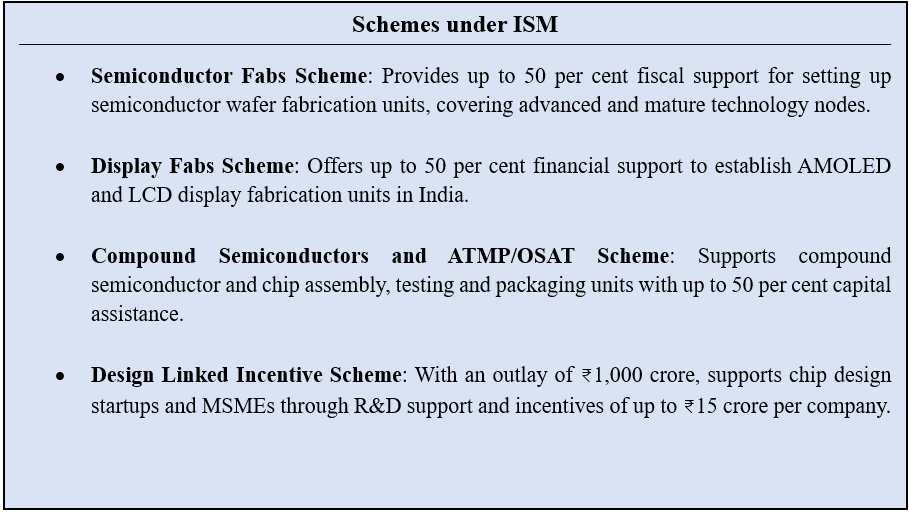
The Government announced fiscal support of up to 50% of eligible project costs for semiconductor fabrication facilities, compound semiconductor units, Assembly, Testing, Marking and Packaging (ATMP) facilities, Outsourced Semiconductor Assembly and Test (OSAT) facilities, and semiconductor design companies.
Over the past few years, the initiative has translated policy into tangible industrial investments. According to the official Government release, ISM 1.0 has resulted in:
- Approval of 10 semiconductor projects
- Total approved investments exceeding ₹1.60 lakh crore
- Projects spread across six Indian states
- Investments covering silicon fabs, silicon carbide manufacturing, memory packaging, advanced packaging, and assembly and testing facilities
Several leading projects approved under ISM 1.0 include:

These facilities are expected to meet the growing chip requirements of key sectors such as consumer appliances, industrial electronics, automobiles, telecommunications, aerospace, and power electronics. Notably, several approved proposals are leveraging indigenous technologies for the assembly, testing, and packaging of semiconductor chips. This shift reflects India’s move towards deeper technological capability and reduced dependence on external systems, strengthening its position in the global semiconductor value chain.
ISM 2.0: Expanding Beyond Manufacturing
- The Union Cabinet chaired by the Prime Minister Shri Narendra Modi has approved the Semicon 2.0 for the development of India's semiconductor design and manufacturing ecosystem, with a total budget outlay of Rs.1,27,500 crore.
Semicon 2.0 is aimed to holistically build the semiconductor ecosystem on the following six pillars:
- First pillar: Design: Semicon 2.0 will build upon the initial success in chip design. With 105 startups already started developing chips, the focus is on deepening the design ecosystem. Further, building blocks have been identified for the development of strategic and commercial products. Under Semicon 2.0, the aim is to develop IPs, designs of chips and systems with this approach. The work under Semicon 2.0 will place India as a key semiconductor chip design IP country.
- Second pillar: Machines and materials: Companies involved in the manufacturing and R&D of the machines and manufacturing of materials, chemicals and gases that are essential for manufacturing semiconductors will be incentivized. This will lay the foundation for the sustainable growth of the semiconductor industry. This will also help in developing the precision manufacturing industry in our country.
- Third pillar: Setting up more fabs: With the first fab scheduled to be commissioned in 2028, the world is showing greater confidence in India’s semiconductor strategy. Efforts will be made to attract more manufacturers to come to India and set up fabs to manufacture chips. This will include silicon fabs, compound semiconductor fabs, discrete component fabs, display fabs, etc.
- Fourth pillar: Further strengthening the ATMP/OSAT industry: With the success of ATMP units, the world is now looking at India as an alternative location for setting up ATMP/OSAT units. These will be actively encouraged with a focus on getting some of the most advanced ATMP technologies to India.
- Fifth pillar: Research & Development: The semiconductor journey has started with 28nm-110nm as the node. Now, the focus will be on developing more advanced nodes and other advanced technologies in collaboration with leading R&D centres within and outside India.
- Sixth pillar: Talent development: With 315 universities training students on complex chip design using the latest EDA tools, around 68,000 students have already been trained. It will be developed further and deepen the level of training while in college. Further, the industry will be actively engaged in deepening the clean room, fab construction and other ecosystem training as well.
Further, Semicon 2.0 will support economic growth across all sectors, strengthen national security through enhanced supply chain resilience, and help establish technological leadership in critical sectors. Approach of building the complete ecosystem, will catalyse semiconductor design and manufacturing in India.

Sectoral Outlook: India’s Semiconductor Ecosystem
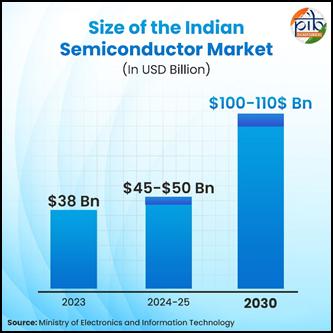
India is steadily emerging as a global semiconductor hub. Large scale investments, expanding manufacturing capacity, and platforms such as SEMICON India 2025 reflect growing global confidence in India’s semiconductor journey. The domestic chip market is witnessing rapid growth. As per industry estimates, the size of the Indian semiconductor market was about $38 Bn in 2023, $45-$50 billion in 2024-2025 and is expected to reach $100-$110 Bn by 2030. This expansion is anchored in the national vision of Make in India and Make for the World, positioning India as both a manufacturing base and a global supplier.
The foundation of this growth was laid with the approval of India Semiconductor Mission 1.0 by the Union Cabinet in December 2021. The Mission is supported by an incentive framework of ₹76,000 crore, offering fiscal support of up to 50 per cent for silicon fabs, compound semiconductor facilities, assembly and testing units, and chip design. As of December 2025, 10 projects with a total investment of ₹1.60 lakh crore have been approved across 6 states. These include silicon fabrication units, silicon carbide fabs, advanced and memory packaging facilities, and specialised assembly and testing infrastructure. Together, they are shaping a resilient domestic semiconductor ecosystem.
By 2029, India is expected to achieve the capability to design and manufacture chips required for nearly 70–75 per cent of domestic applications. Advancing on this foundation, the next phase under Semicon 2.0 will focus on advanced manufacturing, with a clearly defined roadmap to achieve 3-nanometre and 2-nanometre technology nodes. By 2035, India aims to be among the top semiconductor nations globally.
Why the India Semiconductor Mission Matters
Semiconductors have become critical to the functioning of modern economies. Though rarely visible in everyday life, microprocessors quietly power systems that keep societies running. As highlighted in the Economic Survey 2025–26, they form the backbone of energy networks, financial markets and telecommunications. They enable manufacturing units, hospitals, transport systems and satellites. A reliable supply of semiconductors is therefore essential for economic stability and continuity across sectors.
Recent global disruptions have underscored this dependence. The COVID-19 pandemic exposed serious weaknesses in semiconductor supply chains, with shortages affecting more than 169 industries worldwide. Production delays and rising costs followed, slowing economic activity across countries. These shocks revealed the risks of relying on a narrow set of suppliers. Today, the semiconductor industry is dominated by a few countries, including Taiwan, South Korea, Japan, China and the United States. Taiwan alone produces over 60 per cent of the world’s semiconductors and nearly 90 per cent of the most advanced chips, leaving global supply chains vulnerable to external shocks and geopolitical tensions.
In response, major economies are recalibrating their strategies. The United States, the European Union, Japan and South Korea have launched national initiatives to strengthen domestic chip manufacturing and diversify supply chains. India is positioning itself within this global shift as a trusted and reliable partner. The India Semiconductor Mission responds directly to this moment. By building domestic capacity across design, manufacturing and innovation, ISM represents a critical step towards self-sufficiency and technological sovereignty, while strengthening India’s role in a more resilient global semiconductor ecosystem.
At the core of this strategy lies a strong focus on semiconductor design and talent development, which together form the foundation of technological self-reliance.
Advancing Indigenous Microprocessors and Core Semiconductor Technologies
Microprocessors form the foundational layer of modern digital infrastructure, powering devices and systems across telecommunications, mobility, healthcare, industry, defence, and space. Recognising their strategic importance, India has made focused investments to build sovereign capabilities in advanced processor design as a core pillar of semiconductor self-reliance.
A key milestone in this journey is the launch of DHRUV64, a fully indigenous 64-bit microprocessor developed by C-DAC under the Microprocessor Development Programme (MDP). Built on modern architectural principles, DHRUV64 delivers improved efficiency, multitasking capability, and reliability, enabling its deployment across sectors such as 5G infrastructure, automotive electronics, industrial automation, consumer devices, and the Internet of Things (IoT). Its development provides India with a secure, homegrown processor platform, reducing long-term dependence on imported chips—particularly significant given that India consumes nearly 20 per cent of global microprocessor output.
DHRUV64 builds on a growing portfolio of indigenous processors, including SHAKTI, AJIT, VIKRAM, and THEJAS, collectively forming the foundation of an Indian processor ecosystem. Developed under the Digital India RISC-V (DIR-V) Programme, these processors leverage the open-source RISC-V architecture, eliminating licence costs and enabling collaborative innovation across academia, startups, and industry. The rollout of DHRUV64, alongside the ongoing development of DHANUSH and DHANUSH+ System on Chips variants, strengthens India’s R&D ecosystem, accelerates product prototyping, and expands opportunities for domestic design talent.
Together, these initiatives position microprocessors not merely as components, but as strategic enablers of India’s digital sovereignty—supporting innovation, securing critical infrastructure, and anchoring the country’s long-term ambitions in the global semiconductor value chain.
Development of Semiconductor Talent Pipeline
A strong semiconductor ecosystem depends as much on people as on infrastructure. India has therefore adopted a comprehensive approach to build a large, skilled and industry ready talent base across design, manufacturing and advanced packaging. The emphasis is on early exposure to chip technologies, practical training, and continuous upskilling aligned with evolving industry requirements.
- Chips to Start up Programme: The Chips to Start up programme enables access to the latest electronic design automation tools across 397 universities and startups. Using these tools, chip designers from more than 46 universities have designed and fabricated 56 chips at the Semiconductor Laboratory in Mohali.
- Academic Programmes under All India Council for Technical Education (AICTE): Specialised academic programmes have been introduced to integrate semiconductor education into mainstream engineering. These include a B Tech in Electronics Engineering with focus on VLSI design, a diploma in integrated circuit manufacturing, and a minor degree in Electronics Engineering covering VLSI design and technology. Together, these programmes aim to produce graduates equipped with industry relevant skills.
- SMART Lab at NIELIT Calicut: The Skilled Manpower Advanced Research and Training Lab at NIELIT Calicut supports large scale training in semiconductor technologies. The initiative targets one lakh engineers across the country, with more than 62,000 engineers already trained, significantly strengthening the national talent pool.
- Industry Partnership with Lam Research: A large-scale training programme in nanofabrication and process engineering is being implemented in partnership with Lam Research. The focus is on building specialised skills for (ATMP) and advanced packaging facilities. The programme aims to generate 60,000 trained professionals over the next ten years.
- FutureSkills PRIME Programme: FutureSkills PRIME is a joint initiative of MeitY and NASSCOM designed to position India as a global digital talent hub. It focuses on skilling, reskilling and upskilling in emerging technologies, including semiconductors. Courses are developed with industry inputs and delivered through an online portal that enables learners to access training anytime and earn recognised skill certificates aligned with their aspirations.
Together, these initiatives are creating a robust and future ready semiconductor workforce, positioning India to sustain long term growth across the full chip value chain.
