

The Pradhan Mantri Vidyalaxmi Scheme is a flagship initiative of the Education Ministry that seeks to make quality higher education accessible to deserving students facing financial constraints. The scheme provides collateral-free and guarantor-free education loans to such students for studying in top ranked higher education institutions in the country. It further supports beneficiaries through interest subvention based on family income, reducing financial constraints to educational attainment. In doing so, the scheme contributes to India's progress towards SDG 4, which seeks to ensure inclusive and equitable quality education and promote lifelong learning opportunities for all by 2030.

Bridging Financial Barriers to Higher Education
India has witnessed rapid expansion in higher education enrolment over the last decade, with the Gross Enrolment Ratio (GER) rising from 23.7% in 2014-15 to 30.0%in 2023-24. However, for many meritorious students, access to quality higher education in the top-ranked institutions of the country often remains difficult due to financial constraints. Many try to fill the gaps through education loans, but there are many more who cannot afford the high interest rates on these loans. The dreams of these students to study in IITs, IIMs and many other top-ranked institutions of the country remain unfulfilled despite their merit.
The PM Vidyalaxmi Scheme (PM-Vidyalaxmi), approved by the Union Cabinet on 6th November 2024, comes to the aid of such students. This is a mission-mode intervention under which collateral-free, guarantor-free education loans are provided to students who have got admission on their own merit to one of the designated Quality Higher Educational Institutions (QHEIs) in the country. A 3% interest subvention is also provided for students with annual family income up to ₹8,00,000. The objective is to ensure that lack of finance does not prevent any meritorious student from studying in the best institutions in the country.
Features, Benefits and Coverage
PM-Vidyalaxmi provides collateral-free and guarantor-free education loans for students admitted on their own merit to designated QHEIs in the country. Currently, 1,425 QHEIs are covered under the scheme, including both public and private institutions. Management quota, NRI quota, etc. admissions will not get this benefit.
Loans up to ₹ 7.5 lakhs are provided 75% credit guarantee by Government of India, to support banks to expand coverage. For students with up to ₹ 8 lakhs annual family income, the scheme provides for 3% interest subvention on loans up to ₹ 10 lakh. This is in addition to the full interest subvention already offered to students with up to ₹ Rs. 4.5 lakhs annual family income.
Collateral-free, Guarantor-free Education Loans
Students admitted to eligible QHEIs can obtain education loans without furnishing collateral or third-party guarantees under PM-Vidyalaxmi. There is no cut-off on highest amount of education loan. It will depend on course fee and other fees charged by the QHEI and other associated expenses (like mess, hostel fee, other refundable and non-refundable fees of the QHEI, cost of a reasonable quality laptop and reasonable amount of living expenses required by the student during the course period) and students from all income categories are eligible to apply.
To encourage lending institutions to extend loans to students, the Government provides a 75% credit guarantee for loans up to ₹7.5 lakh. This significantly reduces lender risk and improves loan accessibility.
The interest rates charged on the educational loan under the scheme will be capped at the individual bank’s Externally Benchmarked Lending Rate (EBLR) + 0.5%. The rate will always be less than the interest rate charged by the bank on other education loans not covered under PM-Vidyalaxmi. The repayment period of the education loan is up to 15 years, excluding a moratorium period of the course period plus one year. The loan is available for all degree /diploma programmes in India and there is no limit on the number of students getting such loans. The educational loans are provided through Scheduled Banks, Regional Rural Banks (RRBs), and Cooperative Banks participating in the scheme.
Interest Subvention
Case - I: Under Vidya Lakshmi
PM-Vidyalaxmi interest subvention scheme’s coverage is broad-based and includes all courses at designated Quality Higher Educational Institutions (QHEIs). Under the scheme, interest subvention of 3% on loans up to ₹ 10 lakhs is awarded during the moratorium period (course period plus one year) to those meritorious students whose family’s annual income is less than ₹8,00,000.
- If the education loan amount is more than ₹ 10 lakhs, interest subvention is provided for the disbursed total principal amount of the loan up to ₹ 10 lakhs only.
- Student availing any other Central /State Government Scholarship or any other interest subvention scheme or Fee reimbursement shall not be eligible for availing interest subvention benefits under CSIS or PM-Vidyalaxmi.
- In a year, a maximum of one lakh students shall be eligible for 3% interest subvention during the moratorium period. No such limit is for PM USP CSIS beneficiaries.
Case - II: PM-USP CSIS
- Full interest subvention during moratorium for loans up to Rs. 10 Lakh for students with family income up to Rs 4.50 Lakh.
- PM-Vidyalaxmi supplements the PM-USP CSIS (Pradhan Mantri Uchchatar Shiksha Protsahan Central Sector Interest Subsidy Scheme). Under PM-USP CSIS, students who are pursuing technical/ professional courses from approved NAAC accredited HEIs/ NBA accredited courses and whose annual family income is up to ₹4.5 lakhs, shall be eligible for 100% interest subvention during moratorium period for education loan up to ₹ 10 lakhs.
What is Moratorium?
- The moratorium period is course period plus one year. Moratorium period is the period when Bank does not demand principal or Interest.
Loan Tenure and Budget Allocation:
- Loan tenure is maximum up to 15 years excluding course period and moratorium under the scheme.
- Interest subvention and credit guarantee benefits are available only once for undergraduate, postgraduate, or integrated courses.
- The Government has allocated a budget of ₹ 3,600 Crores from 2024-2025 to 2030-2031 for the scheme.

Eligibility Criteria for Students
- The scheme is available to students who have secured merit-based admission through competitive exams in any of the designated Quality Higher Education Institutions (QHEIs) in India.
- The scheme provides education loans for all degree and diploma courses.
- The repayment period of the education loan would be up to 15 years excluding the moratorium period (course period + 1 year).
- To avail all these benefits, students are required to register through Aadhaar, remain enrolled in their courses, and maintain a satisfactory academic performance.
Additional Conditions:
- The applicant must not discontinue the course midway or be expelled from the institution due to disciplinary or academic reasons.
- From the second year onwards, the student must maintain satisfactory academic performance to continue receiving interest subvention benefits.
- The student can avail of interest subvention and credit guarantee benefits only once, either for an undergraduate, postgraduate, or integrated course.
Eligibility Criteria for Higher Education Institutions
The criteria for shortlisting institutions are based on their NIRF rankings. It currently covers institutions that are
- Top 100 ranked HEIs in the overall/ category-specific and/or domain-specific rankings in the latest list of NIRF published by the Ministry of Education
- Top 200 ranked HEIs under the governance of State/Union Territories governments in the latest list of NIRF published by the Ministry of Education
- All remaining HEIs under the governance of the Government of India.
Indian campuses of foreign education institutions, foreign campuses of Indian education institutions and foreign education institutions are not covered under the scheme.
The criteria to select HEIs across India ensures equitable inter-state representation.
- This list is updated using the latest NIRF ranking. As of now, 1,425 institutions are covered under PM-Vidyalaxmi and are eligible for PM-Vidyalaxmi education loans.
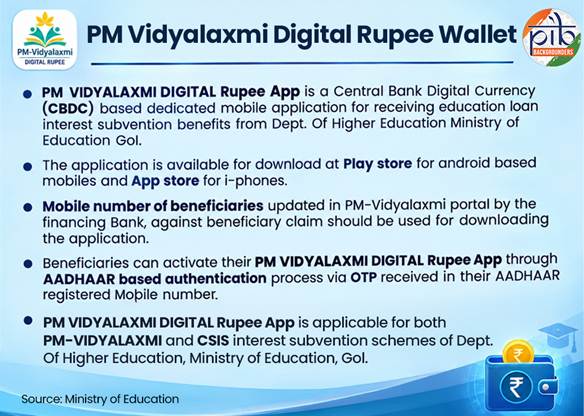
PM Vidyalaxmi Digital Rupee App (CBDC Wallet)
Once the loan is sanctioned and disbursed, eligible students can apply for interest subvention based on their family income. The subsidy amount is credited to the beneficiary's PM Vidyalaxmi Digital Rupee App (CBDC Wallet) and subsequently transferred to the education loan account.
Central Sector Interest Subsidy Scheme (CSIS) provides full interest subsidy during the moratorium period on loan availed for pursuing technical/professional courses in India. Students whose annual gross parental/ family income is up to ₹ 4.5 lakh are eligible under the scheme.
Existing PM-USP CSIS is being administered through the PM-Vidyalaxmi portal and PM-Vidyalaxmi Digital Rupee Wallet. As of July 22, 2026, there are 35,777 active wallets enabling disbursement of subsidies worth ₹57.66 crore. This digital mechanism has helped streamline benefit delivery, reduce delays, and ensure that financial support reaches eligible students efficiently.
Impact of PM Vidyalaxmi Scheme
PM-Vidyalaxmi is designed as a unified, fully digital and transparent education loan facilitation platform, enabling students to apply to banks for all kinds of education loans including PM-Vidyalaxmi loans, through a single portal and track their application status online. The dashboard provides real-time statistics on applications, approvals and processing stages.
In FY 2025-26, 645514 education loan applications were received on the portal across all education schemes. Out of these,110667 applications were for PM-Vidyalaxmi loans.
The scheme facilitates the inclusion of students from financially weaker backgrounds into the mainstream education system, thereby enhancing overall inclusivity. Among the total applications submitted, there were students from the Economically Weaker Section (EWS), General category, Non-Creamy Layer Other Backward Classes (NCOBC), Other Backward Classes (OBC), Scheduled Castes (SC), Scheduled Tribes (ST), and Persons with Disabilities (PwD). The involvement of applicants from all major social groups reflects the scheme’s extensive reach and inclusive framework. This underscores the scheme’s contribution to reducing financial barriers and promoting fair and equitable access to educational opportunities across different sections of society.
Infographic on PM Vidyalaxmi Scheme

Practice Questions for RBI Grade B, NABARD Grade A Exam
Q1. Aditya Verma, a resident of Nagpur, Maharashtra, avails an education loan under the PM-Vidyalaxmi Scheme in 2026. The following facts are available:
- Aditya secured admission to an IIT, a designated QHEI, through JEE Advanced on his own merit.
- He availed a collateral-free and guarantor-free education loan of ₹6 lakh.
- His annual family income is ₹7 lakh, and he claimed 3% interest subvention on the loan.
- The Government provided a 75% credit guarantee on his ₹6 lakh loan.
- He was already availing a State Government scholarship and simultaneously claimed the PM-Vidyalaxmi interest subvention.
- The interest rate on his loan was set at the bank's EBLR + 1.5%.
Which of the following combinations correctly identifies the statements that are not in conformity with the provisions of the PM-Vidyalaxmi Scheme?
A. 3 and 5 only
B. 5 and 6 only
C. 1, 4 and 6 only
D. 2, 3 and 5 only
E. 4, 5 and 6 only
Answer: B
Statement 5 is wrong: a student availing any other Central or State Government scholarship or interest subvention or fee reimbursement is not eligible for PM-Vidyalaxmi interest subvention. Statement 6 is wrong: the interest rate is capped at the bank's EBLR + 0.5%, not EBLR + 1.5%. Statements 1 to 4 conform (merit admission to a QHEI, collateral-free loan, 3% subvention for income up to ₹8 lakh on loans up to ₹10 lakh, and 75% credit guarantee on loans up to ₹7.5 lakh).
Q2. Priya Nair, a resident of Kochi, Kerala, seeks benefits under the PM-Vidyalaxmi Scheme. The following facts are available:
- Priya secured admission to a top-100 NIRF private QHEI under the management quota.
- She applied for a collateral-free, guarantor-free loan of ₹9 lakh.
- Her annual family income is ₹5 lakh, so she claimed full interest subvention under PM-Vidyalaxmi.
- She understood the moratorium period as the course period plus one year.
- She planned to repay the loan over 18 years after the moratorium period.
- The interest rate on her loan was capped at the bank's EBLR + 0.5%.
Which of the following combinations correctly identifies the statements that are not in conformity with the provisions of the scheme?
A. 1, 3 and 5 only
B. 2, 4 and 6 only
C. 1, 5 and 6 only
D. 3, 4 and 5 only
E. 1, 2 and 3 only
Answer: A
Statement 1 is wrong: management quota admissions are not covered. Statement 3 is wrong: PM-Vidyalaxmi provides 3% interest subvention, not full subvention; full subvention during the moratorium is under PM-USP CSIS for family income up to ₹4.5 lakh, which she does not meet. Statement 5 is wrong: the repayment period is up to 15 years, not 18. Statements 2, 4 and 6 conform (no cap on loan amount, correct moratorium definition, EBLR + 0.5% cap).
Q3. Rahul Mishra is comparing which institutions qualify under the PM-Vidyalaxmi Scheme. The following facts are available:
- Rahul got admission to an Indian campus of a foreign university and applied under the scheme.
- His friend enrolled in a State-Government HEI ranked 150 in NIRF, which is covered.
- Another applicant joined a Government of India-governed HEI ranked 350 in NIRF and was told it is not covered.
- A private HEI ranked 80 in the overall NIRF list was included in the QHEI list.
- Rahul's cousin joined a State-Government HEI ranked 250 in NIRF and claimed it qualifies.
- Currently, 1,425 institutions are covered under the scheme.
Which of the following combinations correctly identifies the statements that are not in conformity with the provisions of the scheme?
A. 1, 2 and 4 only
B. 2, 4 and 6 only
C. 1, 3 and 5 only
D. 3, 5 and 6 only
E. 1, 4 and 5 only
Answer: C
Statement 1 is wrong: Indian campuses of foreign institutions are not covered. Statement 3 is wrong: all remaining HEIs under Government of India governance are covered irrespective of rank, so the institution is in fact covered. Statement 5 is wrong: State-Government HEIs qualify only up to the top 200 in NIRF, so a rank of 250 does not qualify. Statements 2, 4 and 6 conform (top 200 State HEIs, top 100 HEIs overall, and the current figure of 1,425 institutions).
Q4. Sneha Roy, a resident of Kolkata, West Bengal, avails scheme benefits. The following facts are available:
- Sneha availed PM-Vidyalaxmi interest subvention for her undergraduate course and later claimed it again for her postgraduate course.
- Her loan amount was ₹12 lakh, and she received 3% interest subvention only on ₹10 lakh of the principal.
- Her family income was ₹7.5 lakh, making her eligible for the 3% interest subvention.
- She was told that up to 5 lakh students per year are eligible for the 3% interest subvention.
- She received the subvention amount in her PM Vidyalaxmi Digital Rupee App (CBDC Wallet).
- The subvention was available for the entire 15-year repayment period.
Which of the following combinations correctly identifies the statements that are not in conformity with the provisions of the scheme?
A. 2, 3 and 5 only
B. 1, 3 and 6 only
C. 4, 5 and 6 only
D. 1, 4 and 6 only
E. 1, 2 and 4 only
Answer: D
Statement 1 is wrong: interest subvention and credit guarantee benefits are available only once, either for an undergraduate, postgraduate, or integrated course. Statement 4 is wrong: a maximum of one lakh students per year are eligible for the 3% subvention, not five lakh. Statement 6 is wrong: subvention is given only during the moratorium period (course period plus one year), not the full repayment tenure. Statements 2, 3 and 5 conform.
Q5. Manoj Kumar is studying the difference between PM-USP CSIS and PM-Vidyalaxmi. The following facts are available:
- Manoj's family income is ₹4 lakh and he is pursuing a technical course at a NAAC-accredited institution; he qualifies for full interest subvention under PM-USP CSIS.
- His CSIS full interest subvention applies during the moratorium period on a loan up to ₹10 lakh.
- He believed there is an annual cap of one lakh students for CSIS beneficiaries.
- His friend with ₹8 lakh family income pursuing a diploma course at a QHEI qualifies for 3% subvention under PM-Vidyalaxmi.
- Manoj also availed a fee reimbursement scheme and simultaneously claimed CSIS interest subvention.
- The subsidy was credited to his PM Vidyalaxmi Digital Rupee App and then transferred to his loan account.
Which of the following combinations correctly identifies the statements that are not in conformity with the provisions of the schemes?
A. 1 and 4 only
B. 3 and 5 only
C. 2 and 6 only
D. 3, 5 and 6 only
E. 1, 3 and 5 only
Answer: B
Statement 3 is wrong: there is no student limit for CSIS beneficiaries; the one lakh per year cap applies only to the PM-Vidyalaxmi 3% subvention. Statement 5 is wrong: availing any fee reimbursement scheme disqualifies a student from CSIS or PM-Vidyalaxmi interest subvention. Statements 1, 2, 4 and 6 conform.
Q6. Kavya Iyer avails an education loan under the scheme. The following facts are available:
- Kavya's loan repayment period is 15 years, excluding a moratorium of course period plus one year.
- Her loan interest rate was set at EBLR + 0.5%.
- Since she serviced her interest during the study and moratorium period, her bank gave her a 2% additional interest concession.
- She availed tax benefits on the interest paid under Section 80C.
- Her loan of ₹7 lakh received a 75% credit guarantee from the Government.
- She got the loan through a Regional Rural Bank participating in the scheme.
Which of the following combinations correctly identifies the statements that are not in conformity with the provisions of the scheme?
A. 3 and 4 only
B. 1 and 2 only
C. 4 and 5 only
D. 3, 4 and 6 only
E. 2, 3 and 4 only
Answer: A
Statement 3 is wrong: banks may provide up to 1% additional interest concession, not 2%. Statement 4 is wrong: the tax benefit on interest paid is under Section 80E, not Section 80C. Statements 1, 2, 5 and 6 conform (15-year repayment excluding moratorium, EBLR + 0.5% cap, 75% credit guarantee on loans up to ₹7.5 lakh, and loans through RRBs).
Q7. A candidate is verifying basic facts about the PM-Vidyalaxmi Scheme. The following statements are available:
- The scheme was approved by the Union Cabinet on 6 November 2024.
- It is a flagship initiative of the Ministry of Finance.
- A budget of ₹3,600 crore has been allocated from 2024-25 to 2030-31.
- The scheme stems from the National Education Policy (NEP), 2020.
- Around 7 lakh fresh students are expected to benefit from the interest subvention over the seven-year period.
- The scheme covers Indian campuses of foreign educational institutions.
Which of the following combinations correctly identifies the statements that are not in conformity with the provisions of the scheme?
A. 1 and 3 only
B. 4 and 5 only
C. 2 and 6 only
D. 2, 4 and 6 only
E. 1, 2 and 6 only
Answer: C
Statement 2 is wrong: it is a flagship initiative of the Education Ministry, not the Ministry of Finance. Statement 6 is wrong: Indian campuses of foreign institutions, foreign campuses of Indian institutions, and foreign institutions are all excluded. Statements 1, 3, 4 and 5 conform.
Q8. Ananya Das is understanding the digital process under the scheme. The following facts are available:
- Students register on the PM-Vidyalaxmi portal using their Aadhaar ID.
- Applicants can select a maximum of up to three banks in the loan application.
- The PM Vidyalaxmi Digital Rupee App is a Central Bank Digital Currency (CBDC) based application.
- Beneficiaries activate the app through PAN-based authentication via OTP.
- The Digital Rupee App is applicable only for PM-Vidyalaxmi and not for CSIS interest subvention.
- Students can track their loan application status on the portal.
Which of the following combinations correctly identifies the statements that are not in conformity with the provisions of the scheme?
A. 1 and 2 only
B. 3 and 6 only
C. 4, 5 and 6 only
D. 1, 4 and 5 only
E. 4 and 5 only
Answer: E
Statement 4 is wrong: activation is through Aadhaar-based authentication via OTP on the Aadhaar-registered mobile number, not PAN-based. Statement 5 is wrong: the Digital Rupee App is applicable for both PM-Vidyalaxmi and CSIS interest subvention schemes. Statements 1, 2, 3 and 6 conform.
Q9. Meera Reddy avails a loan under the scheme. The following facts are available:
- Meera's loan covered her tuition fees, hostel charges, examination fees, and the cost of a reasonable quality laptop.
- There is no cap on the maximum amount of education loan under the scheme.
- She was told that only students from Economically Weaker Sections are eligible to apply for the collateral-free loan.
- Her admission was through the NRI quota, and she still received the scheme benefit.
- The loan was provided through a Cooperative Bank participating in the scheme.
- The loan is available for both degree and diploma programmes.
Which of the following combinations correctly identifies the statements that are not in conformity with the provisions of the scheme?
A. 1 and 2 only
B. 5 and 6 only
C. 3, 4 and 5 only
D. 3 and 4 only
E. 1, 3 and 4 only
Answer: D
Statement 3 is wrong: students from all income categories are eligible to apply for the collateral-free loan; it is the interest subvention that is income-linked. Statement 4 is wrong: NRI quota admissions are not eligible for the scheme benefit. Statements 1, 2, 5 and 6 conform.
Q10. Arjun Singh receives benefits under the scheme. The following facts are available:
- Arjun registered through Aadhaar and remained enrolled in his course to avail scheme benefits.
- He discontinued his course midway but continued to receive the interest subvention.
- From the second year onwards, he maintained satisfactory academic performance to continue receiving interest subvention.
- He was expelled for disciplinary reasons but was assured his credit guarantee benefit would remain intact.
- His annual family income was ₹9 lakh, and he claimed the 3% interest subvention.
- The 75% credit guarantee applied to his loan of ₹7.5 lakh.
Which of the following combinations correctly identifies the statements that are not in conformity with the provisions of the scheme?
A. 1, 3 and 6 only
B. 2, 3 and 4 only
C. 4, 5 and 6 only
D. 1, 2 and 5 only
E. 2, 4 and 5 only
Answer: E
Statement 2 is wrong: a student who discontinues the course midway loses eligibility. Statement 4 is wrong: a student expelled on disciplinary or academic grounds is not eligible for benefits. Statement 5 is wrong: the 3% interest subvention is available only for family income up to ₹8 lakh, so ₹9 lakh is disqualified. Statements 1, 3 and 6 conform.
*****
