

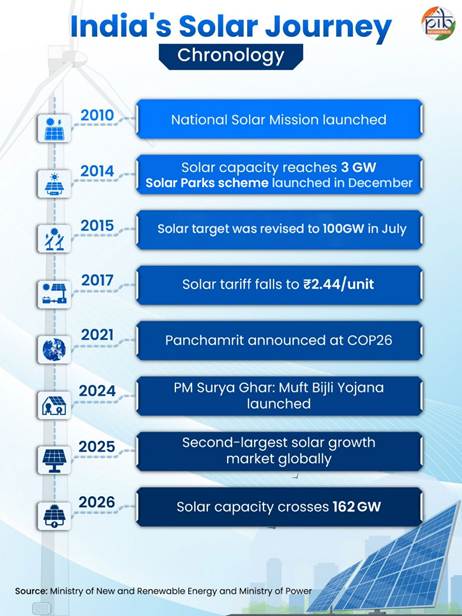
A decade ago, solar power occupied only a small place in India's electricity mix. Today, it forms the largest share of the country's renewable energy capacity. From an installed capacity of approximately 3 GW in 2014, the sector has expanded more than fiftyfold, reaching 162.15 GW till 30 June 2026.
This transformation is driven by policy support, infrastructure development, manufacturing expansion, and citizen participation. Initiatives such as solar parks, rooftop systems, and solarised agricultural pumps are accelerating deployment across the country. The latest push for solar growth is the newly approved Pradhan Mantri Surya Sarovar Yojana (PM-SSY).

The Government approved the Pradhan Mantri Surya Sarovar Yojana (PM-SSY) on 31 July 2026.
- The Union Cabinet chaired by the Prime Minister Shri Narendra Modi approved the 'Pradhan Mantri Surya Sarovar Yojana (PM-SSY)’, a Scheme for the development of Floating Solar Photovoltaic (FSPV) Projects with Energy Storage Systems (ESS) with a total outlay of Rs.5,070 crore.
- The scheme envisages the development of 5,000 MW of Floating Solar Photovoltaic projects with co-located Energy Storage Systems having a minimum storage capacity of two hours i.e.,10,000 MWh. The ESS with a minimum storage capacity of two hours (10,000 MWh) will further help states manage peak demand.
- The projects will be sanctioned during FY 2026-27 to FY 2030-31, with disbursement of financial support continuing up to FY 2032-33.
- The approval follows the recent assessment undertaken by the National Institute of Solar Energy (NISE), which has estimated a floating solar potential of approximately 102.18 GWp across reservoirs and other suitable inland water bodies in the country.
- By utilising existing reservoirs and industrial ponds, the scheme will reduce pressure on scarce land resources.
- Under the scheme, Central Financial Assistance (CFA) of Rs. One crore per MW will be provided for eligible Floating Solar Photovoltaic projects after successful commissioning. In addition, CFA of up to Rs.50 lakh per project will be available for undertaking feasibility studies, including bathymetry and hydrography assessments, environmental studies, and other preparatory activities required for de-risking the project development.
- The scheme is expected to reduce around 10 million tonnes of CO₂ emissions annually. It will generate 16,000–17,000 full-time equivalent jobs.
- It will also promote domestic manufacturing of floatation systems, PV cells, modules and energy storage systems. All States and Union Territories will be eligible to benefit through this scheme.
- The initiative will increase India's floating solar capacity by 5,000 MW, from the current level of around 700 MW.
Solar Capacity Across India
Solar deployment spans diverse geographies and climatic zones. Rajasthan, Gujarat, Karnataka, Tamil Nadu, Andhra Pradesh, and Maharashtra account for a significant share of installed capacity.
- Large solar projects contribute 118.79 GW of installed capacity.
- Some of the large solar projects include the Bhadla Solar Park (Rajasthan), Pavagada Solar Park (Karnataka), and Rewa Ultra Mega Solar Park (Madhya Pradesh).
- Rooftop solar systems connected to the electricity grid contribute another 27.88 GW.
The remaining capacity comes from hybrid solar projects and off-grid solar systems. Hybrid projects combine solar power with battery storage or other power sources, while Off-grid systems provide electricity in areas not connected to the grid.
Record Growth in FY 2025–26
FY 2025–26 marked a milestone year for India's RE sector, with record additions in both solar and non-fossil fuel capacity.
- India added 44.61 GW of solar capacity, nearly double the 23.83 GW added in FY 2024–25.
- Solar module manufacturing capacity increased from 2.3 GW in 2014 to about 172 GW as of 31 March 2026.
- Total non-fossil fuel capacity reached 283.46 GW, including 274.68 GW of renewable energy capacity.
- Highest-ever annual addition of non-fossil fuel capacity recorded at 55.29 GW.
- On 29 July 2025, renewable energy sources met 51.5% of India's electricity demand, the highest monthly share recorded so far.
Policy Architecture Behind the Solar Expansion
A stable policy framework, competitive bidding mechanisms, and long-term targets have helped create a conducive environment for large-scale solar deployment. A set of mutually reinforcing measures has supported India's solar expansion. These can be broadly grouped into five pillars:
Creating Vision: Climate Commitments and Long-Term Targets
At COP26 in Glasgow, India announced the Panchamrit goals, which include 500 GW of non-fossil fuel capacity by 2030 and net-zero emissions by 2070. These commitments were reflected in India's updated Nationally Determined Contributions under the Paris Agreement.
Complementing these efforts, Mission LiFE (Lifestyle for Environment) promotes sustainable consumption and encourages citizens to adopt environmentally conscious practices.
Creating Demand: National Missions and Renewable Purchase Obligations
Strong and sustained demand has been central to India's solar growth. The National Solar Mission established long-term capacity targets and provided an early impetus to solar deployment.
Renewable Purchase Obligations (RPOs) require electricity distribution companies and other obligated entities to procure a specified share of their electricity from renewable sources. RPOs provide long-term market certainty for developers and investors while encouraging greater renewable energy adoption. The RPO trajectory has been notified through 2029–30, with the target for 2026–27, set at 35.95 per cent.
Demand has also expanded beyond utilities and large developers. PM Surya Ghar: Muft Bijli Yojana is encouraging households to adopt rooftop solar systems. Meanwhile, Pradhan Mantri Kisan Urja Suraksha evam Utthaan Mahabhiyan (PM-KUSUM) is supporting the adoption of solar pumps and feeder solarisation in the agriculture sector. Together, these initiatives are expanding the market for solar energy and strengthening participation across consumers, farmers, businesses, and power utilities.
Lowering Costs: Competitive Bidding and Tariff Discovery
One of the most significant developments in solar sector has been the decline in power tariffs over the past decade. This was driven by bidding through the e-Reverse Auction mechanism, where developers compete to supply electricity at the lowest tariff.
Procurement agencies such as the Solar Energy Corporation of India (SECI) have played a key role in scaling this transparent tariff discovery mechanism. As more developers participated, the tariffs declined from around ₹18 per unit in 2010 to a record-low of ₹2.44 per unit. This remarkable achievement was attained at the Bhadla Solar Park auction in 2017. This made solar power more affordable and accelerated its adoption across India.
The decline in tariffs has made solar power increasingly affordable. As a result, India has emerged as one of the world's lowest-cost solar power markets. In 2025, the Levelised Cost of Electricity (LCOE) from utility-scale solar PV stood at USD 35 per MWh, well below the global average of USD 44 per MWh.
Enabling Infrastructure
The government launched the Solar Parks Scheme to provide developers with ready access to land and supporting infrastructure. The scheme was initially launched with a target of 20 GW and later expanded to 40 GW in 2017. As of February 2026, 54 solar parks with a combined sanctioned capacity of 39,188 MW have been approved across the country.
- Supporting the Solar Parks Scheme, the Green Energy Corridor (GEC) Programme aims to facilitate the transfer of power from RE-rich areas to demand centres across the country. The initiative strengthens transmission networks and supports the seamless integration of renewable energy into the electricity grid.
Bhadla Solar Park: From Desert Landscape to Clean Energy Hub
Located in Rajasthan's arid Bhadla region, the park has transformed vast stretches of barren land into one of the world's largest solar power complexes. Development began in 2015 under the Solar Parks Scheme and was completed in phases by 2020.
Spread across nearly 5,700 hectares (56 sq. km.), the park has an installed capacity of 2,245 MW. The region's high solar irradiation, low rainfall, and sparse vegetation make it well-suited for large-scale solar generation.
Beyond its scale, Bhadla showcases the solar park model in action. Common infrastructure, including land preparation and transmission facilities, enabled rapid project development and attracted significant private investment. Competitive bidding at the park also contributed to some of India's lowest solar tariffs, helping make solar energy more affordable.
Taking Solar to Every Household and Farm
India's solar transition extends beyond large-scale power plants. Through dedicated schemes for households and farmers, solar is improving energy access, reducing electricity costs, and creating new livelihood opportunities.
PM Surya Ghar: Muft Bijli Yojana
Launched on 13 February 2024 with an outlay of ₹75,021 crore, PM Surya Ghar: Muft Bijli Yojana brings rooftop solar benefits directly to households nationwide. It is the world's largest domestic rooftop solar programme. Eligible households receive subsidies for rooftop solar installations, while collateral-free loans facilitate adoption. The scheme is implemented through a dedicated national portal, enabling seamless registration, installation, and subsidy disbursement.
Key Achievements
- Over 43 lakh households were solarised as of June 2026.
- ₹14,771.82 crore disbursed as Central Financial Assistance till December 2025.
- Over 7.7 lakh households received zero electricity bills as of 09 December 2025.
The scheme enables households to generate their own electricity. It reduces electricity bills and promotes rooftop solar adoption. PM Surya Ghar: Muft Bijli Yojana has also received international support, with the World Bank approving financing to help scale up residential rooftop solar adoption in India.
Pradhan Mantri-Kisan Urja Suraksha Evam Utthaan Mahabhiyan (PM-KUSUM)
Launched in 2019, the PM-KUSUM seeks to expand the use of solar energy in agriculture. The scheme supports the installation of decentralised solar power plants, standalone solar agriculture pumps, and the solarisation of grid-connected agricultural pumps. It aims to provide reliable daytime power for irrigation, reduce dependence on diesel, and enhance income opportunities for farmers.
PM-KUSUM enables farmers to harness solar energy both for irrigation and power generation. Under the scheme, farmers install solar pumps for irrigation and sell surplus electricity to distribution companies, where eligible. The scheme is focused on adding around 34,800 MW of solar capacity by 2026-27, with Central financial support of ₹34,422 crore.
Key Achievements
- Nearly 11.49 lakh off-grid solar pumps installed for agricultural use.
- More than 15.89 lakh agricultural pumps are covered through feeder-level solarisation.
- Around 1,726 MW of decentralised solar power capacity commissioned on farmers’ land.
- Over 21.77 lakh farmers benefited across the country.
Both schemes have emerged as an important pillar of India's distributed solar energy landscape.
In FY 2025–26, distributed solar solutions contributed 16.3 GW, or 36%, of the 44.61 GW of solar capacity added during the year. Of this, 7.6 GW came from PM-KUSUM and 8.7 GW from rooftop solar.
India's Growing Leadership in Global Solar Cooperation
India's leadership in solar energy extends beyond its borders. The country is strengthening international cooperation, technology exchange, and capacity building.
- International Solar Alliance (ISA): Co-founded by India and France at COP21 in Paris in 2015, the ISA has emerged as a key platform for global solar cooperation. The Alliance brings together countries including the Maldives, Greece, Germany, Italy, Bhutan, Luxembourg, and Argentina to accelerate solar deployment, share knowledge and technology. The ISA has evolved into an important platform for cooperation among member countries.
- One Sun One World One Grid (OSOWOG): Proposed by India in 2018, OSOWOG is a vision for an interconnected global renewable energy network. To advance this vision, India and the United Kingdom launched the Green Grids Initiative–One Sun One World One Grid (GGI–OSOWOG) at COP26 in 2021. The initiative is supported by Australia, France, the United States, and the International Solar Alliance. It promotes cross-border RE trade through interconnected electricity grids, strengthening energy security and accelerating the clean energy transition.
Through the ISA and other partnerships, India has strengthened renewable energy cooperation across the Global South. During its G20 Presidency, India also helped build consensus on tripling global renewable energy capacity by 2030.

Source: PIB
*****
