

A robust economy requires strong risk-protection systems, and insurance serves as a key pillar of financial security and social protection. It is not just a financial contract; it is a system where individuals and businesses transfer risk to insurers in exchange for premiums. By pooling risks, insurance enables households and enterprises to recover from unforeseen events without exhausting savings or selling productive assets. In this way, insurance ensures financial continuity and supports sound financial planning by protecting income, assets, and long-term economic security.
In India, insurance plays an important role in strengthening social security and promoting financial resilience. Rising healthcare costs, livelihood risks, and economic uncertainties underline the importance of accessible insurance coverage for citizens, families, and businesses. Recognizing this, the Insurance Regulatory and Development Authority of India (IRDAI) committed to the vision of “Insurance for All by 2047”. It aims to ensure that every citizen has adequate life, health, and property insurance, and that every enterprise has access to suitable risk protection.
The Indian insurance sector is undergoing a significant transformation in line with this vision. Regulatory reforms and policy initiatives are expanding coverage, improving affordability, and strengthening consumer protection. The transition towards a principle-based regulatory framework has streamlined compliance requirements and provided insurers with greater flexibility to innovate, thereby supporting inclusive insurance growth. Together, these developments are positioning insurance as a vital component of India’s social security framework and economic strength.

Insurance Sector Performance
Insurance, as a vital component of the financial sector, plays a crucial role in India’s economy. Beyond offering protection against life, property, and casualty risks and serving as a safety net across both urban and rural areas, the sector also promotes savings. Its sustained development is essential to support India’s ongoing economic transformation.
India's insurance sector continued its growth momentum in 2024–25, consolidating its position as the 10th largest insurance market globally by nominal premium volumes, with a market share of 1.8%, as per the Swiss Re report. Insurance penetration stood at 3.7% with life insurance at 2.7% and non-life at 1% while insurance density increased marginally to USD 97.0. Reflecting the scale and growing activity in the sector, during FY 2024-25, the sector issued 41.84 crore policies, collected premiums of ₹11.93 lakh crore, paid claims of ₹8.36 lakh crore, and reported assets under management of ₹74.44 lakh crore as on 31 March 2025.
The two main types of Insurance:
- Life insurance provides financial protection against contingencies related to human life, such as death, disability, accidents, and retirement.
- Non-life insurance covers property, businesses, and individuals, offering compensation on an indemnity basis for losses or damages. It provides monetary support in case of unforeseen events and includes health, motor, home, fire, marine, travel, portable equipment, crop, liability insurance, among others.
Recent Policy and Regulatory Measures
To strengthen the insurance ecosystem and enhance protection for policyholders, the Government has undertaken a series of legislative and regulatory reforms. These measures aim to improve insurance affordability, expand coverage, promote ease of doing business, and strengthen consumer safeguards across the sector.
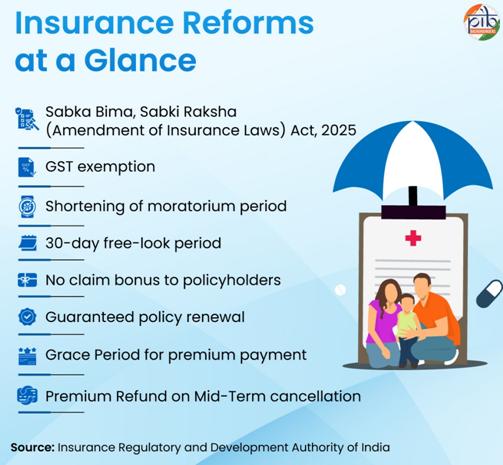
Sabka Bima, Sabki Raksha (Amendment of Insurance Laws) Act, 2025
- The Sabka Bima Sabki Raksha (Amendment of Insurance Laws) Act, 2025has amended various provisions of the Insurance Act, 1938, the Life Insurance Corporation Act, 1956, and Insurance Regulatory and Development Authority Act, 1999. This enhances citizens’ protection, deepen insurance penetration, accelerate growth, further strengthens the insurance sector and improves the ease of doing business. The key provisions of the policy are outlined below:
- Increased FDI Limit: The amendment raises the FDI limit in Indian insurance companies from 74% to 100%. The measure is expected to attract stable long-term investment, facilitate technology transfer, support greater insurance penetration and social protection.
- Promote Ease of Doing Business: To ensure uninterrupted service, support policyholders and promote ease of doing business, following amendments were made:
- One-time registration for insurance intermediaries has been introduced to ensure seamless operations and better service continuity.
- IRDAI approval threshold for share transfers was increased from 1% to 5%, further simplifying compliance.
- Net Owned Fund requirement for foreign reinsurers has been reduced from ₹5,000 crore to ₹1,000 crore, encouraging greater reinsurance participation and capacity in India.
- Insurance laws have been aligned with Digital Personal Data Protection Act, 2023 to create a legal anchor for effective use of digital public infrastructure in the insurance sector, ensuring that policyholders’ information is duly secured and protected.
- The Indian Insurance Companies (Foreign Investment) Amendment Rules, 2025, notified on 30 December 2025 have rationalised conditions for insurance companies and intermediaries to promote ease of doing business.
- Creation of Insurance Awareness: The amendment provides for the creation of a Policyholders’ Education and Protection Fund, to increase citizens’ awareness towards risk protection and promote education for policyholders.
- Improved Policyholders’ Protection: To safeguard policyholder, IRDAI has been empowered to order disgorgement of wrongful gains made by insurers or intermediaries. The maximum penalty for non-compliance with the Insurance Act or the IRDA Act has been enhanced from ₹1 crore to ₹10 crore. It encourages insurers and intermediaries to adhere more strictly to rules and standards, thereby improving governance, protecting policyholders’ interests, and enhancing overall discipline and transparency in the insurance sector. Insurance intermediaries have also been included under this provision, thereby strengthening regulatory compliance.
Major Insurance Protection Schemes
Reflecting its commitment to public welfare, the Government has introduced a comprehensive set of insurance measures to enhance financial security and social protection. These initiatives aim to improve insurance coverage, enhance affordability, and ensure wider access to risk protection across the country.
Life Insurance - Pradhan Mantri Jeevan Jyoti Bima Yojana (PMJJBY)
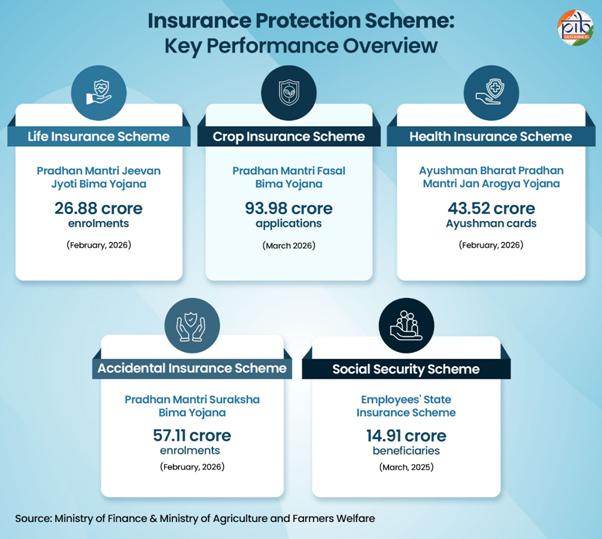
Launched in May 2015, the PMJJBY is a one-year term life insurance scheme renewable yearly. It provides life cover of ₹2 lakh to citizens aged 18–50 years, at an annual premium of ₹436, which is auto-debited from the subscriber’s bank account. It aims to provide financial security and stability to families of the insured in case of untimely death, ensuring that no household faces sudden economic distress due to the loss of a breadwinner. The scheme has recorded 26.88 crore gross enrolments, with 10,45,450 claims disbursed as of February, 2026.
The policy is administered through the Life Insurance Corporation of India (LIC) and other life insurance companies. Death due to non-accidental causes during the first 30 days of enrolment is not covered, while accidental death is covered from day one.
Accidental Insurance - Pradhan Mantri Suraksha Bima Yojana (PMSBY)
PMSBY, launched in May 2015, is a accidental insurance scheme that provides accident and disability cover at an affordable premium, particularly for low-income and informal sector workers.
The scheme is available to all savings bank account holders aged 18 to 70 years. It provides accidental insurance coverage at an annual premium of ₹20, which is auto-debited from the linked bank account. Valid for one year (renewable annually), it offers risk coverage of ₹2 lakh in case of accidental death or full disability and ₹1 lakh for partial disability (as provided in the PMSBY rules).
The scheme has recorded 57.11 crore enrolments, with 1.76 lakh claims disbursed as of February 2026.It provides timely support to families affected by accidental deaths or disabilities, ensuring protection for economically vulnerable citizens.
Health Insurance - Ayushman Bharat Pradhan Mantri Jan Arogya Yojana (AB-PMJAY)
Launched in September 2018, the scheme offers free health insurance coverage of up to ₹5 lakh per family per year for secondary and tertiary healthcare services. The scheme seeks to strengthen the healthcare system through interventions across prevention, promotion, and treatment at primary, secondary, and tertiary levels. It covers all pre-existing diseases from day one, places no restriction on age, gender, or family size, and provides nationwide portability across empanelled hospitals.
In September 2024, the government expanded the health coverage to all senior citizens aged 70 years and above, irrespective of income. As of 28 February 2026, a total of 43.52 crore Ayushman cards have been created under the programme, highlighting the recognition of the scheme among people.
Social Security - Employees' State Insurance Scheme (ESI)
The Employees’ State Insurance (ESI) Scheme is a social security programme that provides protection to employees against contingencies such as sickness, maternity, disablement, and death due to employment injury, while also offering medical care to insured persons and their families. The scheme applies to factories and various establishments such as hotels, restaurants, cinemas, newspapers, shops, and educational and medical institutions registered under ESIC. As on 31 March 2025, the scheme covered 3.24 crore employees and 3.84 crore insured persons, including 83.1 lakh insured women, with a total of 14.91 crore beneficiaries receiving benefits under the programme.
Crop Insurance - Pradhan Mantri Fasal Bima Yojana (PMFBY)
Launched in February 2016, the scheme provides farmers with a simple, affordable, and comprehensive crop insurance. It covers against non-preventable natural risks such as droughts, floods, cyclones, hailstorms, pest attacks, and plant diseases. It also covers the entire crop cycle from pre-sowing to post-harvest, including losses during storage due to notified calamities. The scheme aims to provide timely financial support to farmers helping them manage risks and avoid falling into debt.
The scheme follows the principle of “One Nation, One Crop, One Premium,” ensuring uniform premium rates across the country. Farmers pay a maximum premium of 2% for Kharif food and oilseed crops, 1.5% for Rabi food and oilseed crops, and 5% for annual commercial or horticultural crops, with the remaining actuarial premium shared between the Central and State Governments. As of 13 March 2026, 93.98 crore applications have been received under the scheme, with claims amounting to ₹1,94,505.9 crore paid to farmers.
Together, these initiatives demonstrate the Government’s strong focus on creating an extensive and inclusive social security framework that protects citizens from life, health, and livelihood risks. By expanding coverage, enhancing affordability, and strengthening delivery mechanisms, these schemes are contributing to a more resilient society with improved financial protection across all sections of the population.

****
