

BRICS has emerged as a key platform for coordinating economic policy among major emerging economies. It serves as the principal forum where these nations shape a common position on global governance. Through sustained dialogue, it has become a channel for advancing the interests of the Global South within multilateral institutions. Its agenda spans development, finance, technology, trade and people-to-people exchanges. The grouping reflects the growing economic weight and aspirations of emerging economies globally. It provides members with a platform to share experiences and address common challenges.
India hosted the 18th BRICS Summit (2026) in New Delhi, marking its fourth BRICS Chairship, under the theme “Building for Resilience, Innovation, Cooperation and Sustainability.” The summit concluded with the unanimous adoption of the New Delhi Declaration, focusing on multilateralism, conflict prevention and equitable global governance.
Consensus amid divergences: The summit adopted a joint declaration despite the BRICS Foreign Ministers’ meeting in May 2026 failing to issue a joint statement, highlighting India’s consensus-building role amid differences, particularly over the Iran–UAE conflict.
- Next Chair: China will assume the BRICS Chairship in 2027 and host the 19th BRICS Summit.


- Cross-Border Payments & Local Currency: Mandated the BRICS Payment Task Force to advance the interoperability of payment and messaging channels for trade settlements using local currencies, aiming to insulate BRICS economies from Western financial sanctions and exchange rate volatility.
- BRICS Risk Lab & Insurance Resilience: Endorsed India's proposal to host a BRICS Risk Lab at GIFT City, Gujarat, to build a self-reliant reinsurance ecosystem that mitigates geopolitical risks for large-scale Global South infrastructure projects.
- MSME Invoice Discounting (Jaipur Consensus): BRICS countries welcomed the Jaipur Consensus to study the establishment of an Invoice Discounting Mechanism to help MSMEs unlock working capital from unpaid invoices and strengthen their participation in international trade.
- Contingent Reserve Arrangement (CRA): Approved amendments to the CRA Treaty and initiated the 9th Test Run to strengthen the bloc's internal financial safety net, ensuring swift liquidity support during balance-of-payment crises without relying on the International Monetary Fund (IMF).
- Taxation & Customs Cooperation: Launched the BRICS Tax Cross-Learning Lab and the Authorised Economic Operator (AEO) Action Plan 2026, mandating annual joint customs enforcement operations to dismantle smuggling networks, prevent illicit financial flows, and streamline legitimate trade.
- BRICS gave in-principle approval to an agreement on customs cooperation to facilitate legitimate trade, strengthen border security, and combat illicit trade.
- New Development Bank (NDB) & Multilateral Guarantees: Launched the BRICS-NDB Knowledge Portal and advanced pilot transactions for Multilateral Guarantees to de-risk infrastructure projects and effectively mobilize private institutional capital for developing nations.
- Innovation & Financing: Proposed the BRICS Startup Innovation Fund to finance early-stage ventures.
- Space & Satellite Cooperation: Expanded the BRICS Remote Sensing Satellite Constellation and drafted terms for the BRICS Space Council to democratize access to outer space technology and utilize collective satellite data for disaster risk reduction and climate monitoring.
- Digital Public Infrastructure (DPI): Approved the creation of a BRICS DPI Repository and initiated pilot projects to share scalable, open-source digital public goods (like digital identity and payment systems), preventing monopolistic control by private tech giants.
- Global Research Advanced Infrastructure Network (GRAIN): Adopted an Action Plan to pool financial and intellectual resources for high-cost megascience projects, ensuring long-term technological sovereignty for member states.
- Submarine Cable Network: Tasked a feasibility study for a direct high-speed submarine communication network to ensure secure, resilient data connectivity that bypasses traditional routing choke points controlled by Western entities.
- Energy Grids & Startup Ecosystem: Established the Digital Centre of Excellence for Smart Grids to integrate renewable energy seamlessly using AI, and launched the BRICS Incubator Network to catalyze innovation-led economic growth and foster entrepreneurship.
- BRICS Grain Exchange: BRICS aims to launch the Grain Exchange by 2027. Proposed in 2023 and championed by Russia, it seeks to strengthen food security, reduce grain price volatility, and facilitate intra-BRICS trade.
- BRICS AGRIN (Agro-Inputs, Genetic Resources, and Information Network): It is a collaborative, voluntary, and farmer-centric cooperation framework established by BRICS nations to strengthen joint efforts in seeds, germplasm, and agricultural inputs.
- India showcased its culinary diplomacy by serving Gucchi Marmik, featuring rare Himalayan Gucchi mushrooms. Delegates were also given Koraput coffee from Odisha, promoting Vocal for Local and grassroots economic empowerment.
- Global Forum on Farmers’ Rights in Seed Systems: A platform dedicated to protecting farmers' rights, preserving traditional agricultural knowledge, and addressing shared seed system challenges.
- Centres of Excellence on Agroecology & Regenerative Agriculture: A network established to promote natural and sustainable farming practices for climate resilience and productivity.
- BRICS Network on Digital Agriculture: A tech-focused initiative to scale modern digital solutions across agriculture, agroforestry, fisheries, and aquaculture.
- BRICS Mission for Healthy Lifestyle: The declaration endorses a BRICS Mission for Healthy Lifestyle along with a Joint Roadmap for Healthy Lifestyle Promotion (2026–2029).
- Mental Health & Traditional Medicine: Created a Training Hub Network led by India’s NIMHANS for mental well-being and established an Expert Working Group to integrate safe traditional medicine into modern health systems, advancing affordable Universal Health Coverage.
- BRICS BioDesign Initiative: Spearheaded by the Andhra Pradesh MedTech Zone (AMTZ), the newly launched BRICS BioDesign Centre will advance cross-border healthcare innovation.
- It aims to combine scientific expertise to translate medical ideas into accessible and deployable healthcare solutions for the Global South.
- BRICS Logistics Supply-Chain Cooperation Framework: BRICS agreed on a voluntary framework to strengthen the resilience and sustainability of transport logistics and supply chains through technical cooperation, knowledge sharing, and capacity building.
- BRICS Cooperation on Global Value Chains: BRICS adopted the GVC Action Plan 2026–2030, including a Technical Council and Joint Study, to make global value chains more resilient and efficient while promoting market opening and economic diversification.
- Sustainable Aviation & Urban Mobility: BRICS launched a Sustainable Aviation Fuels Forum, created the BRICS Urban Mobility Hub, and adopted Voluntary Principles for Climate-Resilient Urban Infrastructure to promote sustainable and resilient transport systems.
- Climate Adaptation & Forestry: Adopted principles for Integrated Landscape-Based Greening and Wildfire Preparedness to combat desertification, protect vital carbon sinks like tropical forests, and enhance community-level resilience against extreme weather.
- Counter-Terrorism: Condemned cross-border terrorism and the 2025 Pahalgam terror attack, urging the adoption of the UN Comprehensive Convention on International Terrorism to hold perpetrators accountable and dismantle terror financing networks.
- Asset Recovery & Corruption: Established an Expert Network and a Repository for Tracing Fugitive Offenders to deny safe havens to economic offenders, trace illicit financial flows, and facilitate the legal recovery of stolen national assets.
- Labour, Social Security & Culture: BRICS welcomed the adoption of BRICS CONNECT (BRICS Cooperation Network for Capacity Building, Employability, and New Skills and Technologies) to strengthen the rights of gig workers and promote cross-border portability of social security, along with an Artist Registry to protect cultural heritage and curb illicit trafficking of antiquities.
- BRICS Youth Cooperation: The declaration adopted the BRICS Youth Cooperation Framework 2026 and the Joint Statement of the 2026 BRICS Youth Ministers’ Meeting, while establishing a Working Group on Sport Technology.
- UNSC Reform: BRICS officially backed the Ezulwini Consensus and Sirte Declaration to secure African representation in a reformed UN Security Council, alongside explicit support from China and Russia for the aspirations of India and Brazil, aiming to rectify the Global South's historical underrepresentation in global security decisions.
- WTO & ICAO Expansion: Formally endorsed the World Trade Organisation (WTO) accession bids of Ethiopia and Iran, and backed Ethiopia and Indonesia for newly expanded seats on the International Civil Aviation Organization Council to amplify developing nations' voices in global standard-setting.
- Future Chairship: Confirmed China as the host for the 19th BRICS Summit in 2027 to ensure the seamless continuation and implementation of the New Delhi Declaration’s vast institutional mandates.
- Roadmap for Global Governance Reform: India proposed a 10-point roadmap to reform global governance based on the "3Rs" (Representation, Responsiveness, and Rule-making). This aims to transform the current international system from a "pyramid of privilege" to a "platform of partnership".
Origin and Evolution of BRICS

The Origin
The acronym ‘BRIC’ was coined in 2001 by Goldman Sachs in its Global Economics Paper, ‘The World Needs Better Economic BRICs.’ Based on econometric analysis, the paper projected that Brazil, Russia, India and China would be among the world’s largest economies over the following five decades. Their growing economic weight and vast geographic reach across three continents highlighted their emerging global significance. The BRIC concept subsequently evolved into a formal grouping, with South Africa joining in 2010 and transforming BRIC into BRICS. The evolution marked the transition from an economic grouping identified by analysts to a formal platform for political, economic and development cooperation.
BRICS Through the Years: From Crisis to Collective Action
The 2008 global financial crisis marked a defining moment in the evolution of BRICS. It exposed gaps in the existing global financial architecture. It also created a need for broader consensus on global economic governance. The four BRIC countries articulated a common position on these issues. They called for a more representative international financial system. They sought greater voice for emerging economies in the International Monetary Fund (IMF) and World Bank. They also opposed protectionism and supported an open, rules-based multilateral trading system. This coordination laid the foundation for the first BRIC Summit in Yekaterinburg, Russia, in 2009.
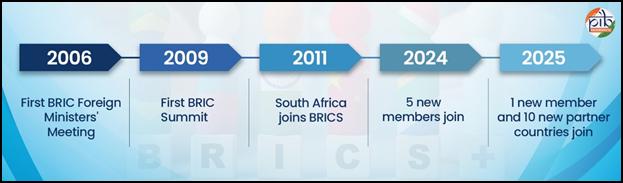
BRIC was formally established in 2006 as a political cooperation forum among Brazil, Russia, India and China. Its founding members shared an aspiration for a more representative and equitable global order. South Africa joined as a full member in 2011, transforming BRIC into BRICS. This inclusion expanded the grouping’s geographical representation across continents. The grouping subsequently broadened its agenda beyond economic issues to development, finance, health, climate action, technology and trade. This evolution strengthened BRICS as a wider framework for engagement among emerging economies.
Today, BRICS comprises 11 countries: Brazil, China, Egypt, Ethiopia, India, Indonesia, Iran, Russia, Saudi Arabia, South Africa and the UAE. Collectively, these members represent 49.5% of the global population, 40% of global GDP, and 26% of global trade. These figures underline their substantial demographic and economic weight. Its expanded membership has also widened its geographical reach across Asia, Africa, the Middle East and Latin America. This diversity brings together major markets, natural resources, technological capabilities and varied development experiences.

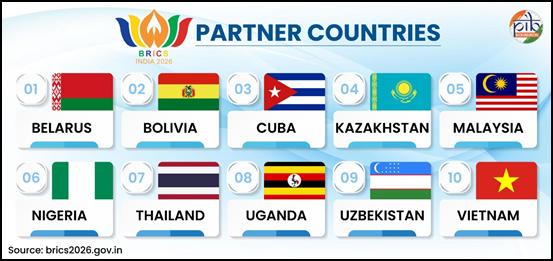
A major phase of expansion began in January 2024. Egypt, Ethiopia, Iran, Saudi Arabia and the UAE became full members. Indonesia joined as the eleventh full member in January 2025. These accessions significantly expanded BRICS’ geographical and economic reach. The expansion was accompanied by the creation of a Partner Country category. Ten countries joined this framework during 2025: Belarus, Bolivia, Cuba, Kazakhstan, Malaysia, Nigeria, Thailand, Uganda, Uzbekistan and Vietnam. The new arrangement provides an additional channel for structured engagement with BRICS.
BRICS Presidency: Rotation and Responsibilities
The BRICS Presidency rotates annually according to the letters of its acronym. Each Presidency term begins on January 1st and concludes on December 31st of the respective year. The country holding the Presidency sets the priorities of the agenda for that year. It also organizes the group's annual Summit and steers key ministerial and working group meetings. With the recent expansion of BRICS membership, a new rotation formula for the Presidency is also being discussed among member countries.
Before this year, India has previously chaired BRICS in 2012, 2016 and 2021.
- India hosted the Fourth BRICS Summit in New Delhi on 29 March 2012. The Summit was held under the theme “BRICS Partnership for Global Stability, Security and Prosperity.”
- India hosted the Eighth BRICS Summit in Goa in October 2016. The Summit was held under the theme “Building Responsive, Inclusive and Collective Solutions.” India’s Chairship focused on strengthening intra-BRICS cooperation and expanding outreach.
- India hosted the 13th BRICS Summit virtually on 9 September 2021. The Summit marked the 15th anniversary of BRICS. It was held under the theme “BRICS@15: Intra-BRICS Cooperation for Continuity, Consolidation and Consensus.”
- India assumed its fourth BRICS Chairship on 1 January 2026.
More than 350 meetings and high-level engagements were held across 25 cities during India’s Chairship. The meetings generated practical and development-oriented outcomes across key areas of cooperation. The following outcomes emerged from ministerial meetings held during India’s 2026 BRICS Chairship.
- BRICS Centres of Excellence on Agro-Ecology agreed upon as a collaborative platform for joint research, knowledge sharing and capacity building on natural, organic and regenerative farming practices to promote climate-resilient and sustainable agricultural systems (initially coordinated by ICAR-Indian Institute of Farming Systems Research, Modipuram). BRICS Network on Digital Agriculture to deepen cooperation and scale the deployment of AI‑driven decision‑support systems, geospatial intelligence, IoT‑enabled monitoring, and advanced data analytics in agriculture (initially coordinated by IIT Delhi).
- BRICS AGRIN (Agro-Inputs, Genetic Resources and Information Network) agreed upon as a voluntary, farmer-centric cooperation framework among BRICS countries to strengthen collaboration in seeds, germplasm, and agricultural inputs.
- BRICS Mission for Healthy Lifestyle: The priority was launched along with the BRICS Roadmap for a Joint Initiative on Healthy Lifestyle Promotion (2026-2029). It aims to serve as a collaborative platform for technical cooperation, knowledge exchange and coordinated awareness initiatives, promoting preventive and life-course approaches to obesity and other non-communicable diseases.
- BRICS Expert Working Group on Traditional, Complementary and Integrative Medicine (TCIM): It aims to serve as a platform for structured and consensus-based cooperation on TCIM, covering policy dialogue, research and evidence generation, capacity building and academic exchange, digital knowledge platforms, quality and regulatory standards, and the protection of traditional and indigenous knowledge.
- Focus on Mental Health through BRICS Training Hub Network and BRICS Network of Centres of Excellence, with NIMHANS India as the coordinating Centre. It aims to optimize human resources for mental health through upskilling, task-sharing and standardized training, and to integrate mental well-being into primary healthcare.
- Mainstreaming Traditional Knowledge through adoption of BRICS Principles for Advancing Climate Resilience through People-centric and Community-based Adaptation and BRICS Guiding Principles on Strengthening Academic Collaboration on Traditional and Indigenous Knowledge Systems.
- Advancing Sustainable Lifestyles through Network of BRICS Institutions to Advance Knowledge Sharing, Research & Innovation and Sustainable Lifestyles Week for exchange of knowledge on policies, programmes, initiatives and leading practices; conduct capacity-building workshops on thematic areas; facilitate dialogue among stakeholders including academic and research institutions; and compilation of case studies.
- BRICS CONNECT for Skilling: A BRICS Cooperation Network for Capacity Building, Employability, and New Skills and Technologies (BRICS CONNECT), building on the BRICS Virtual Liaison Office. It is a flexible platform with four components, namely capacity building for advancing social security, women’s participation in the workforce, skills and employability, and digital public infrastructure. Cooperation under it is voluntary and non-binding.
Significance of BRICS for India and the Global South
• Strategic Autonomy: BRICS enables India to engage major powers and emerging economies simultaneously, expanding its diplomatic space amid growing geopolitical fragmentation.
• Global South Leadership: The expanded grouping strengthens India’s platform to articulate developing-country concerns on finance, trade, technology, climate and development and share India's development experience.
• Reformed Multilateralism: BRICS reinforces India’s demand for greater representation of developing countries in global institutions, including the UN, IMF, World Bank and WTO.
• Economic & Technological Resilience: Cooperation in local-currency payments, resilient supply chains, critical minerals, DPI, AI, health and advanced industries can strengthen South-South economic and technological cooperation.
• Development-oriented Cooperation: India’s Chairship sought to reposition BRICS as a complementary, development-oriented platform focused on practical and scalable solutions for the Global South rather than merely a geopolitical grouping.
Source: PIB Background
